
Why Meta Will Allow Rival AI Chatbots On WhatsApp In Europe
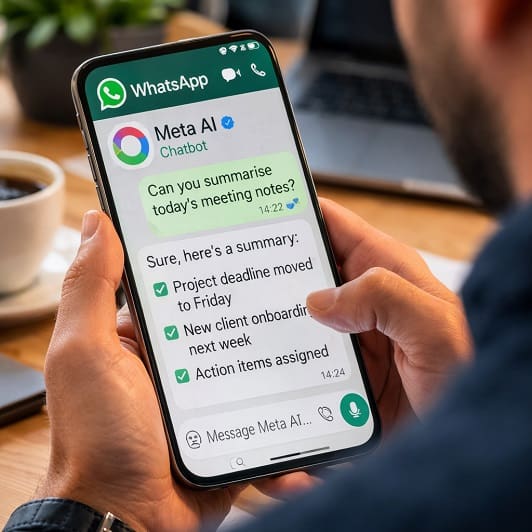
Meta has agreed to allow rival AI chatbots to operate on WhatsApp in Europe for the next 12 months, but providers will have to pay a per-message fee to access the platform.
Regulatory Pressure
The decision follows regulatory pressure from the European Commission, which has been investigating whether Meta unlawfully restricted competition by blocking third-party AI assistants from WhatsApp.
What Triggered The Dispute
The dispute began in October 2025 when Meta updated the terms governing its WhatsApp Business platform. The change effectively prevented developers of general-purpose AI assistants from offering their chatbots through the WhatsApp Business API.
As a result, from 15 January 2026, the only AI assistant available directly on WhatsApp was Meta’s own product, Meta AI. Rival services such as ChatGPT, Claude and other conversational AI systems could not be integrated through the platform in the same way.
Several AI companies complained to regulators that the move disrupted their ability to reach users and could limit competition in the fast-growing AI assistant market.
Regulators Step In
The European Commission responded by opening a formal investigation into the policy. In February it issued a Statement of Objections outlining its preliminary view that the restriction could breach EU competition rules.
The Commission said Meta is likely to hold a dominant position in the European market for consumer communication apps through WhatsApp. Blocking rival AI assistants from accessing the platform could therefore limit competition in a rapidly developing technology sector.
Regulators also warned that WhatsApp acts as an important gateway for companies trying to reach consumers with digital services. Excluding third-party AI assistants could create barriers for smaller competitors seeking to enter or expand in the market.
In light of those concerns, the Commission said it was considering imposing interim measures to prevent serious and irreparable harm to competition while the investigation continues
Meta Changes Course
Shortly after the Commission signalled it might intervene, Meta announced a policy change.
The company said it will allow general-purpose AI chatbot providers to operate on WhatsApp through the Business API in Europe for the next 12 months. Meta said the move should remove the need for immediate regulatory intervention while the investigation runs its course.
In a statement, Meta said: “For the next 12 months, we’ll support general-purpose AI chatbots using the WhatsApp Business API in Europe in response to the European Commission’s regulatory process.”
The company added that the move should allow regulators time to complete their investigation without disruption, saying: “We believe that this removes the need for any immediate intervention as it gives the European Commission the time it needs to conclude its investigation.”
However, the concession comes with an important condition.
AI providers will be charged for each message their chatbot sends through the WhatsApp Business platform.
How The Pricing Works
Meta has introduced a new pricing category specifically for developers of AI assistants.
Under the policy, third-party AI providers must pay a fee for every non-template message sent to users through WhatsApp. A non-template message is a standard conversational reply rather than a pre-written automated notification.
According to Meta’s developer documentation, the price will vary depending on the country but typically ranges from about €0.0490 to €0.1323 per message.
That structure could become expensive for AI providers because chatbot interactions often involve multiple messages in a single conversation. A typical exchange with an AI assistant may include dozens of prompts and replies.
Meta has clarified that the new pricing model only applies to developers offering general-purpose AI assistants through the platform.
Businesses using WhatsApp for customer service automation, such as retailers deploying support chatbots, will not be affected by the change.
Where The Policy Applies
The charging model applies in markets where Meta is legally required to permit AI assistants to operate on the WhatsApp platform.
The system is already in effect in Italy and is being extended across a wide range of European countries including France, Germany, Spain, Ireland, the Netherlands, Sweden and Portugal.
Meta says these changes are designed to comply with regulatory requirements while ensuring the company can manage the technical demands created by AI chatbots operating on messaging infrastructure.
The Wider Competition Debate
The dispute reflects a growing global debate about competition in the artificial intelligence market.
Messaging platforms such as WhatsApp represent one of the most direct ways for AI assistants to reach large numbers of users. With more than two billion users worldwide, WhatsApp is a particularly valuable distribution channel.
Regulators are increasingly concerned that technology platforms that control these channels could favour their own AI services over those developed by competitors.
Meta has previously argued that the AI market remains highly competitive and that consumers can access AI assistants through many other routes, including dedicated apps, websites and operating systems.
What Does This Mean For Your Business?
For businesses developing or deploying AI assistants, the decision highlights how platform access and regulation are becoming key factors in the AI economy.
Messaging apps such as WhatsApp provide direct access to very large audiences and are increasingly seen as a natural place for AI assistants to interact with users. However, access to those platforms may depend on pricing models, regulatory decisions and the policies of the platform owner.
The introduction of per-message charges for AI providers also shows how quickly the economics of AI services can change when they rely on third-party infrastructure. Organisations planning to deliver AI services through messaging platforms will need to consider not only development costs but also ongoing usage fees and platform dependency risks.
Businesses building AI services should therefore monitor platform rules, competition investigations and integration costs carefully. As AI assistants become more embedded in messaging environments, the ability to access those ecosystems on fair and predictable terms may prove just as important as the technology itself.
Sponsored
Ready to find out more?
Drop us a line today for a free quote!
