
WhatsApp Tests Paid ‘Plus’ Subscription
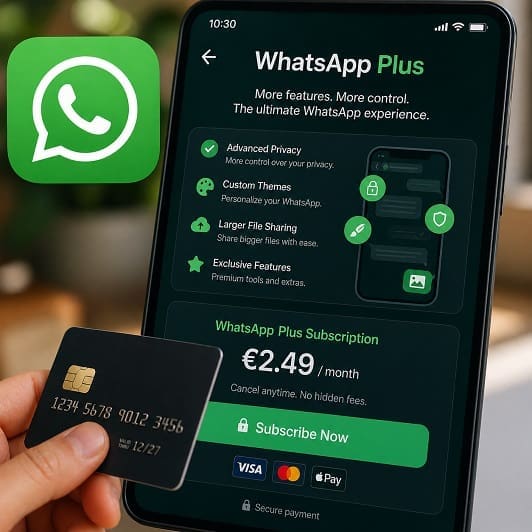
WhatsApp is testing a new optional subscription called WhatsApp Plus, perhaps signalling a broader move by Meta to introduce paid features across its apps while keeping core messaging free for billions of users.
What Does WhatsApp Plus Offer?
The new subscription is currently being tested with a small group of users and is expected to cost around €2.49 per month in Europe, with adjusted pricing in other regions.
At this stage, it seems the features are largely cosmetic. For example, users have access to additional chat themes, custom app icons, exclusive ringtones, and the ability to pin significantly more conversations than the standard free tier allows. The core functionality of WhatsApp, including messaging, voice and video calls, and end-to-end encryption, remains unchanged and free.
It’s been reported that Meta has said the feature is aimed at users who want more control over how WhatsApp looks and is organised, and that the test is being used to understand whether people see real value in it.
From a product perspective, it seems to be quite a modest upgrade, but from a strategic perspective, it could be much more significant.
Why Meta Is Introducing Paid Tiers Now
Meta’s business model has historically depended almost entirely on advertising, which still accounts for more than 95 percent of its revenue. However, the company is now investing heavily in artificial intelligence infrastructure, with spending expected to reach well over $100 billion this year.
That level of investment is forcing a rethink of how revenue is generated. Subscriptions offer a more predictable income stream and reduce reliance on user attention in an environment where AI is beginning to change how people interact with digital platforms.
WhatsApp is particularly important in this context because the platform has more than three billion users globally but has traditionally generated revenue through business messaging rather than consumer payments. Its paid messaging services for companies have already reached a multi-billion-dollar annual run rate, demonstrating that users are actually willing to pay indirectly through business interactions.
Meta is taking a different approach with WhatsApp Plus by shifting some of its monetisation focus towards individual users, testing whether people are willing to pay for enhancements to their personal experience rather than relying solely on business messaging revenue.
How WhatsApp Plus Fits Into Meta’s Wider Platform Strategy
WhatsApp Plus is part of a broader push by Meta to introduce paid tiers across its major platforms, following the recent rollout of Instagram Plus with features such as anonymous story viewing and extended content visibility in selected markets.
Taken together, these launches mark the first time Meta has tested consumer-facing subscriptions across multiple major platforms at the same time, pointing towards a coordinated effort to establish a consistent framework that can be expanded over time.
While the current features may appear limited, they serve a specific purpose by focusing on personalisation rather than functionality, allowing Meta to test pricing sensitivity and user demand without disrupting the core experience that users rely on.
This approach is also likely to help the company navigate regulatory pressure, particularly in Europe, where previous attempts to link payment with privacy controls have faced challenges under the Digital Markets Act. By offering optional cosmetic upgrades instead of charging for ad-free access or data protection, WhatsApp Plus introduces a paid layer without raising the same regulatory concerns.
Why The Features Matter Less Than The Model
On the surface, paying for chat themes and ringtones may not appear compelling. For example, competing platforms such as Telegram Premium and Snapchat+ offer more functional enhancements at higher price points.
However, the success of WhatsApp Plus does not depend on feature depth alone, but also on scale.
Even a small percentage of WhatsApp’s user base subscribing would generate some pretty meaningful revenue. With more than three billion users, a one percent conversion rate could translate into hundreds of millions, or even billions, in annual income depending on regional pricing.
More importantly, this model creates a foundation for future expansion. Once a subscription infrastructure is in place, additional features can be layered on top without changing the core product.
This is where AI is likely to come into play. Meta has already invested in AI agents and generative tools across its platforms, and future subscription tiers are expected to include enhanced AI capabilities, higher usage limits, or more advanced personalisation features powered by those systems.
What This Means For The Future Of WhatsApp
The introduction of WhatsApp Plus doesn’t signal a move away from free messaging but, instead, reflects a shift towards a hybrid model where the core service remains free while optional layers generate additional revenue.
For users, this means the day-to-day experience is unlikely to change in the short term. Messaging will remain accessible, and there is no indication that essential features will be placed behind a paywall.
For Meta, the implications are a bit more substantial. The company is building a mechanism that allows it to monetise new capabilities as they emerge, particularly in areas such as AI, without relying solely on advertising.
This approach also provides flexibility. If users respond positively to cosmetic subscriptions, Meta can expand them. If adoption is limited, the company still gains valuable data about user preferences at minimal cost.
What Does This Mean For Your Business?
For most organisations, WhatsApp Plus is not about the features themselves but about what it signals.
The move highlights a broader change in how major platforms are thinking about revenue, moving towards a mix of advertising, subscriptions, and AI-driven services. This has implications for how businesses engage with customers, particularly on platforms that have historically been free and frictionless.
If subscription layers become more common, businesses may need to consider how these affect user behaviour, engagement, and expectations. Features that improve organisation, personalisation, or automation could influence how customers interact with messaging channels over time.
There is also a longer-term consideration around AI. As platforms begin to integrate more advanced capabilities into paid tiers, organisations may need to decide whether to adopt those tools and how they fit into existing workflows.
WhatsApp Plus itself is a relatively small step, but it represents the early stages of a much larger transition. As Meta continues to invest heavily in AI and platform infrastructure, the ability to monetise those investments through subscriptions is likely to become increasingly important, shaping how the next generation of digital services is delivered and consumed.
