
The Companies Spending £££ Thousands Per Employee On AI
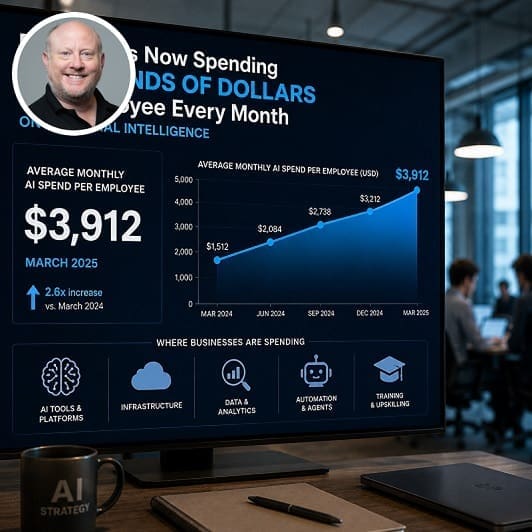
A small but growing group of businesses is now spending thousands of dollars per employee every month on artificial intelligence, suggesting that AI is increasingly being treated as core business infrastructure rather than simply another productivity tool.
The Rise Of The “AI-Pilled” Company
The findings come from the latest Ramp AI Index, which analyses anonymised spending data from more than 70,000 US businesses to track how organisations are adopting AI.
Until recently, most AI adoption studies focused on whether businesses were using AI or not. Ramp now believes that question is becoming less useful as AI adoption becomes increasingly widespread. Instead, the company is focusing on what it calls the “intensity of adoption”, i.e., how heavily businesses are actually investing in AI.
One of the report’s most eye-catching findings is that the top 1 per cent of firms, described by Ramp as “AI-pilled”, are spending an average of $7,449 per employee per month on AI services. By comparison, the top 10 per cent spend around $611 per employee, while the median business spends just $11.38, roughly equivalent to a single ChatGPT or Claude subscription.
The figures highlight just how wide the gap is becoming between businesses experimenting with AI and those building it deeply into everyday operations.
What Does “AI-Pilled” Mean?
The tech sector term “AI-pilled” essentially describes organisations that have moved beyond occasional AI use and started treating AI as a core operating model.
At Ramp itself, chief product officer Geoff Charles recently outlined how the company achieved 99.5 per cent AI adoption among employees, with more than 1,500 internal applications reportedly created in six weeks by over 800 different staff members.
The goal is not simply to give employees access to chatbots. Instead, it involves embedding AI into workflows, automating routine tasks, building internal tools, deploying coding agents, and allowing staff across multiple departments to use AI as part of their daily work.
In these organisations, AI is increasingly viewed as a business capability rather than a software product.
Still Cheaper Than Hiring People
Despite the impressive spending figures, Ramp’s research suggests that AI has not yet reached the point where organisations are routinely spending more on AI than on employees.
The report notes that “the top 1 per cent of firms spend $7.45K per employee per month” but also points out that this remains less than half the typical monthly salary of a software engineer.
That finding is important because it challenges some of the more dramatic claims surrounding AI adoption.
Recent headlines have highlighted companies spending heavily on AI agents, tokens, and computing power, while some technology executives have suggested AI could eventually become a larger cost centre than human labour.
For now, however, the data suggests that even the most advanced adopters continue to view AI as something that augments employees rather than replaces them entirely.
Why Spending Continues To Rise
Perhaps the most significant finding is not how much these firms are spending, but how quickly that spending is growing. For example, Ramp found that the top 1 per cent of AI users increased spending per employee by 14.1 per cent in a single month.
This is happening despite growing awareness of AI costs and increasing efforts to use cheaper models where possible.
The report notes that many businesses are actively seeking lower-cost alternatives, including open-source models and newer competitors such as DeepSeek, yet overall spending continues to climb.
One explanation is that businesses are moving from occasional AI usage towards much broader deployment. As organisations connect AI into customer service, software development, analytics, administration, marketing, finance, and operations, overall consumption naturally increases.
The more AI becomes embedded into business processes, the more computing power, tokens, APIs, and specialist tools are required to support it.
No Single Vendor Dominates
Another interesting finding is that the most advanced AI users are not putting all their eggs in one basket.
According to Ramp, “advanced usage of AI means using multiple frontier models”, alongside platforms providing access to open-source models and specialist AI-native software.
This suggests that businesses are becoming increasingly sophisticated in how they approach AI procurement.
Rather than committing exclusively to one provider, many organisations appear to be selecting different models for different tasks based on performance, capabilities, security requirements, and cost.
That approach mirrors earlier developments in cloud computing, where organisations often adopted multi-cloud strategies to reduce dependence on a single supplier.
Why This Matters
The wider significance of Ramp’s findings is not really about the $7,500 figure. The more important story here is that a growing number of businesses now appear to view AI as an operational resource that sits alongside software, cloud infrastructure, and human expertise.
For years, technology adoption was largely measured by whether organisations used a tool at all. Increasingly, the competitive gap may depend on how deeply AI becomes integrated into workflows and decision-making processes.
The data also suggests that AI adoption is becoming far more uneven. While many businesses remain at the subscription stage, a small group of early adopters is investing heavily and experimenting with entirely new ways of operating.
What Does This Mean For Your Business?
For businesses, the report highlights an important distinction between using AI and building around AI.
Most organisations are unlikely to spend thousands of dollars per employee each month on AI in the foreseeable future. However, the research suggests that some companies are already treating AI as a strategic capability worthy of significant ongoing investment.
That doesn’t necessarily mean every business should increase its AI budget dramatically. Ramp’s figures measure spending, not outcomes, and high expenditure alone does not guarantee productivity gains or return on investment.
The more useful lesson here may be that leading adopters are moving beyond standalone chatbots and experimenting with AI agents, automation, workflow integration, and multi-model strategies. As the technology continues to mature, the organisations that learn how to apply AI effectively across their operations may gain a greater advantage than those that simply spend the most money on it.
