
Why Financial Markets Are Starting To Trade AI
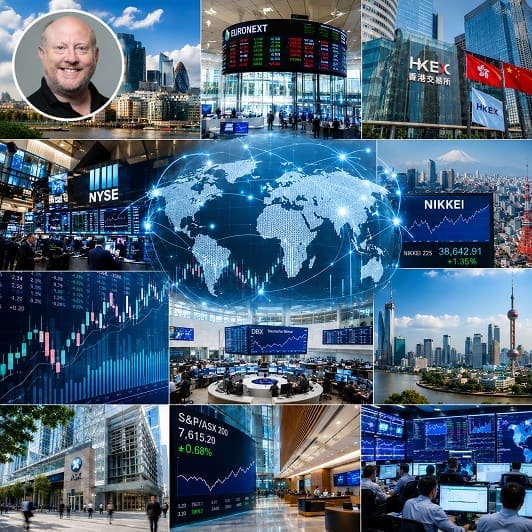
In this Tech Insight, we look at how artificial intelligence is becoming so economically important that financial markets are starting to treat it like a tradable commodity.
Why?
For most businesses, AI is still thought of primarily as chatbots, virtual assistants, or productivity tools.
Behind the scenes, however, every AI request consumes computing resources that carry real costs. For example, every prompt submitted to ChatGPT, Claude, Gemini, or other large language models requires processing power, memory, storage, networking, and electricity.
Increasingly, those costs are being measured and priced using tokens, which are the units that represent how much information an AI system processes.
In practical terms, this means that tokens are becoming one of the fundamental economic building blocks of the AI industry. Every question asked, every document analysed, every image generated, and every AI agent action consumes them.
As AI adoption accelerates, token consumption is growing rapidly across governments, businesses, software providers, and consumers.
The Emergence Of AI Markets
It seems that growth is now attracting the attention of financial markets. For example, reports indicate that China’s Shanghai Futures Exchange is now exploring the development of futures contracts linked to AI tokens, while major US exchanges are examining futures products linked to AI computing power.
Although these developments remain at an early stage, they point towards a significant change in how AI infrastructure may eventually be bought and sold.
Traditionally, futures contracts allow organisations to manage uncertainty by locking in future prices for important resources. Airlines hedge jet fuel prices, manufacturers hedge metal costs, and energy companies hedge electricity and gas prices.
As AI becomes a core operational expense, similar financial mechanisms may begin emerging around AI infrastructure itself.
What Are Businesses Actually Buying?
One reason this development may seem unusual is that many organisations never directly see the underlying economics of AI. Most users simply pay a monthly subscription or software licence.
Behind those subscriptions, however, AI providers are already pricing services based on token usage, processing volumes, and computing consumption. The more powerful the model, the larger the context window, and the greater the volume of activity, the higher the underlying costs become.
Large organisations running AI-powered customer support, software development, research, analytics, and automation systems can consume vast quantities of tokens every day.
As AI becomes embedded across more business processes, controlling those costs becomes increasingly important.
The Infrastructure Race
This also helps explain why technology companies, cloud providers, semiconductor manufacturers, and investors are spending hundreds of billions of pounds on AI infrastructure.
The industry is currently experiencing one of the largest technology infrastructure buildouts in history.
New data centres are being constructed across the world. GPU manufacturers are expanding production. Cloud providers are investing heavily in additional capacity. Entire businesses are emerging to rent computing power to AI developers.
The underlying assumption is that demand for AI processing will continue growing for years. If that happens, the resources needed to power AI systems could become increasingly valuable in their own right.
A New Asset Class?
Some industry figures believe AI computing resources could eventually develop into an entirely new financial asset class, the logic being that businesses already trade commodities that are essential to economic activity, i.e., electricity powers factories, oil fuels transport networks, and natural gas supports manufacturing and heating.
AI is increasingly becoming part of the infrastructure that powers knowledge work, decision-making, automation, software development, customer service, and business operations.
As organisations become more dependent on AI, the costs associated with computing power and token consumption may become significant enough to justify dedicated financial markets.
This would allow companies to manage future price volatility and provide investors with new ways to gain exposure to the growth of AI infrastructure.
Why This Matters
The bigger story is not really about financial derivatives. The more important issue is that AI is increasingly being treated as a utility rather than simply a software product.
Most technology platforms charge for access to applications. Increasingly, AI providers are charging for consumption of intelligence itself. That distinction may sound subtle, but it represents quite a change.
Historically, businesses bought software licences but increasingly, they are purchasing access to processing capability, model capacity, and AI-generated outputs. It now seems that the financial markets are beginning to recognise that change.
What Does This Mean For Your Business?
For businesses, the emergence of AI-related futures markets is another indication that AI is rapidly becoming part of the world’s economic infrastructure rather than simply another technology trend.
Of course, most organisations won’t be trading AI token futures any time soon. However, they are likely to feel the effects indirectly as AI costs become more visible, more measurable, and more closely linked to underlying computing resources.
As AI becomes embedded into customer service, marketing, software development, administration, research, and operational workflows, understanding how AI usage translates into business costs will become increasingly important.
The wider significance is that the technology industry appears to be moving towards a future where intelligence itself becomes a metered resource. If financial markets are already beginning to build mechanisms for trading and hedging AI consumption, it suggests many investors and infrastructure providers believe AI will become as economically important as the utilities and commodities that underpin the modern economy today.
