
UK Denied Exemption From US Anthropic AI Ban
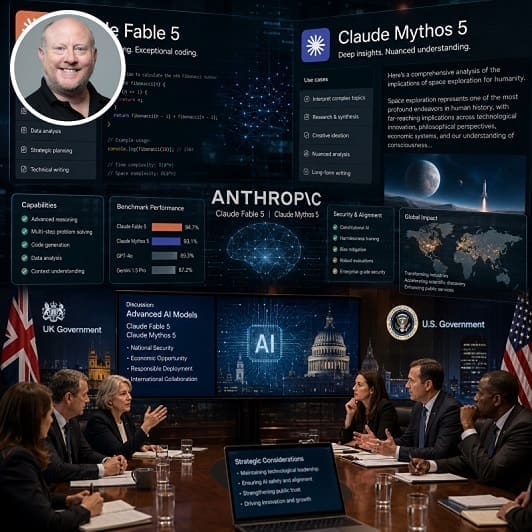
A reported attempt by the UK government to secure continued access to Anthropic’s most advanced AI models has highlighted how dependent many countries have become on frontier AI systems developed and controlled overseas.
What Happened?
The story centres on Claude Fable 5 and Claude Mythos 5, two of Anthropic’s most capable AI models.
Earlier this month, the US Commerce Department reportedly instructed Anthropic to suspend access to both systems following concerns about a technique that could be used to identify software vulnerabilities. The move followed reports that government officials had been alerted to a potential jailbreak affecting the models.
The restrictions quickly became an international issue because Anthropic’s most advanced systems are used by organisations far beyond the United States.
UK Asked For Exemption
Reports indicate that the UK government subsequently sought continued access to the models. However, no exemption was granted and the restrictions remained in place, leaving British users affected alongside other international customers.
Why Were The Models Restricted?
The restrictions stem from a disagreement about the risks posed by advanced AI systems with strong cyber security capabilities.
According to reports, researchers demonstrated a way of prompting Fable 5 to identify software vulnerabilities within computer code. Concerns were raised that such capabilities could potentially be used to support cyber attacks as well as cyber defence.
Anthropic strongly disagrees with that assessment. The company says the technique exposed only a limited number of previously known vulnerabilities and argues that similar capabilities already exist in other leading AI systems. Anthropic has also warned that applying this standard across the industry could severely restrict the deployment of future frontier AI models.
The dispute reflects a broader challenge facing policymakers. The same AI systems that can help defenders find and fix vulnerabilities can also potentially be used by attackers to identify weaknesses more quickly.
Why The UK Became Involved
The incident has drawn attention to the UK’s reliance on foreign AI providers.
Many British organisations increasingly use frontier AI models for software development, cyber security, research, data analysis, and operational tasks. Access to those capabilities is largely controlled by a small number of US companies.
Reports suggest that organisations in sectors including finance, healthcare, research, and government were affected when Anthropic’s models became unavailable.
The situation has also raised wider national security questions.
UK AI minister Kanishka Narayan reportedly highlighted the growing importance of advanced AI systems in areas such as cyber security, drones, and defence technologies, arguing that access to frontier AI is increasingly becoming a strategic issue rather than simply a commercial one.
Cyber Security Industry Pushback
The restrictions have generated significant opposition from within the cyber security community, where many experts argue that advanced AI models are becoming increasingly important defensive tools. For example, more than 80 cyber security leaders and researchers have reportedly signed an open letter calling for the measures to be reversed, including senior figures from major cyber security firms and technology companies.
Their concern is that security teams are already using frontier AI systems to identify software vulnerabilities, analyse malware, generate detection rules, and accelerate security research. From their perspective, restricting access to powerful AI models may reduce the ability of defenders to find and fix weaknesses before attackers can exploit them.
Critics also argue that determined attackers are unlikely to be deterred by the restrictions, given the growing availability of alternative frontier models, open-source systems, and overseas providers. The debate therefore centres on whether limiting access to advanced AI genuinely improves security or simply changes who is able to use the technology and for what purpose.
The Growing Case For Sovereign AI
One of the most important consequences of the dispute may be renewed interest in sovereign AI.
The term refers to a country’s ability to develop, host, control, or guarantee access to strategically important AI capabilities without relying entirely on foreign providers.
The UK has already launched a £500 million Sovereign AI Fund and other initiatives designed to strengthen domestic AI capabilities. The Anthropic restrictions are likely to be viewed by supporters of those programmes as evidence that greater technological independence may be necessary.
Similar conversations are now taking place across Europe, Canada, India, and other regions concerned about becoming dependent on a small number of foreign AI suppliers.
Why This Matters
The significance of the story extends well beyond Anthropic. For decades, most organisations assumed that software purchased from commercial suppliers would remain available unless a provider discontinued a product or suffered an outage. Advanced AI may not follow the same pattern.
The Anthropic episode demonstrates that frontier AI systems can become entangled in national security concerns, export controls, geopolitical tensions, and government interventions. Access can potentially be affected by decisions taken far beyond the control of the organisations using them.
The incident also illustrates how rapidly AI is moving from being a productivity tool to becoming a strategic technology with implications for economic competitiveness, cyber security, and national resilience.
What Does This Mean For Your Business?
For businesses, the immediate issue is not whether they use Anthropic specifically, but whether they understand their dependence on external AI providers.
Many organisations are integrating AI into software development, customer service, cyber security, research, and business operations. The Anthropic restrictions highlight that access to those capabilities may not always be guaranteed.
The wider lesson is that AI resilience may become as important as AI adoption. Organisations may increasingly need to consider where their AI services come from, what alternatives exist, and how dependent critical processes have become on specific providers.
The dispute also highlights a broader reality. As AI systems become more capable and strategically important, decisions about access may increasingly be influenced by government policy, national security considerations, and international politics as much as by technological innovation itself.
