
What Is “Physical” Intelligence?
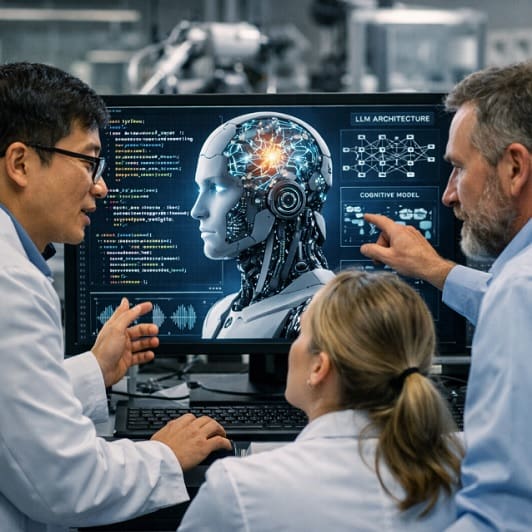
Physical Intelligence is developing a single AI system designed to power many different robots across tasks and environments, and its research driven approach is reshaping how Silicon Valley views the future of automation.
Building Foundation Models
Physical Intelligence, often referred to as PI or π, is a San Francisco based AI robotics company focused on bringing general purpose artificial intelligence into the physical world. Rather than designing robots for narrowly defined roles or tightly coupling software to specific machines, the company is building foundation models intended to act as a shared intelligence layer for a wide range of robots and physically actuated devices.
The core idea mirrors the impact of large language models (LLMs) in software. For example, just as language models can be adapted to many tasks without being retrained from scratch, Physical Intelligence aims to create a robot brain that can transfer skills across environments, learn from experience, and adapt to new situations without extensive reprogramming. This ambition could place the company at the centre of a growing push towards what researchers describe as embodied AI, where intelligence is expressed through physical action rather than text or images alone.
What Physical Intelligence Is Building
At the heart of Physical Intelligence’s work are vision language action models, known as VLAs. These models combine perception, reasoning and motor control into a single system. Instead of separating vision, language understanding and movement planning into distinct modules, VLAs are trained end to end so the model can observe an environment, interpret instructions, plan a sequence of actions and physically execute them.
First Public Release Back in October 2024
The company’s first major public release was π0 in October 2024, which it described as its first generalist policy. This model was trained using large scale multi task and multi robot data and introduced a new network architecture designed to improve dexterity and generalisation. Subsequent versions have expanded those capabilities. For example, in April 2025, π0.5 introduced what the company called open world generalisation, allowing a mobile manipulator to perform clean up tasks in entirely new kitchens or bedrooms without prior exposure. Also, in November 2025, π*0.6 added reinforcement learning so the model could improve success rates and throughput based on real world experience.
A Mission To Bring General Purpose AI Into The Physical World
On its website, Physical Intelligence describes its mission as “bringing general purpose AI into the physical world” and says it is “developing foundation models and learning algorithms to power the robots of today and the physically actuated devices of the future”. The emphasis throughout its research output is on intelligence rather than hardware, with the company repeatedly arguing that strong generalisation can compensate for relatively simple mechanical systems.
How And Where The Work Is Being Done
Physical Intelligence operates primarily out of San Francisco, where it runs a series of data collection and testing environments. These include warehouse style spaces, domestic settings and test kitchens filled with everyday appliances and furniture. Robots are exposed to real tasks such as folding clothes, assembling boxes, operating kitchen equipment and manipulating unfamiliar objects.
The company follows a continuous training loop. For example, robots perform tasks in these environments, data is collected from those interactions, new models are trained using that data, and the updated models are then redeployed for further evaluation. The company says this process allows the system to learn from failure and success in physical settings rather than relying solely on simulation.
Human To Robot Transfer
Human to robot transfer is another key element of the company’s approach. For example, several of its published research posts explore how robots can learn from human video data, allowing models to absorb information about actions and affordances without requiring every behaviour to be demonstrated physically by a robot. Back in a December 2025 research article titled Emergence of Human to Robot Transfer in VLAs, the company explained how this capability begins to appear naturally as models scale, rather than being explicitly programmed.
What Makes Physical Intelligence Different?
What seems to distinguish Physical Intelligence from many robotics startups is its apparent refusal to prioritise near term commercialisation. For example, the company does not offer investors a clear timeline for revenue generation and has not launched a mass market product. Instead, it has positioned itself as a long horizon research organisation focused on solving what it sees as the core problem in robotics, which is general purpose physical intelligence.
Despite this, the company has raised around $1 billion and was valued at approximately $5.6 billion following a $600 million funding round in late 2025. That round was led by CapitalG (Alphabet’s growth stage venture capital fund) and included participation from Lux Capital (a science and deep tech focused venture capital firm), Thrive Capital (a technology focused venture capital firm), and Index Ventures (a global venture capital firm investing in technology companies), T. Rowe Price and Jeff Bezos. According to reporting from Bloomberg and Axios, much of the company’s spending is directed towards compute and large scale data collection rather than manufacturing or sales infrastructure.
The leadership team has been explicit about this strategy, and on its website and in published research updates Physical Intelligence frames progress in terms of model capability rather than deployment milestones, stating that its internal roadmap originally projected five to ten years of development, even though some technical goals were reached earlier than expected as models scaled.
The Competitive Landscape
It should be noted here that Physical Intelligence is not the only company working on producing general purpose robotics, but it represents one end of a wider strategic divide. For example, one of its most prominent counterparts is Skild AI, a Pittsburgh based company founded in 2023 that is also building a general purpose robotic brain. Skild has raised more than $1 billion and claims its Skild Brain has already been deployed commercially across security, warehouse and manufacturing environments, generating tens of millions of dollars in revenue.
Skild takes a more deployment led approach and has publicly criticised what it views as over reliance on vision language models trained primarily on internet data. For example, in a July 2025 blog post titled Building the General Purpose Robotic Brain, the company argued that many robotics foundation models are “VLMs in disguise” that lack true physical common sense because they do not contain sufficient action grounded data. Skild instead emphasises large scale simulation combined with targeted real world data as the path to scale.
Other companies operating in adjacent areas include Figure AI, which is developing humanoid robots with backing from Microsoft and OpenAI, Agility Robotics with its Digit robot designed for warehouse work, and large internal research efforts at organisations such as Google DeepMind, Tesla and Nvidia. These groups vary widely in how closely they couple hardware and software, and in how quickly they seek commercial deployment.
Implications For Businesses And The Robotics Market
If Physical Intelligence’s approach proves effective, it could really lower the cost and complexity of deploying robots across multiple industries. A shared intelligence layer that can be transferred between platforms would reduce the need for bespoke programming and make automation more flexible. Logistics, grocery fulfilment and manufacturing are already being explored through limited partnerships, according to the company and investor statements.
Also, the implications extend beyond efficiency gains. For example, more adaptable robots could change how businesses think about workforce planning, task allocation and safety. At the same time, general purpose physical intelligence raises regulatory and operational questions, particularly around reliability, accountability and failure modes in unpredictable environments.
Challenges And Criticisms
Despite strong investor backing, Physical Intelligence does face some substantial challenges. For example, critics question whether a single model can actually generalise effectively across a wide range of physical tasks without becoming inefficient or unpredictable. Others have pointed to the cost of large scale computing resources and the practical difficulty of collecting high quality real world robotics data at scale.
Hardware is also a constraint. For example, Physical Intelligence has acknowledged in its research posts that working in the physical world introduces delays, safety limitations and mechanical failures that do not exist in software only systems. These factors slow experimentation and complicate iteration.
There are also some unresolved questions about demand. While investors appear willing to tolerate long timelines, it remains unclear which markets will first adopt general purpose robotic intelligence at scale and under what economic conditions. For now, Physical Intelligence continues to focus on advancing core capabilities rather than answering those commercial questions directly.
What Does This Mean For Your Business?
Physical Intelligence is betting that solving general purpose physical intelligence first will ultimately unlock more durable and transferable value than pursuing early, narrow deployments, and that wager now sits at the centre of an increasingly important debate in robotics. The contrast with more commercially focused competitors highlights a fundamental uncertainty in the market about whether generalisation is best achieved through long term research or through rapid real world deployment and iteration. The answer is unlikely to be settled quickly, particularly given the technical difficulty of training systems that can reliably operate across unpredictable physical environments while remaining safe, efficient and economically viable.
For UK businesses, this work points to a future where robotics adoption may become less about investing in bespoke machines for individual tasks and more about accessing shared intelligence layers that can adapt over time. Sectors such as logistics, manufacturing, food production and facilities management could eventually benefit from more flexible automation, although near term deployment will continue to depend on cost, reliability and regulatory clarity. For investors, policymakers and workers, the progress of companies like Physical Intelligence will shape expectations around how quickly embodied AI moves from research environments into everyday operations, and how the balance between innovation, safety and economic impact is managed as robots become more capable and more general purpose.
Sponsored
Ready to find out more?
Drop us a line today for a free quote!
