
Satellite Finds Its Own Targets Using AI
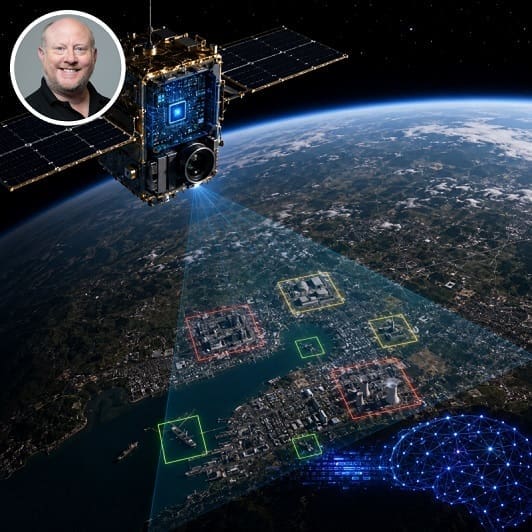
An Earth observation satellite has successfully identified targets on its own while in orbit, without requiring human analysts on the ground, marking what is believed to be the first reported use of a vision-language AI model operating in space.
What Happened?
The milestone took place aboard YAM-9, a satellite operated by space infrastructure company Loft Orbital.
Traditionally, Earth observation satellites collect large volumes of imagery and sensor data, which are then transmitted to Earth for analysis by either human operators or machine-learning systems. In this case, however, the analysis happened directly on the satellite itself.
Using software developed by NASA’s Jet Propulsion Laboratory (JPL) and Google’s Gemma 3 vision-language model, the spacecraft was able to interpret natural-language instructions and identify relevant features within the imagery it was collecting. According to reports, researchers asked the system to locate things such as infrastructure around railway hubs and areas where human development meets the natural environment, and the satellite successfully identified them.
The demonstration is believed to be the first publicly reported example of a vision-language model operating autonomously in orbit.
How The Technology Works
The project combined several technologies that have become increasingly important in artificial intelligence.
Vision-language models differ from conventional image-recognition systems because they can understand both images and natural-language instructions. Rather than being trained to identify only specific objects, they can interpret broader requests expressed in everyday language.
On YAM-9, Google’s Gemma 3 model was integrated into a software platform called NAVI-Orbital, developed by NASA JPL. The system ran on an Nvidia Jetson Orin AGX processor carried onboard the satellite.
This allowed the satellite to analyse imagery while still in orbit rather than waiting for instructions from Earth.
Instead of downloading vast quantities of raw data and asking analysts to search through it later, the satellite could determine which information was relevant and prioritise it automatically.
Why This Matters
The development could significantly change the economics and usefulness of Earth observation.
Modern satellites generate enormous amounts of data, much of which may never be examined in detail because analysing it requires time, computing resources, and human expertise. By performing initial analysis onboard, future satellites could reduce the volume of data that needs to be transmitted and processed on the ground.
Paul Lasserre, Loft Orbital’s head of AI, described the wider opportunity by saying: “If you have a VLM, you can have logic, like ‘monitor this border for me, and let me know when something is suspicious,’ and interact back and forth with the satellites.”
That represents a change from satellites acting primarily as remote cameras towards becoming active participants in monitoring and decision-making processes.
The technology could also help reduce delays. For example, rather than waiting for imagery to be downloaded and reviewed, operators could potentially receive alerts about significant events as they occur.
Potential Applications
The possible uses extend across both commercial and public-sector activities.
Loft Orbital already highlights applications including vessel detection, asset monitoring, border security, environmental tracking, wildfire detection, vegetation monitoring, and deforestation analysis. The company’s wider vision involves deploying AI applications directly in orbit rather than relying entirely on ground-based processing.
The company states that its AI-enabled infrastructure allows decision-makers to have “their questions answered in near real-time”.
Future systems could potentially monitor shipping routes, identify unusual activity around critical infrastructure, detect environmental changes, or support emergency response efforts following natural disasters.
Loft is also developing Altair, a planned ten-satellite AI-enabled constellation designed for near real-time monitoring and deployment of space-based AI applications.
Part Of A Bigger Change
The demonstration also points towards a broader trend within the space industry. For decades, satellites have primarily been designed to collect information and transmit it elsewhere for analysis. Increasingly powerful onboard processors are now making it possible for spacecraft to perform far more sophisticated tasks independently.
According to Loft Orbital, “Traditional satellites cannot keep up” with the pace of AI development, which is why the company is investing heavily in on-orbit computing and AI infrastructure.
Researchers involved in the project also see potential applications beyond Earth observation. NASA JPL has previously discussed how similar AI assistants could eventually help astronauts working on the Moon or Mars by providing interactive support without requiring constant communication with Earth.
What Does This Mean For Your Business?
The project really demonstrates how AI is increasingly moving closer to where data is generated rather than relying entirely on centralised data centres and cloud platforms. Similar trends are already emerging in manufacturing, transport, cyber security, healthcare, and industrial monitoring, where AI systems are being deployed directly at the edge rather than waiting for data to be sent elsewhere.
The satellite also highlights a change in how organisations may interact with technology. For example, rather than collecting information and analysing it later, future systems are increasingly being designed to understand objectives, identify relevant information, and proactively highlight what matters.
The result is not simply faster analysis, but it also represents a move towards autonomous systems that can act as intelligent assistants, helping people make decisions from vast amounts of data that would otherwise be impossible to process efficiently. As AI capabilities continue to improve, that model is likely to become increasingly common both in space and here on Earth.
