
Altman’s Biometric-Checker In Popular Platforms
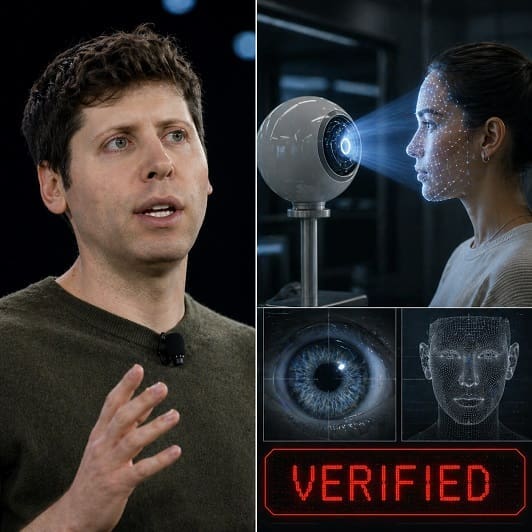
Sam Altman’s World project is rapidly expanding partnerships with everyday platforms like Tinder and Zoom as it pushes to embed human verification into everyday digital interactions, responding to a growing wave of AI-generated content, bots, and deepfake fraud.
What Is ‘World’ And How Does It Work?
World, developed by Tools for Humanity, the company co-founded by OpenAI’s Sam Altman, is a digital identity system designed to prove that someone is a real, unique human online without requiring them to share personal information such as their name or identity documents.
The system is built around what the company calls “proof of human”, a way of confirming that a real person, rather than an AI system or automated bot, is behind an online account or interaction. As the company explains, “World ID lets you verify real humans without compromising privacy,” positioning the technology as a privacy-first alternative to traditional identity checks.
Uses The Orb
The system centres around a biometric verification process using a device known as the Orb, which scans a user’s iris and converts it into a unique cryptographic identifier. That identifier becomes the user’s World ID, which can then be used across multiple platforms.
The company says that this approach is designed to protect user anonymity. According to its own materials, “the Orb captures and processes photos to verify uniqueness without the need to retain your images or collect any other information,” with encrypted data stored locally and under user control.
This model reflects a change in how identity is being handled online. For example, instead of repeatedly sharing personal details with different services, with this type of system, users can prove they are a real person once and then reuse that verification across multiple environments.
To support different use cases, World has also introduced multiple levels of verification, ranging from high-security Orb scans to lower-friction methods such as document checks or selfies. This allows platforms to choose the level of assurance that matches their risk profile.
Why World Is Expanding Beyond Its Own Platform
With that foundation in place, World is now moving to scale its technology by integrating directly into high-traffic consumer and business platforms where trust has become a growing issue.
At the same time, the problem it is trying to solve is becoming more urgent. As generative AI systems improve, the volume of synthetic content online is rising sharply, making it harder for users and organisations to know whether they are interacting with a real person or an automated system.
As Sam Altman explained at a recent event, “we are also heading to a world now where there’s going to be more stuff generated by AI than by humans.” That shift is already affecting areas such as online dating, customer interactions, and business communications, where authenticity has direct financial and reputational consequences.
Why Platforms Like Tinder And Zoom Are Getting Involved With World
The choice of partners highlights where these pressures are already being felt most strongly. For example, on platforms like Tinder, the challenge is driven by bots and romance scams, which are becoming more convincing as AI-generated profiles and conversations improve.
By integrating World ID, Tinder can offer users a visible signal that a profile belongs to a verified human, helping to rebuild trust in an environment where uncertainty has become common.
In business environments, the risks are more direct and potentially more costly. World’s partnership with Zoom reflects growing concern about deepfake impersonation, particularly in video calls where financial or operational decisions are being made.
Cases involving AI-generated participants in meetings have already resulted in significant financial losses, highlighting the limitations of traditional security measures. World’s approach, which links a live video feed to a previously verified identity, is designed to address this by confirming that the person on screen is genuine.
Beyond these examples, World is also expanding into areas such as digital contracts, ticketing, and online commerce. Integrations with platforms like DocuSign aim to ensure that agreements are signed by real people, while partnerships with ticketing providers such as Ticketmaster and Eventbrite are designed to reduce bot-driven purchasing and reselling.
What This Means For The Future Of Online Trust
The wider significance of these partnerships lies in how they reshape the idea of identity on the internet. Rather than relying solely on usernames, passwords, or document-based verification, platforms are beginning to adopt a model based on proving that a user is a real, unique human.
World’s own positioning reflects this change. The company says its technology can “securely and anonymously prove that every user is a real and unique human online,” while also helping to “eliminate bots and Sybil attacks at scale,” strengthening platform integrity.
This approach has some clear advantages. For example, using this type of verification system, platforms can reduce fake accounts, improve moderation, and create more reliable user experiences, while businesses can lower the risk of fraud and build greater trust with customers and partners.
Biometrics Still A Sensitive Issue
However, there are still many questions around the sensitive issue of the use of biometric verification. In fact, World has already faced scrutiny from regulators in multiple countries over how its technology is deployed, while practical considerations around accessibility persist given that the highest level of verification still depends on specialised hardware.
At the same time, the model highlights a wider challenge, as the rapid development of AI is increasing the need to verify real people while also making impersonation more realistic and easier to carry out at scale.
What Does This Mean For Your Business?
For most organisations, World’s technology will not be something they implement directly in the immediate term, but the change it represents is already relevant.
As AI-driven fraud, impersonation, and automation continue to increase, the ability to verify that a user is genuinely human is likely to become a standard requirement across many digital services. This applies not only to customer-facing platforms but also to internal systems, supply chains, and remote collaboration tools.
A reusable, privacy-focused identity layer has the potential to simplify how organisations manage trust, reducing reliance on fragmented verification methods and lowering exposure to risks such as fake accounts and social engineering attacks.
At the same time, adopting these approaches will require some careful consideration of compliance, user experience, and operational fit. Organisations will need to assess where human verification adds value and how it aligns with their existing systems and processes.
World’s expanding network of partnerships, such as Tinder, shows that this model is already moving into mainstream use. As platforms begin to embed proof-of-human verification into their core functionality, organisations that understand how it works and where it can be applied will be better positioned to operate in a digital environment where proving you are human may become just as important as proving who you are.
