
Spying Concerns Over Ring’s New “Search Party” Feature
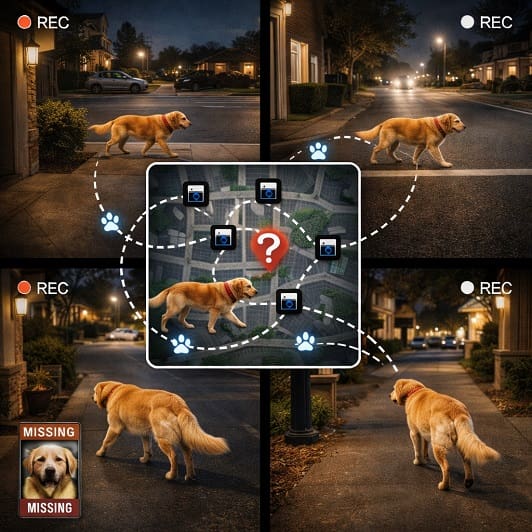
Ring’s latest AI-powered tool, designed to help find lost dogs and monitor wildfires, has prompted a backlash over how far neighbourhood camera networks should go.
Search Party Expanded
Ring, owned by Amazon, has just expanded its new Search Party feature across the United States, allowing its outdoor cameras to automatically scan for missing dogs reported in the Ring app.
Opt-Out and “Function Creep”
The system is enabled by default on eligible devices, meaning users must actively switch it off if they do not want to take part, a detail that has fuelled some questions and controversy.
The company says the feature has already helped reunite “more than one lost dog a day” with its owner since launch. Privacy campaigners, meanwhile, warn it represents another example of AI-driven “function creep”, where tools introduced for safety gradually widen the scope of surveillance.
What is Search Party?
Search Party is an AI-powered feature built into Ring’s Neighbours ecosystem. With the feature, when someone creates a Lost Dog Post in the Ring app, participating outdoor Ring cameras in the surrounding area then begin scanning for dogs that resemble the missing pet.
Ring explains the process in its official help documentation: “When a neighbor reports a missing dog in the Ring app, your outdoor Ring cameras use AI to look for matches in your recordings.” If a camera spots what it believes may be the missing dog, the camera owner receives an alert that includes “A picture of the missing dog” and “Video footage from your camera”.
The footage is not automatically sent to the dog’s owner. Instead, the camera owner chooses whether to share the clip or ignore the alert. Ring says this ensures participation remains voluntary and that users retain control over their content.
The feature has now been expanded so that anyone in the US can start a Search Party in the Ring app, even if they do not own a Ring device. This broadens the potential reach of the network significantly.
Better Than Driving Around Looking For The Dog
Jamie Siminoff, Ring’s chief inventor, said: “Before Search Party, the best you could do was drive up and down the neighborhood, shouting your dog’s name in hopes of finding them. Now, pet owners can mobilise the whole community — and communities are empowered to help — to find lost pets more effectively than ever before.”
Ring adds that lost pets are among the most common posts in the Neighbours app, with “more than 1 million reports of lost or found pets made in the app last year alone”. The company estimates there are roughly 90 million dogs across around 60 million US households, underscoring the potential scale of the problem it is attempting to address.
Questions
Despite Amazon’s explanations of the value of the feature, it has sparked some controversy centring on how the technology operates.
The most contentious point appears to be that Search Party is switched on by default. That said, users were actually emailed about the change and told: “You can always turn off Search Party.” To opt out, users must navigate to the Control Centre in the Ring app and manually disable “Search for Lost Pets” for each camera.
However, critics argue that default activation shifts responsibility onto users and expands automated scanning across neighbourhoods without explicit consent from each camera owner at the outset.
Relationship With Law Enforcement
The feature also arrives against a backdrop of growing scrutiny over Ring’s relationship with law enforcement and its broader AI ambitions. Although Search Party is limited to detecting dogs and wildfire indicators, privacy advocates question how easily such systems could be adapted for other forms of tracking.
One of the key concerns is what technologists call function creep, i.e., where a tool introduced for a narrow purpose gradually evolves into something more expansive. AI-powered computer vision, once embedded across large numbers of residential cameras, can theoretically be trained to identify a wide range of objects or patterns.
Ring has stated that Search Party does not scan human faces and that sharing footage remains optional. The company’s help page makes this clear, saying: “You can choose to ignore the alert or respond to the alert and share the info with your neighbour.”
Even so, some campaigners warn that object recognition systems deployed at scale change the character of neighbourhood surveillance, even if they begin with benign goals.
Fire Watch and Broader Monitoring
Search Party is not solely about missing pets. It also incorporates a wildfire monitoring function known as Fire Watch.
According to Ring’s support materials, Fire Watch activates when Watch Duty, a non-profit wildfire monitoring organisation, reports a fire near a user’s location. During an active event, eligible outdoor cameras can use AI to monitor for “visible flames and smoke patterns”.
It should be noted here that Ring has stressed the limitations of this function, saying: “Your camera can make mistakes and might produce false positives (detecting fire when there isn’t one) or false negatives (missing actual fires). Fire Watch is not a safety alerting tool and should not be relied upon as your primary source for fire safety information.”
Users Can Choose To Share Images
Users can choose to share static image snapshots with Watch Duty for up to 24 hours at a time. Snapshot sharing ends automatically when the fire event concludes or when consent is withdrawn.
The inclusion of wildfire monitoring under the same umbrella has reinforced concerns among some critics that Search Party represents a broader shift towards AI-driven community surveillance infrastructure.
Ring’s Wider AI push
Search Party builds on Ring’s recent expansion into generative AI features. For example, in 2025, the company introduced Video Descriptions, which provides short AI-generated summaries of motion activity detected by cameras.
Siminoff described that development as “seizing on the potential of gen AI to shift more of the work of your home’s security to Ring’s AI”, signalling a strategic shift towards automated analysis rather than simple recording.
Search Party applies similar technology to neighbourhood-level scanning. For example, instead of waiting for users to manually review footage, the system proactively searches for visual matches when triggered by a Lost Dog Post or wildfire alert.
Community Empowerment
Ring seems keen to position this feature as community empowerment. For example, in its announcement, the company said: “Search Party’s expansion reflects a meaningful step forward in Ring’s mission to make neighborhoods safer — including for all our four-legged family members.”
It has also committed $1 million to equip animal shelters across the US with Ring camera systems, aiming to reduce the time lost dogs spend in shelters before being reunited with their owners.
Opting Out and User Control
Despite the controversy, participation in the feature is optional. For example, users can disable Search Party at any time in the Ring app by selecting Control Centre, choosing Search Party, and toggling off “Search for Lost Pets” for individual cameras. A separate toggle controls Fire Watch monitoring.
Non-subscribers can also still receive fire event alerts and access live view during wildfire events, but cannot use AI fire detection or share content with first responders.
Ring emphasises that camera owners decide on a case-by-case basis whether to share footage and that no automatic data transfer occurs without user action.
In essence then, the debate here centres on how much automation users are comfortable allowing within residential camera networks. For example, for some, the prospect of finding a missing dog within minutes outweighs the abstract risk of expanded AI scanning whereas, for others, the default activation of a feature that mobilises neighbourhood cameras may seem like a step too far in the normalisation of always-on visual monitoring.
What Does This Mean For Your Business?
The central question here is not whether finding lost dogs is worthwhile, but how much automated scanning people are prepared to accept as standard in their streets. Ring stresses that Search Party does not use facial recognition, that sharing footage is voluntary and that users can opt out at any time. It also points to early results, saying the feature has already helped reunite more than one dog a day. For many households, that practical benefit will matter.
The concern, however, is that once AI-powered object recognition is embedded across millions of cameras, the technical capability exists to expand what those systems detect. Even if it is currently limited to just spotting dogs and signs of wildfire, critics say the bigger issue is that the same technology could be adapted in future to look for other things. For example, once cameras are routinely scanning footage automatically, it will become easier to expand what they are scanning for. Also, the fact that the feature is switched on by default has intensified those concerns, because it means the system begins operating unless users actively turn it off.
It seems that for Amazon and Ring, maintaining trust will depend on transparency and meaningful user control, but for regulators and privacy groups, the rollout is reinforcing calls for clear guardrails around AI-enabled surveillance.
For UK businesses, this is a reminder that AI in security systems must be deployed with privacy by design and explicit consent, particularly under UK GDPR. For consumers, communities and emergency services, the benefits are tangible, but so too are the longer-term questions about how far automated monitoring should extend.
Sponsored
Ready to find out more?
Drop us a line today for a free quote!
