
Poland’s Tech Sovereignty Test For Government AI Purchases
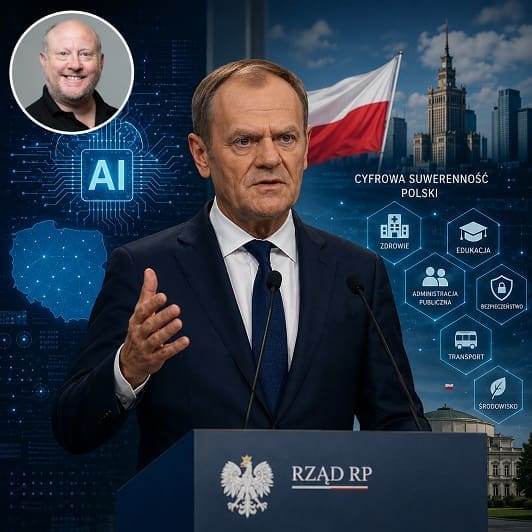
Poland will introduce a new “sovereignty test” for major government technology purchases as Prime Minister Donald Tusk warns that growing dependence on foreign digital infrastructure and AI providers has become a strategic national concern.
What Has Been Announced?
Speaking at the European Financial Congress in Sopot, Tusk said Poland would begin assessing significant public-sector technology procurements through a sovereignty lens, while also publishing annual reports tracking the country’s progress towards greater IT independence.
Although the full details of the test have not yet been released, the policy is expected to examine issues such as vendor dependence, control over critical systems, access to data, and the strategic risks associated with relying heavily on a small number of technology suppliers.
Explaining the reasoning behind the move, Tusk said: “At this point, the scale of this dependency, and I’m referring here to the relationship between the state and the digital sphere, has reached such proportions that it must prompt serious economic, institutional, and organisational decisions.”
The announcement represents one of the clearest examples yet of a European government moving beyond discussions about digital sovereignty and beginning to embed those concerns directly into procurement policy.
Why Poland Is Concerned
The policy reflects growing concern across Europe that critical public services increasingly depend on technology platforms, cloud infrastructure, AI systems, and digital services controlled by a relatively small number of foreign companies.
Tusk argued that technological sovereignty should become a strategic objective for Poland, not because the country wants to isolate itself from global technology markets, but because governments need meaningful choice rather than dependence.
According to figures cited by the Polish government, the country’s digital trade deficit has grown from approximately PLN 9 billion in 2016 to around PLN 45 billion in 2025, highlighting the increasing flow of technology spending towards foreign providers.
At the same time, artificial intelligence is creating new forms of dependency. Governments increasingly rely on cloud platforms, AI models, cybersecurity tools, data infrastructure, and software ecosystems that are often developed and controlled outside their own borders.
As AI becomes embedded in healthcare, public administration, education, defence, transport, and critical infrastructure, questions about who owns, controls, and maintains those systems are becoming more politically significant.
Part Of A Wider European Debate
Poland’s announcement reflects a wider debate taking place across Europe about digital sovereignty. For example, for several years, European policymakers have expressed concerns about dependence on both American technology giants and Chinese hardware suppliers. However, the rapid emergence of generative AI has added fresh urgency to those discussions.
Many European leaders now worry that regulation alone may not be enough if the most advanced AI systems, cloud platforms, and digital infrastructure remain concentrated in the hands of a small number of overseas providers.
The challenge is particularly evident in AI, where the most advanced models currently come largely from companies based in the United States. European governments and businesses increasingly face difficult decisions about balancing access to the best available technology against concerns around strategic dependence.
Poland has already taken steps in this direction. For example, earlier this year, the government restricted certain Chinese technologies from sensitive military environments and has increased support for domestic AI initiatives, including the development of Polish-language AI models.
What Could The Sovereignty Test Mean In Practice?
Although the final framework remains unclear, the test is unlikely to operate as a simple ban on foreign technology suppliers.
Instead, it appears more likely that government departments will be required to assess whether major procurements create excessive dependence on a single vendor or introduce risks around control, resilience, security, or long-term flexibility.
For example, authorities may need to consider whether critical systems can be migrated elsewhere if required, whether data remains under appropriate control, and whether alternative suppliers exist.
Such considerations are already becoming common in discussions around cloud computing, cybersecurity platforms, AI systems, telecommunications infrastructure, and public-sector software procurement.
The broader objective appears to be ensuring that Poland retains meaningful strategic choice rather than finding itself locked into technologies that become difficult or impossible to replace.
What Does This Mean For Your Business?
For businesses, Poland’s announcement highlights how technology procurement is increasingly becoming a strategic and geopolitical issue rather than simply a commercial one.
Cost, functionality, and performance remain important, but governments and organisations are paying growing attention to questions of control, resilience, supplier concentration, and long-term dependency.
The policy also reflects a wider change in how AI is being viewed. Rather than treating AI purely as a productivity tool, governments are increasingly seeing access to AI infrastructure and capabilities as a matter of economic competitiveness and national security.
Whether other countries follow Poland’s lead remains to be seen. However, the introduction of a sovereignty test suggests that future technology purchasing decisions may increasingly involve questions about who controls the technology, where it is hosted, and how dependent organisations become on the companies that provide it.
