
Meta Pulls Facial Recognition Code From Smart Glasses App
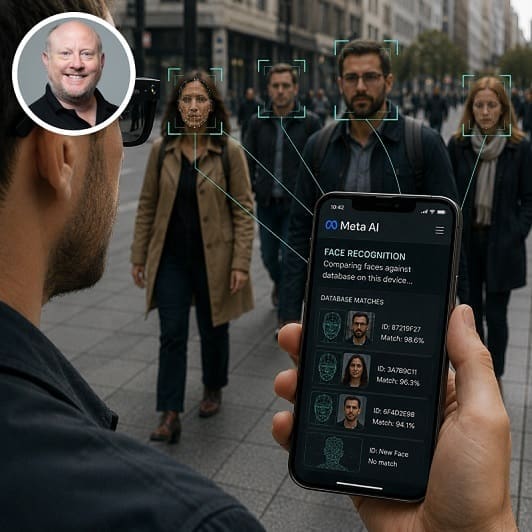
It’s been reported that Meta has quietly removed facial recognition code from the companion app used by its AI-powered smart glasses, reigniting concerns about how far wearable technology companies may be willing to go in their pursuit of always-on artificial intelligence.
What Was Removed?
The controversy centres on an internal system called NameTag, which was discovered inside the Meta AI smartphone app that works alongside the company’s Ray-Ban smart glasses. According to reporting first published by WIRED, the code appeared to support facial recognition capabilities that had never been publicly released.
The system was reportedly designed to convert faces captured by the glasses into unique biometric identifiers, often referred to as faceprints, and compare them against a database stored on the user’s device. Evidence within the software also suggested that faces the system could not identify would be cropped, indexed, and stored locally for future processing.
Most notably, the code was present inside an application installed on tens of millions of devices despite Meta repeatedly stating that no final decision had been made about introducing facial recognition to its smart glasses platform.
Just one day after the findings became public, Meta released an updated version of the app that removed almost all traces of the NameTag system.
Meta’s Response
Meta says the facial recognition system was an internal exploratory project rather than a planned product feature. However, the speed with which the code was removed has inevitably attracted attention.
Reports indicate that the original software contained multiple AI models dedicated to detecting faces, cropping facial images, and converting them into biometric signatures. The app also reportedly contained a “Person recognised” alert that would have been displayed if someone was successfully identified.
Meta has not publicly explained why the code was removed immediately after the discovery or whether the changes had already been planned before the reporting appeared.
Why Facial Recognition In Glasses Is Different
The debate is not really about facial recognition itself. The technology has existed for many years and is already widely used in smartphones, airports, security systems, and consumer applications.
What makes smart glasses different is that they allow facial recognition to move from fixed locations and deliberate actions into everyday social interactions.
Unlike a phone, which requires someone to consciously point a camera at another person, smart glasses can continuously capture information while being worn. Combined with AI, cameras, microphones, and internet connectivity, they create the possibility of real-time identification in public spaces without the knowledge of the people being observed.
Supporters argue that such technology could have legitimate uses. For example, facial recognition could help visually impaired users identify friends, family members, or colleagues. It could also assist people with memory difficulties or cognitive impairments.
Critics, however, have raised concerns that the same technology could be misused for stalking, harassment, surveillance, or the identification of strangers without consent.
Those concerns become even more significant when combined with generative AI systems capable of searching, analysing, and contextualising information automatically.
Part Of A Bigger Strategy
The discovery also provides an insight into Meta’s longer-term ambitions for wearable AI. For example, chief executive Mark Zuckerberg has repeatedly described smart glasses as a future computing platform where AI assistants become constantly available throughout the day. The company’s recent investments in Ray-Ban and Oakley smart glasses reflect a belief that future digital interactions will increasingly move away from smartphones and towards wearable devices.
Facial recognition could potentially play an important role in that vision. An AI assistant capable of recognising people, understanding context, remembering previous interactions, and providing relevant information could become far more useful than one that simply responds to voice commands.
However, it is precisely that capability which raises difficult questions about privacy, consent, and personal data.
The Wider Privacy Challenge
The incident arrives at a time when regulators in Europe, the UK, and the United States are paying closer attention to biometric technologies.
Unlike passwords or usernames, biometric identifiers are linked directly to an individual’s physical characteristics. If compromised or misused, they cannot simply be changed or reset.
Privacy campaigners have long argued that facial recognition requires stronger safeguards than many other forms of personal data because of its potential to identify individuals at scale and without their active participation.
The rapid removal of the NameTag code suggests that Meta recognises the sensitivity of the issue, even if the company insists the feature was only exploratory.
What Does This Mean For Your Business?
For businesses, the story highlights how quickly AI is beginning to move beyond software and into the physical world.
Many organisations are already evaluating AI tools for productivity, automation, and customer service. The next wave of AI innovation is likely to involve wearable devices that can see, hear, interpret, and respond to the environment around them in real time.
That creates new opportunities, particularly in areas such as accessibility, training, field services, logistics, and hands-free information access. At the same time, it introduces new questions around privacy, data governance, consent, and the collection of biometric information.
The wider lesson is that as AI becomes more deeply embedded into everyday devices, businesses will need to think not only about what these systems can do, but also about what employees, customers, and the public are comfortable allowing them to do. The reaction to Meta’s facial recognition experiment suggests those conversations are only just beginning.
