
HMRC Deploys British AI To Hunt Tax Fraud
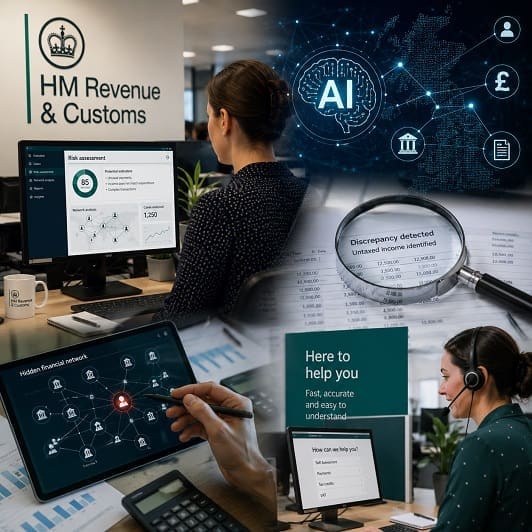
HMRC is handing a British AI company £175 million to help it spot tax fraud, uncover hidden financial networks, reduce costly mistakes, and improve customer service, as pressure mounts over rising complaints, growing complexity, and a £46.8 billion tax gap.
Deal With Quantexa
The decade-long deal with London-based AI and analytics firm Quantexa marks one of the largest AI deployments ever seen inside the UK public sector. It also signals a major strategic change in how the government wants critical public systems to use artificial intelligence.
Rather than relying on a US technology giant, HMRC is betting heavily on a British-developed “Decision Intelligence” platform designed to connect fragmented data, identify suspicious patterns, and support human investigators and customer service teams.
Why HMRC Wants AI Help
HMRC has been under mounting criticism for years over long waits, processing delays, incorrect tax notices, and declining service standards.
According to figures obtained through Freedom of Information requests by the Contentious Tax Group, complaints against HMRC climbed to more than 93,000 in 2024/25, up sharply from around 70,000 five years earlier.
Also, compensation payments linked to HMRC errors and distress have also risen significantly.
At the same time, the tax authority is handling growing volumes of digital data as initiatives like Making Tax Digital expand across the UK economy.
It seems the problem for HMRC is not a lack of information, but that the information often sits in disconnected systems that can’t easily “see” relationships between people, companies, transactions, and behaviours.
Quantexa specialises in connecting fragmented datasets and using graph analytics and machine learning to identify patterns, relationships, and anomalies that would be extremely difficult for human investigators to spot manually across millions of disconnected records and transactions.
Its technology was originally developed for anti-money laundering work inside banks. Customers already include HSBC and Vodafone.
Now HMRC wants to apply similar techniques to tax compliance, fraud detection, and operational efficiency.
Connecting The Dots
One of the most significant parts of the project involves what Quantexa calls “entity resolution”. In simple terms, the system attempts to identify when multiple records, companies, transactions, or identities may actually be connected.
That matters because complex fraud networks often hide behind layers of shell companies, false references, mismatched addresses, or disconnected records spread across multiple databases.
The technology is designed to create what Quantexa describes as “a clearer, connected view of its data to improve performance, help identify tax at risk, and strengthen control.”
Positive Points
One positive point about the new system is that it should be able to help HMRC track legitimate payments that have been incorrectly referenced, which could potentially reduce some of the administrative headaches faced by businesses and taxpayers.
Also, importantly, Quantexa says the platform is not intended to replace human decision-making. As Quantexa CEO Vishal Marria says: “In government environments, AI cannot operate as a black box,” and that “Decisions need to be transparent, auditable, and explainable, particularly in areas affecting citizens directly.”
In fact, this point matters politically as much as technically. For example, governments worldwide are increasingly nervous about allowing opaque AI systems to make decisions affecting taxes, benefits, healthcare, or policing without clear accountability.
The Digital Sovereignty Angle
There is another layer to this story that goes well beyond tax collection. The Quantexa deal is being viewed inside government as part of a wider push towards so-called “digital sovereignty”.
In recent years, the UK government has awarded huge contracts to American data firms including Palantir Technologies, the US data analytics company co-founded by billionaire Peter Thiel, whose NHS data platform deal generated considerable political controversy.
This time, ministers appear keen to emphasise that the supplier is British, the systems are governed, and the data stays under HMRC control.
Also, Quantexa’s online announcement about the deal with HMRC strongly emphasised sovereignty and governance concerns, with Quantexa highlighting how “Public sector organisations are accelerating digital transformation while needing to maintain sovereignty, auditability and control.”
It added that the platform creates “a trusted, governed foundation for advanced analytics and the safe deployment of AI at scale.”
The language used around the project is deliberate because governments are no longer debating simply whether AI can improve public services, they are increasingly focused on who controls the systems, where sensitive national data is stored, and whether automated decisions can be properly explained, audited, and challenged when citizens are affected.
A Major Test For Government AI
The contract could become a defining test case for how AI is used across British government departments. If successful, similar approaches could spread rapidly into compliance, policing, border control, welfare systems, and other high-data public services.
However, the pressure to deliver will be intense because HMRC’s tax gap currently stands at £46.8 billion, representing money theoretically owed but not collected, and the government is clearly placing significant faith in AI and Quantexa’s ability to help recover far more of it. Quantexa founder and CEO Vishal Marria says governments worldwide are struggling with “how to turn complex, fragmented data into confident, timely decisions”, which goes directly to the heart of HMRC’s long-running problems with disconnected systems, slow processes, and rising operational complexity. The company believes that by “creating context from data and embedding trusted, governed AI”, HMRC will be able to make “confident, informed decisions” more quickly, while improving fraud detection, strengthening oversight, and reducing the kinds of administrative errors that have increasingly damaged public confidence in the tax authority.
What Does This Mean For Your Business?
For businesses, accountants, and taxpayers, this signals a future where HMRC becomes far more data-driven, interconnected, and AI-assisted. That could mean faster identification of fraud and errors, quicker handling of customer queries, and improved detection of suspicious tax activity.
It could also mean increased scrutiny. As AI systems become better at linking records and spotting inconsistencies across datasets, businesses may find it harder to hide mistakes, discrepancies, or unusual financial behaviour inside disconnected systems.
At the same time, the project highlights something much bigger happening across the UK economy. Artificial intelligence is rapidly moving beyond chatbots and productivity tools into core national infrastructure, including taxation, compliance, and public administration.
It now seems that businesses that maintain accurate records, consistent reporting, and well-organised financial systems are likely to face far fewer problems in an environment where AI is increasingly being used to connect data, identify anomalies, and scrutinise tax activity far more efficiently than before.
