
Court Rules AI Overviews Are Google’s Words
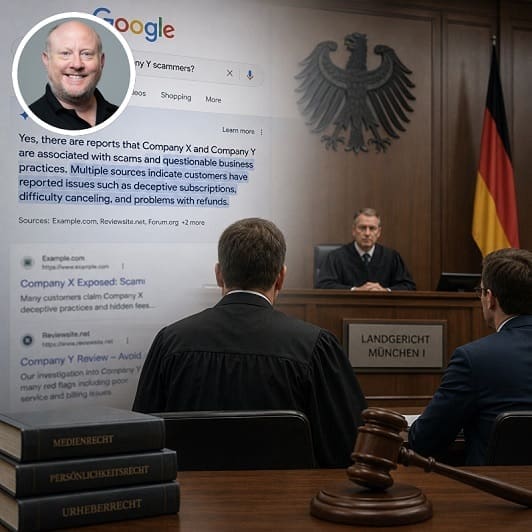
A German court has ruled that Google can be held directly responsible for false information generated by its AI Overviews feature, a decision that could have significant implications for AI-powered search engines and chatbots worldwide.
What Happened?
The case centres on Google’s AI Overviews, the AI-generated summaries that increasingly appear at the top of search results and attempt to answer users’ questions directly without requiring them to visit other websites.
The ruling came after two German publishers discovered that AI Overviews had falsely associated them with scams, subscription traps, and questionable business practices. According to court documents, the AI-generated summaries created links and allegations that did not appear in the sources cited by Google.
The Regional Court of Munich issued an injunction preventing Google from repeating the statements and concluded that the AI-generated content should be treated as Google’s own speech rather than merely a summary of information published elsewhere.
Why The Court Reached This Decision
The most significant aspect of the ruling is the distinction the judges drew between traditional search results and AI-generated answers.
For many years, search engines have generally benefited from limited liability protections because they primarily act as intermediaries, directing users to content created by third parties. If a search result links to an inaccurate webpage, responsibility normally rests with the publisher of that page rather than the search engine itself.
AI Overviews operate differently. According to the Munich court’s judgment, AI Overviews do not simply display links or snippets. Instead, they create “independent, new and substantive statements” that are generated by Google’s AI systems and presented to users as complete answers. The judges noted that Google controls the AI model and the algorithms that produce these summaries and therefore has responsibility for the content they generate.
The court also highlighted that the disputed statements were not simply copied from third-party websites. In several cases, the AI generated connections and allegations that were not present in the source material at all.
Why Google’s Defence Failed
Google argued that users can inspect the sources linked within AI Overviews and therefore verify information for themselves. However, the court rejected that argument.
The judges compared AI Overviews to headlines or teaser text that many readers consume without investigating further. They concluded that if an AI-generated answer is presented as a complete and understandable response, the fact that users could conduct additional research does not remove responsibility from the party that published it.
The court also found that AI Overviews are not essential to the functioning of search in the same way that traditional search results are. Users can still find information through ordinary links without requiring an AI-generated summary.
That distinction helped the judges justify imposing a higher level of responsibility on Google for AI-generated content than has historically applied to search engines.
Google Plans To Appeal
Google has confirmed that it intends to challenge the ruling. A company spokesperson told Reuters that the case focuses on specific errors rather than the fundamental operation of AI Overviews and said the company disagrees with the court’s conclusions.
Google also argued that the overwhelming majority of AI Overviews are accurate, while acknowledging that AI systems can occasionally miss context or misinterpret information. The company says it takes action when policy violations are identified.
The case remains a preliminary injunction rather than a final appellate ruling, meaning the legal position could still change as appeals progress.
A New Liability Challenge For AI
AI systems increasingly generate answers by analysing information from multiple sources and presenting users with a single, consolidated response. That approach is now common across search engines, chatbots, virtual assistants, and business productivity tools.
The Munich court’s reasoning suggests that once an AI system begins creating its own narrative, combining information from multiple sources and generating new conclusions, the provider may no longer be able to rely on the legal protections traditionally available to search engines and hosting platforms.
If that principle survives appeal, it could affect a wide range of AI products, including AI-powered search tools, enterprise assistants, customer service bots, and generative AI platforms.
Also, regulators across Europe are paying closer attention to AI transparency, accountability, and safety. Questions about who should be responsible when an AI system produces false, defamatory, or harmful information are becoming increasingly important as these tools become more widely used by businesses and consumers alike.
What Does This Mean For Your Business?
Most businesses are unlikely to see any immediate operational impact from the ruling, but it highlights an issue that organisations should already be considering.
AI-generated answers can appear authoritative and convincing while still containing errors, misunderstandings, or entirely fabricated information. As AI tools become more deeply embedded into search engines, productivity software, and business workflows, organisations should avoid treating AI-generated content as automatically accurate.
The ruling also serves as a reminder that businesses should monitor how AI systems describe their brands, products, and services online. If an AI-generated summary contains false information, legal avenues for challenging those statements may become clearer if courts increasingly view AI output as the responsibility of the platform that generated it.
More broadly, the case signals that regulators and courts are beginning to move beyond the question of what AI can do and focus instead on who should be accountable when it gets things wrong.
