
Children Fool Online Age Checks With Fake Moustaches
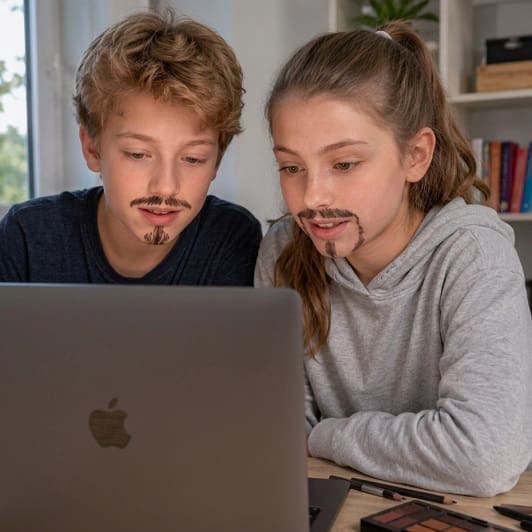
Children are reportedly bypassing online age-verification systems using methods as simple as drawing fake facial hair, raising fresh questions about whether current age-assurance technology is robust enough to protect young users online.
How Children Are Bypassing Age Checks
The issue was highlighted in a new report from UK online safety organisation Internet Matters, which surveyed more than 1,200 UK children and parents about online safety and age verification under the Online Safety Act.
The findings suggest that many children already understand how to bypass checks designed to block access to adult content, restricted social media features, and age-limited online platforms. The report found that 46 per cent of children believe age checks are easy to bypass, while only 17 per cent described them as difficult.
One of the more unusual techniques involved children drawing fake mustaches or facial hair using makeup pencils in order to fool facial age-estimation systems. Internet Matters stated that “children demonstrated a clear awareness of how to bypass age checks” and noted that drawing on facial hair was “reported as working in multiple instances”.
The report also found that around one-third of children admitted bypassing age checks entirely, including by entering fake birthdays, using someone else’s account, uploading photos of adults, or using VPNs to avoid restrictions.
Parents were also found to play a role in some cases. Internet Matters reported that 26 per cent of parents had either helped their child bypass age checks or knowingly allowed it.
Why Age Verification Is Expanding
The rapid growth of age-verification systems is being driven largely by new online safety laws introduced across the UK, Europe, Australia, and parts of the United States.
In the UK, the Online Safety Act requires platforms to take stronger steps to protect children from harmful content, including pornography, violence, self-harm material, and certain addictive platform features. The law also requires pornography services to implement what Ofcom describes as “highly effective age assurance”.
As a result, many websites and apps now use facial age estimation, government ID uploads, third-party verification systems, or behavioural analysis to estimate a user’s age.
Internet Matters found that 53 per cent of children had recently been asked to verify their age online, with checks commonly appearing on platforms including TikTok, YouTube, Roblox, Instagram, Reddit, Discord, and Twitch.
The report also noted that many children actually support stronger safety protections online. One child quoted in the research said: “I think it’s good because it keeps us from viewing adult content which is not going to be good for our mental health.”
How Meta Is Using AI To Estimate Age
The wider technology industry is already moving beyond simple “enter your birthday” systems and towards AI-driven age estimation.
Meta recently confirmed it is using AI systems to analyse photos, videos, captions, interactions, and behavioural signals to determine whether users may actually be underage, even if they claim to be adults.
According to Meta, its systems now use “visual analysis” to estimate age using factors such as height, bone structure, and broader visual cues. The company stated: “Our AI looks at general themes and visual cues, for example height or bone structure, to estimate someone’s general age.”
Meta stressed that this “is not facial recognition” and says the technology is designed to place suspected teenagers into stricter “Teen Account” protections automatically, or remove users believed to be under 13 until they can verify their age.
The company is also expanding these systems across Instagram, Facebook, Messenger, Reels, Live streams, and Groups as governments place increasing pressure on platforms to improve child safety.
Why The Technology Still Struggles
Despite increasingly sophisticated systems, the latest findings show that age assurance remains far from foolproof.
Facial age-estimation technology relies heavily on probability rather than certainty, meaning lighting, makeup, camera quality, facial expressions, accessories, and image manipulation can all affect results. Internet Matters also found that some children had successfully used video game characters, AI-generated faces, or edited images to bypass checks.
The report also highlighted wider concerns around privacy and cybersecurity. Some parents and children expressed discomfort about uploading passports, ID documents, or facial scans online, particularly if third-party verification companies are involved.
Others worried that large-scale age verification could create attractive targets for cybercriminals if sensitive personal data were breached or leaked.
At the same time, supporters argue that platforms cannot realistically deliver age-appropriate experiences without some form of reliable age assurance.
What Does This Mean For Your Business?
For UK businesses, the story highlights the growing difficulty of verifying identity and age online, particularly when AI systems are being asked to make judgement calls based on appearance, behaviour, and probability rather than certainty.
Organisations developing online platforms, customer portals, AI tools, or digital services are likely to face increasing regulatory pressure around age assurance, child safety, privacy, and identity verification as online safety laws continue to expand globally.
The findings also underline a wider cybersecurity and governance challenge. Systems that rely entirely on automated trust signals can often be manipulated in unexpected ways, particularly when users actively look for workarounds.
At the same time, the growing use of facial analysis, behavioural monitoring, and AI-driven verification is likely to increase scrutiny around privacy, biometric data handling, transparency, and UK GDPR compliance.
The main lesson here for businesses is that safety technology alone rarely solves behavioural problems completely. Effective online protection increasingly depends on combining technical controls with education, parental involvement, platform accountability, and realistic expectations about how people actually behave online.
