
ChatGPT Launches Interactive Visual Tools
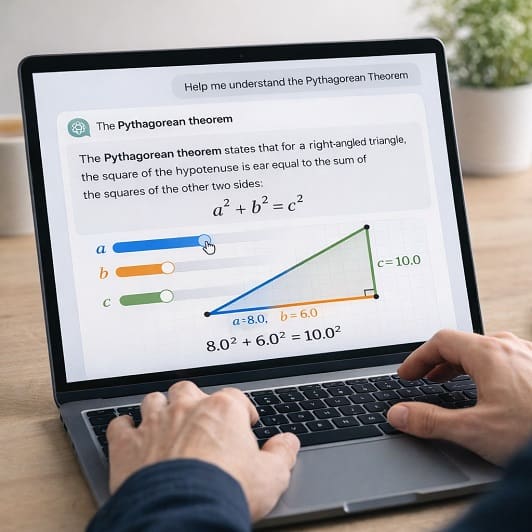
OpenAI has introduced a new feature in ChatGPT that allows users to understand maths and science concepts through interactive visual explanations, turning formulas and equations into dynamic models that can be manipulated in real time.
Why?
This new capability reflects the growing role of ChatGPT as a learning tool rather than simply a conversational AI assistant. According to OpenAI, millions of people already rely on the system to help them understand academic subjects.
As the company explains, “ChatGPT has quickly become one of the most widely used tools for learning. Each week, 140 million people use ChatGPT to help them understand math and science concepts alone.”
Maths and science are areas where many learners struggle with abstract ideas and formulas that can be difficult to visualise. OpenAI says the new feature aims to make these concepts easier to understand by allowing users to interact with them directly rather than simply reading about them.
Turning Equations Into Interactive Experiments
The new feature, called dynamic visual explanations, enables ChatGPT to generate interactive visual modules when users ask questions about certain mathematical or scientific topics.
This means that, instead of receiving only a written explanation or a static diagram, users can adjust numbers and variables and immediately see how the results change. This effectively turns equations into small interactive experiments that learners can explore.
For example, someone asking about the Pythagorean theorem can adjust the lengths of the sides of a triangle and instantly see how the hypotenuse changes. A user exploring compound interest could modify the interest rate or time period and watch the growth curve update in real time.
According to OpenAI, the goal is to help people understand how relationships between variables actually work.
Examples Of What It Can Do
The interactive visuals support more than 70 maths and science topics, including concepts commonly taught at high school and college level.
Among the topics currently available are the Pythagorean theorem, Ohm’s law, Hooke’s law, exponential decay, kinetic energy, Coulomb’s law and compound interest. Geometry topics such as circle area and triangle area are also included.
When users ask ChatGPT about one of these subjects, the system can now provide both a written explanation and an interactive visual model that responds as the user adjusts variables.
OpenAI says the number of supported topics will expand over time as the system evolves.
Why Visual Learning Can Improve Understanding
The idea behind the feature is based on educational research suggesting that visual and interactive learning can improve understanding of complex subjects.
Many mathematical and scientific concepts describe relationships between variables. Seeing those relationships change dynamically can make them easier to grasp.
OpenAI explains that the goal is to move beyond simple explanations and help learners understand how ideas connect. As one educator involved in early feedback on the system noted, “What stands out is how strongly this feature emphasises conceptual understanding. When learning math, understanding why something works and how ideas connect helps concepts stick long term.”
The system has also been designed to encourage users to explore concepts further by adjusting variables and testing different scenarios.
How The Feature Fits Into ChatGPT’s Growing Education Tools
Dynamic visual explanations are actually part of a wider effort by OpenAI to develop ChatGPT as a learning platform.
In recent years, the company has introduced several features designed to support studying and exam preparation. These include Study Mode, which guides users through problems step by step, and quiz tools that allow people to create flashcards and test their knowledge.
OpenAI says the broader aim is to help people explore ideas and build deeper understanding.
As the company explains, “Helping people explore ideas, experiment with concepts, and build deeper understanding is one of the most meaningful ways we can bring the benefits of AI to people everywhere.”
The new visual tools extend that approach by allowing users to experiment directly with the mathematical relationships behind many common formulas.
AI Learning Tools Are Becoming A Competitive Battleground
OpenAI is not the only company exploring interactive learning tools powered by artificial intelligence. Other major AI developers are also introducing visual learning features. Google, for example, recently added interactive diagrams to its Gemini AI system to help explain scientific and mathematical concepts.
These developments really reflect a broader shift in how AI systems are being used in education. For example, rather than simply providing answers to questions, they are increasingly designed to act as interactive learning environments.
At the same time, the growing use of AI in education has sparked debate among teachers and policymakers. Some educators worry that students may become too dependent on AI tools, while others see them as a valuable way to support understanding of difficult subjects.
What Does This Mean For Your Business?
The introduction of interactive learning features in ChatGPT highlights how AI systems are evolving from information tools into platforms that help people understand complex ideas more effectively.
For businesses, this development may have implications for training, professional development and workplace learning. Many organisations already rely on digital tools to help employees develop technical skills in areas such as engineering, finance, data analysis and IT.
Interactive AI systems could make it easier for staff to understand complex concepts by allowing them to manipulate variables and see how formulas and scientific relationships behave in real time, rather than simply reading static explanations.
For organisations responsible for technical training, this could help accelerate learning and make difficult subjects more accessible to employees who may not have strong mathematical or scientific backgrounds.
At the same time, the growing role of AI in learning environments means businesses will need to think carefully about how these tools are used alongside traditional teaching, mentoring and professional guidance.
As AI learning tools continue to develop, they may increasingly become part of how organisations train staff in technical subjects such as mathematics, science, engineering and financial modelling.
Sponsored
Ready to find out more?
Drop us a line today for a free quote!
