
Cate Blanchett Launches Human Consent Registry
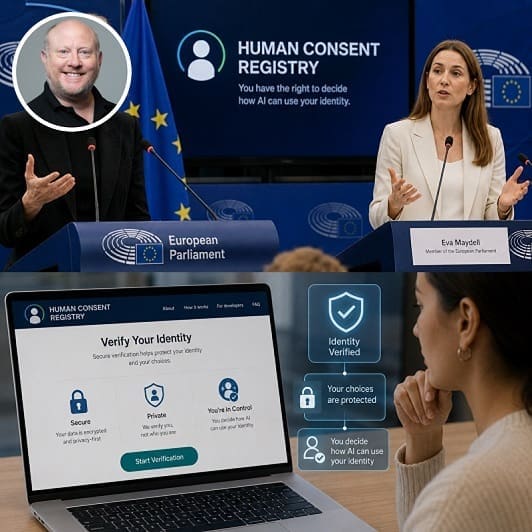
Actor and producer Cate Blanchett has helped launch a free online registry designed to give people a practical way to tell artificial intelligence systems whether they can use their name, face, voice and other personal characteristics, as concerns continue to grow over AI-generated content and digital identity.
What Is The Human Consent Registry?
The new Human Consent Registry has been developed by RSL Media, a non-profit organisation co-founded by Blanchett, and was officially launched at the European Parliament alongside Member of the European Parliament Eva Maydell.
The registry is built around the idea that people should be able to decide how AI systems use their identity, in much the same way they can decide how other forms of intellectual property are licensed.
Announcing the launch at the European Parliament in Brussels, Blanchett said: “Your identity is your IP in the age of AI, and every person deserves the right to decide how AI can or cannot use it.”
Initially, the registry covers identity rights, including a person’s name, image, likeness, voice, movement and other personal characteristics. RSL Media says future versions will also support creative works, fictional characters, brands and trademarks.
How Does It Work?
The system has been designed to be simple enough for anyone to use, regardless of their technical knowledge.
After registering and verifying their identity, users choose one of three permission settings. They can allow AI systems to use their identity, allow it subject to specified conditions, or prohibit its use altogether.
RSL Media compares the approach to a traffic light, where green means permitted, yellow means conditional use and red means prohibited.
Those choices are then converted into machine-readable signals that AI developers and online platforms can check automatically before using someone’s identity.
The aim is to make consent both discoverable and practical at internet scale rather than relying on individual legal agreements or manual permission requests.
Who Is It For?
Although Blanchett’s involvement has attracted considerable attention, the registry is not aimed solely at actors, musicians or other public figures.
Anyone can register free of charge on their own behalf. The system also supports people who work through agents, managers, licensing organisations or other authorised representatives, allowing AI companies to route permission requests through established professional channels.
RSL Media believes this approach could eventually become useful for anyone whose identity might be reproduced, cloned or imitated by AI systems, whether they are a celebrity, a business owner or a private individual.
Why Has It Been Launched Now?
The launch reflects growing concern about the speed at which generative AI is developing.
Advances in AI have made it increasingly easy to generate convincing images, videos and synthetic voices that resemble real people. At the same time, many creators have questioned whether AI developers should be allowed to train their systems using copyrighted material or personal identity without permission.
Blanchett has become one of a growing number of public figures calling for stronger safeguards around AI consent.
Speaking at the launch, she said the Human Consent Registry “gives everyone a voice and a way to take action on AI permissions, helping to preserve and protect trust across the evolving AI landscape.”
The launch at the European Parliament also carries some symbolic significance. For example, the Parliament was responsible for developing and approving the EU AI Act, which places a strong emphasis on transparency, accountability and responsible AI development.
Eva Maydell, a Member of the European Parliament and one of the lead negotiators on the EU AI Act, described the registry as “a tool that makes rights transparent, scales trust, and keeps human creativity at the centre of technological progress.”
What The Registry Cannot Do
The Human Consent Registry is intended to make consent easier to communicate, but it does not automatically prevent AI companies from using someone’s identity.
Its effectiveness ultimately depends on whether AI developers and platform providers choose, or are required, to check the registry before creating or training AI systems.
At present, the registry acts as a publicly available record of an individual’s preferences rather than a legally binding enforcement mechanism.
That said, supporters believe that creating a single, machine-readable source of consent could make it much easier for responsible AI developers to respect people’s wishes while providing policymakers with practical infrastructure that complements emerging AI regulation.
What Does This Mean For Your Business?
For organisations developing or using AI, the Human Consent Registry highlights how questions of consent are becoming increasingly important as AI systems become more capable of generating realistic digital content.
Many businesses already use AI to create marketing material, customer communications, training content and multimedia assets. As these tools improve, organisations will need greater confidence that the names, voices and images they use have been licensed appropriately.
The wider lesson here is that AI governance is expanding beyond data privacy and cyber security into areas such as digital identity, intellectual property and personal consent. Although the Human Consent Registry is still at an early stage, it provides a practical example of how those issues may increasingly be managed through shared technical standards rather than relying solely on legal contracts.
Whether the registry becomes widely adopted remains uncertain. However, the underlying principle is likely to become increasingly difficult to ignore. As AI becomes better at recreating people, the ability for individuals to control how their identity is used may become just as important as controlling how their personal data is collected and stored.
