
Brain Implant Restores Speech To ALS Patient
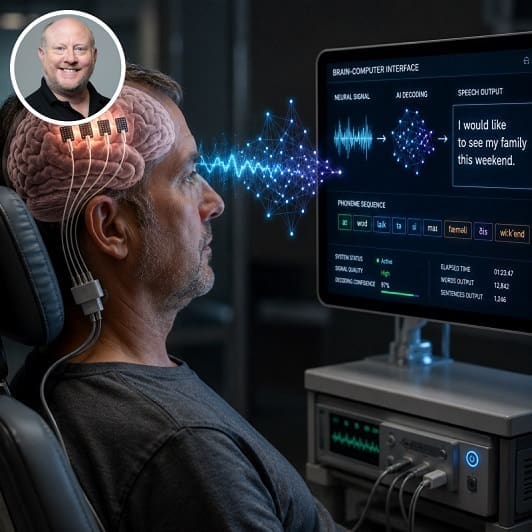
A brain-computer interface developed by researchers at the University of California, Davis, has enabled a man with advanced ALS to communicate with remarkable accuracy, return to full-time employment, and use a computer independently for nearly two years, marking one of the most significant real-world demonstrations of the technology to date.
How The System Works
The breakthrough centres on Casey Harrell, a man living with amyotrophic lateral sclerosis (ALS), a progressive neurological condition that destroys motor neurons and can eventually leave people unable to speak or move.
In 2023, surgeons implanted four microelectrode arrays into the speech motor region of Harrell’s brain. The arrays record neural activity associated with attempted speech, which is then analysed by machine-learning software developed by the UC Davis team.
The system translates those neural signals into phonemes, the basic sounds that make up words, before converting them into complete sentences. The decoded text can then be displayed on screen or spoken aloud using a synthesised version of Harrell’s voice from before ALS affected his speech.
According to the research paper published in Nature Medicine, the system achieved more than 99 per cent word accuracy during formal testing using a vocabulary of 125,000 words. Over nearly two years of real-world use, Harrell communicated more than 183,000 sentences, totalling almost two million words.
Moving Beyond The Laboratory
What makes the achievement particularly significant is that the technology was used independently at home rather than under constant supervision from researchers.
Many previous brain-computer interface studies have demonstrated impressive results in controlled laboratory settings. However, practical day-to-day use has remained a major challenge.
The UC Davis team reported that Harrell used the system for more than 3,800 hours over a 19-month period and operated it without researchers being present. After initial setup by trained care partners, he was able to communicate, browse the internet, send messages, participate in video calls, and control a computer cursor using only neural signals.
The researchers described this as one of the key barriers to real-world adoption that the project has now overcome.
In the paper, they wrote that the results demonstrate “that intracortical BCIs have the potential to support independent use in the home, marking a critical step toward practical assistive technology for people with severe motor impairment.”
Helping Someone Return To Work
The technology’s impact extends beyond technical performance metrics.
Despite being paralysed and unable to speak naturally, Harrell has returned to full-time employment as an environmental advocate while using the system. Researchers reported that he used the brain-computer interface as his primary method of communication, preferring it to previous assistive technologies.
The study states that the system enabled him to maintain “full-time employment” while independently managing professional and personal communications.
Harrell also highlighted the personal benefits of the technology. Speaking through the brain-computer interface, he said: “It is a life that is more full of dynamic action and with friends and family, with colleagues, and it is something that allows me to communicate more in my natural way of communicating than any other technology that I have experienced.”
Why AI Is Central To The Breakthrough
Although brain implants often attract the headlines, the most important innovation may actually be the software.
The hardware used in the project is based on existing microelectrode technology. The major advance comes from the AI-powered decoding system developed by the UC Davis team.
Their software platform, known as BRAND, uses machine-learning algorithms to interpret complex neural signals in real time and convert them into meaningful language. Researchers continually refined the algorithms during the study to improve accuracy, stability, and ease of use.
The research paper notes that the latest transformer-based decoder achieved a state-of-the-art word accuracy rate of 99.2 per cent while requiring little or no daily recalibration.
Important Limitations Remain
Despite the encouraging results, it should be noted here that the technology remains in the experimental stage.
The study involved only a single participant, and researchers acknowledge that it is not yet known how widely the results will apply to other patients with ALS or different neurological conditions.
The system also still relies on external computers, wired connections, and trained carers to connect the equipment each day. Widespread clinical use would require further miniaturisation, regulatory approval, and substantial reductions in cost.
The researchers themselves note that “future work will be needed to evaluate wireless or fully implantable systems, minimise setup time and expand access to users with different clinical profiles.”
What Does This Mean For Your Business?
For most organisations, brain-computer interfaces may seem far removed from everyday business concerns. However, the study provides another example of how AI is increasingly moving beyond software applications and becoming integrated with healthcare, assistive technologies, and human-machine interaction.
The achievement also highlights the growing role of AI in solving complex real-world problems that extend well beyond productivity tools and chatbots. In this case, machine learning is helping restore communication, digital access, and employment opportunities for someone who would otherwise face severe limitations.
The technology remains years away from routine commercial deployment, but the results suggest that brain-computer interfaces are beginning to transition from research projects into practical assistive tools. If future studies can replicate these results at scale, they could significantly improve quality of life for people living with ALS, paralysis, and other severe neurological conditions.
