
Boys Forming Romantic Bonds With AI
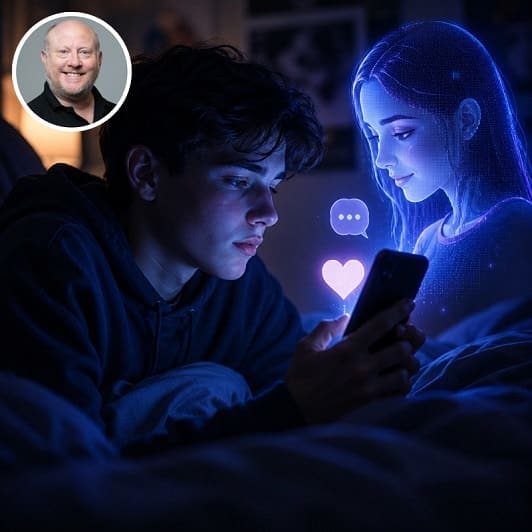
A major UK study has found that some teenage boys are developing romantic and emotionally intimate relationships with AI chatbots, prompting growing concern among researchers, parents and regulators about how these increasingly human-like systems may be shaping young people’s understanding of relationships.
Why Is This Happening?
Artificial intelligence has become remarkably good at conversation. Modern AI companions are designed not simply to answer questions, but to remember previous conversations, display empathy, offer reassurance and build ongoing relationships with users.
While many people use tools such as ChatGPT for work or study, it seems a growing number of teenagers are instead using AI as companions. For example, dedicated services such as Character.AI, Replika and Chai actively encourage extended conversations with virtual personalities, while general-purpose AI systems are increasingly being used in similar ways.
The concern is that these systems are available 24 hours a day, never become impatient, rarely disagree strongly with users and are designed to keep conversations flowing, creating an experience that can sometimes feel more emotionally rewarding than interacting with real people.
AI Relationships Are Becoming More Common
Recent research from Bangor University perhaps offers one of the clearest pictures yet of how widespread AI companionship has become among UK teenagers. Surveying 1,009 AI companion users aged between 13 and 18, the researchers found that almost a third interacted with AI companions on most days, while more than half had confided something important or serious to an AI companion at least once.
Perhaps more strikingly, 56 per cent believed AI companions could “think” or understand them, although 77 per cent did not believe they could genuinely feel emotions. Among younger teenagers, however, 21 per cent believed AI companions could actually feel, suggesting many younger users may struggle to distinguish between simulated empathy and genuine emotional understanding.
The report also found that advice was the biggest reason teenagers used AI companions, followed by entertainment, curiosity and the fact that they were always available. Romance or sexual conversations remained a relatively small motivation, with 6 per cent of younger teenagers and 4 per cent of older teenagers identifying this as a reason for using them.
Why Boys Appear Particularly Vulnerable
Although AI companions are used by both sexes, researchers and psychologists are increasingly expressing concern that adolescent boys may be especially susceptible to developing emotionally dependent relationships with them.
For many teenage boys, AI companions provide something that can sometimes feel difficult to find elsewhere. For example, they offer constant attention, unlimited patience, encouragement without judgement and conversations that adapt to whatever the user wants to discuss. Also, unlike real relationships, there is no fear of rejection, embarrassment or misunderstanding.
Customised Personalities
Many AI companion services also allow users to customise personalities, appearance and behaviour, creating digital companions that appear perfectly matched to individual preferences. Unlike real people, these companions rarely disagree, reject or challenge users, which can reinforce unrealistic expectations about how human relationships work.
Part of the reason these interactions can feel so convincing is that many teenagers attribute human qualities to AI companions. As Professor Andrew McStay, Director of Bangor University’s Emotional AI Lab, said: “Though most teenagers do not believe AI companions can feel, a majority do believe they can think or understand. This distinction matters.” He added that teenagers are “attributing mind-like properties” to AI companions, helping explain why they trust their advice, disclose personal information and sometimes find conversations with them more satisfying than those with friends.
Growing Regulatory And Industry Concerns
It seems that these concerns are no longer simply confined to academic debate. For example, several high-profile legal cases in the United States have focused attention on AI companions after allegations that emotionally vulnerable teenagers formed unhealthy attachments to chatbots. Character.AI has since introduced additional safeguards for younger users and withdrew its services for under-18s in late 2025 following mounting regulatory pressure and legal action, according to the Bangor report.
Regulators are also beginning to take notice. For example, the report highlights growing interest from Ofcom, the US Federal Trade Commission, several US states and the European Union in developing rules specifically covering AI companion services, recognising that they present different challenges from traditional search engines or productivity chatbots.
Importantly, however, the researchers have warned against exaggerating the problem. It should be noted here that two-thirds of teenagers surveyed said AI companions were not affecting their human friendships at all, while around a quarter believed they actually helped them develop more human friendships by improving confidence and social skills. Only 7 per cent felt AI companions were replacing some of their real-world friendships.
What Does This Mean For Your Business?
Although this story focuses largely on teenagers, it highlights a much broader trend that businesses should not ignore. AI is rapidly evolving beyond being simply a productivity tool into technology capable of forming persuasive, emotionally engaging relationships with users.
That creates opportunities in areas such as customer service, coaching, healthcare and education, but it also raises important questions about trust, transparency and ethics whenever AI begins simulating empathy or emotional understanding.
For employers, parents and technology providers, the challenge is likely to be finding the right balance between allowing people to benefit from increasingly capable conversational AI while ensuring users understand that, however convincing these interactions become, they remain carefully designed simulations rather than genuine human relationships. As AI companions become more sophisticated, understanding that distinction may prove just as important as understanding the technology itself.
