
Anthropic Releases AI Once Deemed Too Dangerous
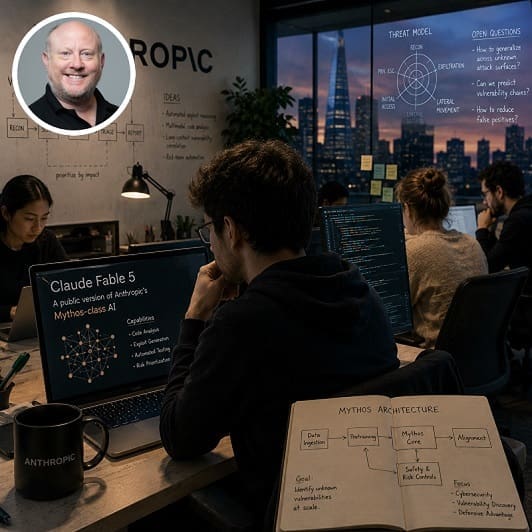
Anthropic has released a public version of the same AI technology that it previously restricted because of concerns about its cyber security capabilities, only for access to be suspended days after an intervention by the US government.
What Is Claude Fable 5?
Claude Fable 5 is a public version of Anthropic’s Mythos-class AI, a highly capable model originally developed for cyber security and vulnerability discovery work.
According to Anthropic, Claude Fable 5 and Claude Mythos 5 are “the same underlying model”, with the main difference being that Fable 5 includes additional safeguards designed to prevent misuse in areas such as cyber security, biology, chemistry, and model extraction. Mythos 5, by contrast, has some of those restrictions removed for approved users.
Anthropic originally developed Mythos-class models as part of Project Glasswing, a programme aimed at helping cyber defenders and critical infrastructure providers identify serious software vulnerabilities before attackers could exploit them.
When the first Mythos model was launched in April, Anthropic limited access to a small group of carefully vetted organisations because it believed the system’s cyber capabilities presented significant risks if made widely available.
Those concerns were not entirely theoretical. According to Anthropic, organisations using Mythos-class models have already identified “more than ten thousand high- or critical-severity vulnerabilities across the most systemically important software in the world”.
Why Anthropic Decided To Release It
Anthropic says it spent several months developing safeguards that would allow Mythos-level capabilities to be released more broadly while reducing the risk of misuse.
The result was Claude Fable 5, which the company described as “a Mythos-class model that we’ve made safe for general use”.
According to Anthropic, Claude Fable 5 delivers capabilities that were previously available only to a small group of approved organisations using Mythos. The company said: “Fable 5’s capabilities exceed those of any model we’ve ever made generally available.”
The model reportedly demonstrates state-of-the-art performance across software engineering, scientific research, vision tasks, analytical reasoning, and long-running autonomous work. Anthropic said it can “work autonomously for longer than any previous Claude models”, enabling it to tackle more complex tasks with less human supervision.
To reduce the risks associated with releasing such a powerful model, Anthropic introduced new safety systems that automatically redirect certain high-risk requests to a less capable model, Claude Opus 4.8.
According to the company, those safeguards were deliberately configured conservatively because “releasing a model this capable comes with risks”.
Suspended
However, just days after launch, Anthropic announced that access to both Fable 5 and Mythos 5 was being suspended.
The company said the US government had issued an export-control directive requiring it to disable access for foreign nationals, whether inside or outside the United States. Anthropic stated that the government believed it had become aware of a method for bypassing, or “jailbreaking”, Fable 5’s safeguards. A jailbreak is a technique designed to trick an AI system into ignoring or circumventing its built-in restrictions.
Challenged By Anthropic
However, Anthropic strongly challenged the significance of the alleged vulnerability. The company said it had reviewed the reported technique and found that it was capable of identifying only “a small number of previously known, minor vulnerabilities”. It also argued that comparable results could already be achieved using other publicly available frontier AI models.
Anthropic further stated: “We disagree that the finding of a narrow potential jailbreak should be cause for recalling a commercial model deployed to hundreds of millions of people.”
The company warned that applying the same standard across the industry could effectively prevent the release of future frontier AI models.
A New Kind Of National Security Debate
The dispute highlights a broader change taking place in how governments are approaching advanced AI. For example, historically, software products were largely regulated after release if problems emerged. Frontier AI models are increasingly being treated differently because of concerns that they may create new risks in areas such as cyber security, biotechnology, critical infrastructure, defence, and intelligence.
Anthropic itself appears to recognise that reality, and the company has repeatedly argued that governments should have the ability to intervene when genuinely dangerous models emerge. However, it also insists that such decisions should be transparent and supported by clear technical evidence.
In its response to the suspension order, Anthropic stated that governments should be able to block unsafe deployments “as part of a statutory process that is transparent, fair, clear, and grounded in technical facts”.
The disagreement therefore appears to be less about whether oversight is needed and more about where the threshold for intervention should sit.
Why This Matters
The release and subsequent suspension of Fable 5 suggests that AI developers are now reaching capability levels where some models may be viewed as strategic assets rather than ordinary software products.
That raises some difficult questions for regulators, governments, technology companies, and investors alike. If advanced AI models can genuinely accelerate vulnerability discovery, scientific research, software development, and other high-value activities, restricting access could slow innovation. However, if those same capabilities can be misused, governments may feel increasing pressure to intervene.
Anthropic appears to believe that tension will become increasingly common as frontier AI systems become more capable. The company has argued that governments should have powers to intervene where genuine risks exist, while also warning that overly broad restrictions could hinder beneficial uses of the technology.
The dispute over Fable 5 therefore highlights a growing challenge facing policymakers: deciding when an AI model should be treated as a normal commercial product and when it should be treated as a potential national security concern.
What Does This Mean For Your Business?
For businesses, the story highlights how rapidly the AI landscape is evolving beyond questions of productivity and automation.
Many organisations are still deciding which AI tools to adopt, yet policymakers are already debating whether some frontier models should be treated as potential national security concerns. That represents a notable change in how AI is viewed by governments.
The wider lesson is that future AI adoption may be influenced not only by technological progress but also by regulation, export controls, safety requirements, and geopolitical considerations. As AI systems become more capable, businesses may find that access to certain models, features, or services depends as much on policy decisions as on technical innovation.
The dispute over Fable 5 may ultimately be remembered as an early example of a much larger challenge: how to make increasingly powerful AI systems broadly available while still managing the risks that come with them.
