
Anthropic Introduces AI Teammate For Slack
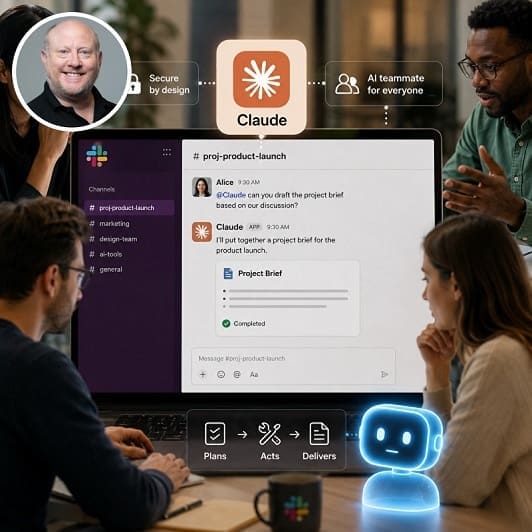
Anthropic has unveiled Claude Tag, a new AI-powered assistant designed to work as a shared digital teammate inside Slack, marking a significant move beyond chatbots that simply answer questions towards AI systems that can collaborate with entire teams and complete work independently.
What Is Claude Tag?
Claude Tag is Anthropic’s latest workplace AI tool, built on its Opus 4.8 model and designed to operate directly within Slack, one of the world’s most widely used business collaboration platforms.
Rather than opening a separate AI chatbot or application, users simply tag “@Claude” within a Slack conversation and assign it a task. Claude then plans how to complete the work, carries it out using the tools and information it has been authorised to access, and posts the finished results back into the conversation.
Anthropic describes it as “the beginning of an evolution of Claude Code”, adding that “tagging @Claude is now one of the main ways we get things done at Anthropic.”
The company says around 65 per cent of its own product team’s code is now created using its internal version of Claude Tag.
How It Works
While using Claude Tag is designed to be simple, it introduces several capabilities that distinguish it from traditional AI assistants.
For example, instead of responding only to one individual, Claude exists as a shared participant within each Slack channel. This means that anyone in that channel can see what it is working on, ask follow-up questions or continue conversations started by colleagues.
Anthropic says this makes interacting with Claude “much more like interacting collaboratively with a teammate” than using a conventional chatbot.
The system is also designed to work asynchronously. In other words, rather than waiting while an AI generates a response, users can delegate work and continue with other tasks while Claude carries out the request, whether that takes minutes, hours or even days.
According to Anthropic, Claude can “schedule tasks for itself, pursuing a project autonomously over hours or days”, allowing teams to hand over longer-running work without constant supervision.
Learning As It Goes
One of Claude Tag’s most significant features seems to be its ability to build context over time.
For example, as it participates in authorised Slack channels, it gradually develops an understanding of projects, terminology and ongoing work. That means users don’t need to explain the same background information every time they ask for assistance.
Where administrators permit it, Claude can also learn from connected business systems and other authorised Slack channels, allowing it to combine information from multiple sources before responding.
Importantly, Anthropic says Claude does not access private Slack channels unless permission has been granted, and memories remain isolated between different business functions.
The company explains that administrators effectively create separate Claude identities for different departments, meaning “a model set up for sales work won’t pass on memories to one set up for engineering; nor will it give engineers access to any sales data or tools.”
Taking A More Active Role
Claude Tag also introduces what Anthropic describes as “ambient” behaviour.
Instead of waiting to be prompted, Claude can proactively notify users about developments it believes may be relevant, highlight unresolved issues, identify stalled discussions or follow up on tasks that have not been completed. Claude Tag is really an example of how AI is becoming more capable of working independently.
Until recently, most AI systems remained passive, responding only when someone asked a question. Increasingly, developers are building AI agents that monitor ongoing work, make decisions about priorities and carry out delegated tasks with much less human intervention.
For Anthropic, Slack is really just the first step. The company says it ultimately wants teams to be able to tag Claude “in the many other places they work”.
Security And Control
Given the amount of potentially sensitive business information involved, Anthropic has placed considerable emphasis on security.
System administrators decide exactly which channels, tools and data Claude can access, while organisations can also set spending limits for AI usage and review detailed logs showing every task the assistant has performed.
That level of oversight is likely to be particularly important as organisations become more comfortable allowing AI systems to work with confidential business information.
More Than Just A Productivity Feature
Claude Tag is more than another workplace productivity feature. Many organisations already use AI to generate text, write software, analyse documents or answer questions. Anthropic’s latest development seems to give us a look at the next stage of enterprise AI may involve organisations treating AI as an active participant in team workflows rather than simply another application employees open when they need assistance.
The distinction may seem subtle, but it has significant implications. Instead of individuals repeatedly consulting AI, teams may increasingly delegate routine work to AI colleagues that understand ongoing projects, remember previous discussions and continue working independently between conversations.
What Does This Mean For Your Business?
For businesses, Claude Tag provides another indication that enterprise AI is moving rapidly beyond standalone chatbots.
Many organisations are still experimenting with AI as a productivity tool. Anthropic’s vision points towards something more ambitious, where AI becomes embedded within everyday collaboration, capable of handling routine tasks, maintaining organisational knowledge and working alongside employees over extended periods.
That has the potential to improve productivity, reduce repetitive work and accelerate decision-making. However, it also raises important questions around governance, access controls, oversight and trust. Organisations will need clear policies governing what information AI can access, what decisions it can make and how its work should be reviewed.
Whether Claude Tag itself becomes widely adopted remains to be seen. However, the broader direction is becoming increasingly clear.
