
AI Beats Nuclear Weapons As Defence Leaders’ Biggest Concern
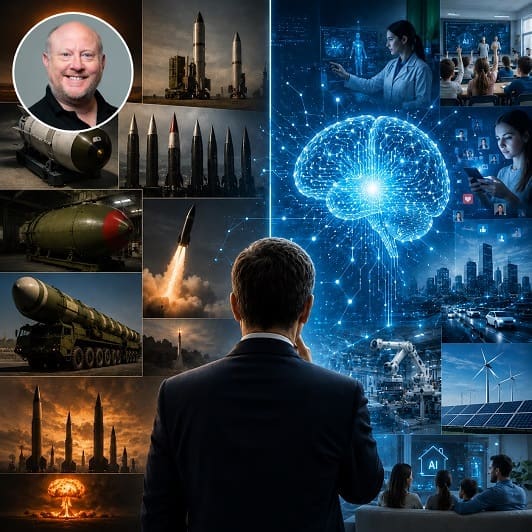
Artificial intelligence emerged as a bigger concern than nuclear weapons during a major strategic stability discussion at the Shangri-La Dialogue in Singapore, as senior military leaders warned that AI is accelerating the speed of conflict beyond the pace of human decision-making.
Why AI Dominated The Discussion
The Shangri-La Dialogue is one of the world’s most important defence and security forums, bringing together defence ministers, military commanders, policymakers, and security experts from across the Indo-Pacific and beyond.
Traditionally, discussions about strategic stability have focused heavily on nuclear deterrence, missile defence, arms control, and the balance of power between major states. This year, however, much of the conversation centred on artificial intelligence and the risks it could introduce into military decision-making.
The concern was not that AI is becoming conscious or uncontrollable. Rather, military leaders repeatedly highlighted the possibility that AI-enabled systems could compress decision-making timelines so dramatically that humans struggle to assess situations properly before responding.
Lieutenant General Nauman Zakria, Commander of 1 Corps and the Army Rocket Force Command of the Pakistan Army, explained the problem through the military concept known as the OODA loop, which stands for Observe, Orient, Decide, and Act.
According to Zakria, AI is compressing that cycle to the point where “a human can’t evaluate the situation fast enough.”
He warned that under such conditions, “People will act irrationally, and the actions will be extreme.”
Why Military Leaders Are So Worried
The concern centres on escalation. For example, for decades, strategic stability has relied on the assumption that leaders have sufficient time to evaluate information, consult advisers, communicate with allies, and consider the consequences of military action.
AI-enabled systems have the potential to analyse data, identify threats, recommend responses, and support operational decisions far faster than human decision-makers can process information themselves.
That speed may offer significant military advantages. However, crucially, it also raises the possibility that misunderstandings, false alarms, technical errors, or incorrect threat assessments could trigger responses before humans have time to intervene.
The faster the decision cycle becomes, the less opportunity there is to question assumptions or prevent mistakes.
Already On The Battlefield
Several speakers stressed that these concerns are no longer theoretical. For example, General Onno Eichelsheim, Chief of Defence of the Netherlands, pointed to the growing use of AI in active conflicts, including Ukrainian efforts to anticipate Russian attacks and coordinate drone operations. The United States has also confirmed using AI tools to support military planning and targeting decisions.
As Eichelsheim put it: “AI is a huge risk in escalation. I think that’s clear.”
At the same time, he acknowledged that military adoption is unlikely to slow, adding: “But I’m not naive. It’ll be used in the domain. It is already being used.”
Those comments reflect a growing reality that military organisations increasingly see AI as a capability they cannot afford to ignore, even while recognising the risks associated with it.
The Pace Is Accelerating
What makes these concerns more pressing is the speed at which military AI capabilities are evolving. Increasingly, AI is being integrated with drones, autonomous systems, and robotics rather than operating solely as a decision-support tool.
For example, US startup Foundation Future Industries, which has Eric Trump as an adviser, recently tested humanoid robots in Ukraine with support from Ukrainian authorities. The company says it hopes to deploy more advanced versions with military forces within the next 12 to 18 months. Although the trials focused on logistics rather than combat, they illustrate how AI, robotics, and military operations are becoming increasingly interconnected.
Taken together, these developments suggest that AI is moving beyond the planning room and becoming a more active part of military operations, raising further questions about human oversight, accountability, and control during conflict.
A Humanitarian Concern
The strongest warning came from Mirjana Spoljaric, President of the International Committee of the Red Cross. While military leaders focused largely on strategic and operational risks, Spoljaric highlighted the humanitarian implications of increasingly automated warfare.
She warned that the growing distance between decision-makers and the battlefield creates new challenges for accountability and civilian protection.
“We don’t know where the trigger is pulled,” she said. “It could be thousands of kilometres away.”
Spoljaric also argued that while AI may eventually offer benefits for civilian protection, current deployments are highlighting more of the risks than the advantages.
Her comments reflect wider concerns among humanitarian organisations that meaningful human control over lethal decisions could become increasingly difficult to maintain as AI capabilities advance.
Nuclear Weapons Have Not Gone Away
It should be noted here, however, that nuclear deterrence remained part of the discussion. Major General Meng Xiangqing of China’s People’s Liberation Army reaffirmed China’s long-standing no-first-use nuclear policy and proposed broader commitments among nuclear powers.
“If we can do so, we can reduce the risk and we can further enhance strategic stability,” he said. However, the fact that AI repeatedly returned to the centre of the discussion was itself notable.
A panel that would traditionally be dominated by nuclear strategy spent much of its time examining how artificial intelligence could reshape military escalation, crisis management, and conflict decision-making.
What Does This Mean For Your Business?
For businesses, the discussion highlights how quickly AI is moving from a productivity and automation tool into an issue of national security, geopolitics, and strategic risk.
Many organisations currently view AI primarily through the lens of efficiency, customer service, software development, or data analysis. Governments and defence planners are increasingly focused on a different question, namely what happens when AI systems begin influencing decisions where mistakes carry serious consequences.
The wider significance is that AI’s impact may ultimately extend far beyond individual applications or business processes. The technology is beginning to affect how countries think about defence, deterrence, crisis management, and international stability.
The message emerging from the Shangri-La Dialogue was not that AI should be stopped. Rather, it was that societies may need to think much more carefully about how much decision-making authority is delegated to systems that can operate faster than humans can fully understand the situations they are responding to.
