
SpaceX IPO Signals A New Phase Of Tech Power And Funding
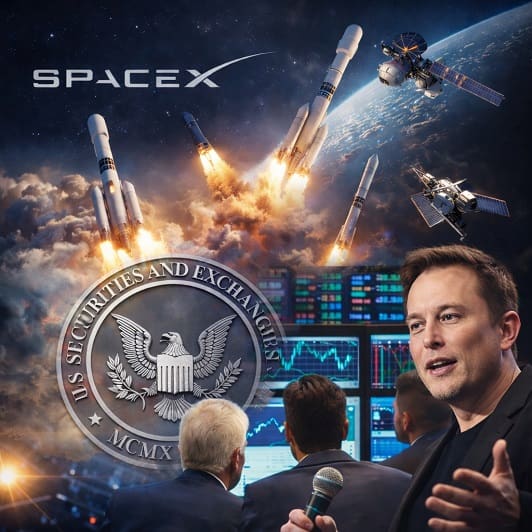
It’s been reported that SpaceX has confidentially filed for what could be the largest IPO in history, with the timing and structure of the move suggesting this may be as much about funding pressure and strategic consolidation as it is about market opportunity.
What Has Been Reported?
Multiple sources (including Bloomberg and Reuters) have reported that Elon Musk’s SpaceX company has submitted draft IPO paperwork to the US Securities and Exchange Commission, with plans to raise between $40 billion and $75 billion. An IPO is when a company sells shares to the public for the first time to raise investment, effectively becoming a publicly listed company, similar to a plc in the UK.
Becoming One Of The Most Valuable Companies In The World
At the upper end, this would comfortably exceed Saudi Aramco’s record $29 billion listing and could value SpaceX at up to $1.75 trillion. That would place it among the most valuable companies in the world at the point of listing.
Confidential Filing
It’s been reported that the filing was made confidentially. This is actually quite a common approach that allows companies to receive regulatory feedback before publicly disclosing financial details. A listing could follow as early as June, depending on market conditions.
Why Is SpaceX Going Public Now?
For years, Elon Musk had suggested SpaceX would remain private until its long-term goals, particularly around Mars, were further advanced. That position now appears to have changed, and the most likely reason is financial rather than philosophical.
SpaceX is no longer just a launch provider. It is now a capital-intensive technology platform spanning satellite internet, heavy-lift rocketry, defence contracts, and artificial intelligence. That means each of these areas requires sustained, large-scale investment.
Starship development alone is expected to cost billions, while Starlink requires constant satellite replacement and expansion. On top of this, the integration of Musk’s AI company xAI introduces a further layer of cost, particularly given the expense of compute, data centres, and energy required to train and run large models.
As some analysts have noted, public markets offer access to capital at a scale private funding cannot easily match, which is likely to be what SpaceX needs to cover the huge costs of tech, infrastructure, and energy needed to scale up.
The Business Behind The Valuation
The strongest commercial foundation for the IPO is Starlink, which has become the most financially successful part of the business. Reports suggest it generated over $10 billion in revenue in 2025 with strong margins, driven by rapid global subscriber growth.
This matters because it provides a predictable, recurring revenue stream that investors can understand and value. In effect, Starlink transforms SpaceX from a project-driven aerospace company into something closer to a telecoms and infrastructure provider.
However, the business itself is becoming more complex. The recent merger with xAI, alongside the integration of the X platform, means SpaceX now operates across communications, AI, defence, and media, rather than being focused purely on space and satellites.
While this may strengthen the long-term strategic story, it also makes valuation more difficult. Some analysts have suggested the merger allows less mature or loss-making parts of the business to be supported by Starlink’s cash flow ahead of the IPO.
Governance And Market Scrutiny
Going public will bring a level of scrutiny that SpaceX has largely avoided as a private company. Quarterly reporting, audited financials, and shareholder accountability will become standard.
Conflicts Of Interest?
There are also broader governance questions. For example, the combination of multiple Musk-controlled companies into a single entity, along with his significant personal stake, raises some familiar concerns around decision-making and possible conflicts of interest.
These concerns are amplified by SpaceX’s role in government infrastructure. For example, the company holds major contracts with NASA and the US Department of Defense, and its Starlink network has become critical communications infrastructure in certain geopolitical situations.
The overlap between private commercial activity and public sector dependency is not new, but at this scale it becomes more visible and more relevant to investors.
Why The Structure Of The IPO Matters
One unusual reported feature is the intention to allocate a larger than normal proportion of shares to retail investors.
If confirmed, this would broaden access to the offering but may also create a shareholder base that is more aligned with Musk’s long-term vision and less focused on short-term governance challenges.
This approach echoes earlier tech IPOs that sought to balance institutional control with wider participation, though it can also reduce pressure from activist investors.
What Does This Mean For Your Business?
For UK businesses, the SpaceX IPO is less about space exploration and more about how modern infrastructure is being built and funded.
The company sits at the intersection of connectivity, defence, and AI, all areas that increasingly underpin day-to-day business operations. Its move to public markets reflects the scale of investment now required to compete in these sectors.
It also highlights a broader trend. The most influential technology platforms are no longer narrow products or services. They are integrated systems combining data, infrastructure, and intelligence, often across multiple industries.
From a risk and strategy perspective, this creates both opportunity and dependency. Businesses benefit from faster innovation and more capable platforms, but they also become more reliant on a smaller number of providers whose decisions are shaped by capital markets as much as technology.
There is also a lesson around scrutiny here. As companies grow in scale and importance, transparency becomes unavoidable. The shift from private to public ownership brings greater visibility, but also greater accountability.
In simple terms, this IPO is not just a milestone for SpaceX. It is a signal that the next phase of technology competition will be defined by access to capital, control of infrastructure, and the ability to operate at global scale.
Sponsored
Ready to find out more?
Drop us a line today for a free quote!
