
SpaceX Focus Shifts To Moon City
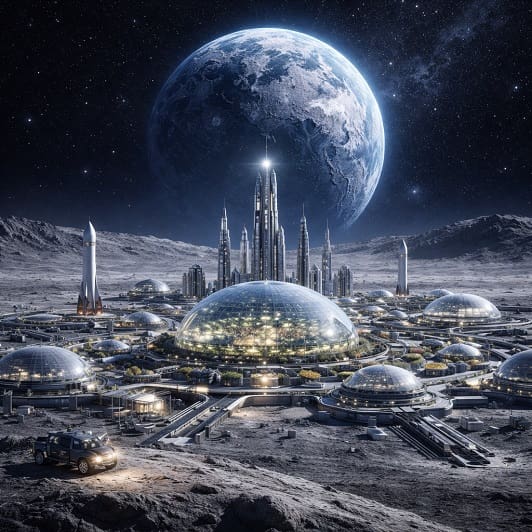
SpaceX is now prioritising plans to build what Elon Musk describes as a “self-growing city” on the Moon, placing it ahead of its long-stated ambition to establish a settlement on Mars.
A Public Reordering Of Priorities
Elon Musk announced on X that SpaceX is focusing first on the Moon rather than Mars. He wrote: “For those unaware, SpaceX has already shifted focus to building a self-growing city on the Moon, as we can potentially achieve that in less than 10 years, whereas Mars would take 20+ years.”
He added: “The mission of SpaceX remains the same: extend consciousness and life as we know it to the stars.”
It Was Always Mars
For most of its 24-year history, SpaceX has presented Mars as its primary long-term destination. The new position does not abandon that objective, but does seem to change the order of SpaceX’s priorities. For example, in the same series of posts, Musk said SpaceX would “also strive to build a Mars city and begin doing so in about 5 to 7 years, but the overriding priority is securing the future of civilisation and the Moon is faster.”
Why The Moon First?
Musk’s reasoning seems to centre on orbital mechanics and launch frequency. For example, travel to Mars depends on favourable alignment between Earth and Mars, which occurs approximately every 26 months. The journey itself takes around six months using current propulsion technology.
By contrast, missions to the Moon can launch roughly every 10 days, with a transit time of about two days. As highlighted by Musk: “It is only possible to travel to Mars when the planets align every 26 months (six month trip time), whereas we can launch to the Moon every 10 days (2 day trip time). This means we can iterate much faster to complete a Moon city than a Mars city.”
This reference to iteration appears to relate to repeated testing and incremental development, which is an approach that SpaceX has used extensively in the development of its reusable rockets, particularly the Starship vehicle. Also, a closer destination allows more frequent missions, which in theory could enable faster engineering feedback and adjustment.
What Is Meant By A “Self Growing City”?
Musk has not published detailed technical plans for a lunar settlement, however the phrase “self-growing city” implies a base that can expand using local resources rather than relying entirely on supplies from Earth. This approach, which is not a new idea, is commonly described as in situ resource utilisation, meaning the extraction and processing of materials found on the Moon itself.
For example, lunar regolith, the powdery layer of dust and fragmented rock covering the surface, could potentially be used for construction. Water ice has also been identified in permanently shadowed craters near the lunar poles and could be processed into drinking water, breathable oxygen and rocket propellant. Developing such capabilities would be essential for long-term habitation.
The Law
It should also be noted here that international law provides part of the framework for these ambitions. For example, the 1967 Outer Space Treaty prohibits any nation from claiming sovereignty over the Moon. However, the United States Commercial Space Launch Competitiveness Act of 2015 allows American companies to own and sell resources they extract from celestial bodies. The interpretation of these rules remains a subject of debate among spacefaring nations.
The Commercial And Strategic Context
The renewed emphasis on the Moon comes during a period of wider corporate change across Musk’s businesses. For example, SpaceX recently completed the acquisition of xAI, the artificial intelligence company also led by Musk, in a transaction that valued SpaceX at around one trillion dollars and xAI at 250 billion dollars, according to public reporting.
Musk has linked space infrastructure to artificial intelligence development, arguing that large-scale computing capacity will be critical in future competition. In separate public remarks, he has suggested that space-based data centres could form part of that strategy, although detailed plans have not been formally published.
SpaceX’s revenue base is also evolving. For example, Musk wrote on X that NASA will constitute less than 5 per cent of SpaceX revenue this year, adding: “Vast majority of SpaceX revenue is the commercial Starlink system.” Starlink operates thousands of satellites in low Earth orbit and provides broadband services globally.
Reports also indicate that SpaceX may be preparing for a potential public offering later in 2026. Publicly emphasising a nearer-term lunar objective may be viewed as more achievable within a defined timeframe than a multi-decade Mars programme, although no official IPO prospectus has yet been released.
NASA, Artemis And International Competition
SpaceX remains a central contractor in NASA’s Artemis programme, which aims to return astronauts to the lunar surface for the first time since Apollo 17 in 1972. Under a contract valued at approximately 4 billion dollars, SpaceX is developing a lunar lander version of its Starship rocket to transport astronauts from lunar orbit to the surface.
Public reporting has indicated that SpaceX is targeting March 2027 for an uncrewed lunar landing. Such a mission would represent a step towards sustained operations on the Moon.
Competition From China
The United States faces growing competition in lunar exploration, mainly from China, which has outlined plans for crewed lunar missions in the 2030s and is working with Russia on proposals for a joint lunar research station. The renewed focus on the Moon, therefore, seems to sit within a broader geopolitical context involving technological leadership and strategic positioning.
The Change In Tone On Mars
The new emphasis on the Moon contrasts with Musk’s earlier public comments. For example, as recently as January last year, he wrote on X in response to discussion about lunar missions: “No, we’re going straight to Mars. The Moon is a distraction.”
The current position reverses that assessment, with the Moon now being described as the faster route to securing humanity’s long-term future beyond Earth, while Mars remains a longer-term objective.
Technical And Financial Uncertainties
Establishing a permanent human presence on the Moon would require solutions to multiple, complex engineering challenges. For example, the lunar surface experiences extreme temperature variation, ranging from approximately minus 170 degrees Celsius at night to more than 120 degrees Celsius during the day. There is no atmosphere to shield inhabitants from radiation or micrometeoroids, and life support systems would need to operate reliably in a vacuum environment.
Energy supply presents another very important issue. Solar power is available during the roughly 14-day lunar daylight period, however it is absent during the equally long night. Nuclear power systems are being studied by space agencies as a possible alternative for continuous energy generation.
Transport capacity would depend heavily on the continued development of Starship, which is designed to carry large payloads to orbit and beyond. As of early 2026, Starship remains in active testing, with multiple integrated flight tests conducted but not yet a fully routine operational cadence.
Financial requirements have not been publicly detailed. However, previous discussions about interplanetary settlement have implied very large launch numbers and sustained investment over many years. Musk’s stated timeframe of under 10 years for a lunar city, which seems quite soon given the challenges, may reflect more of an aspirational target rather than a confirmed programme schedule.
What Does This Mean For Your Business?
What this really represents is a change in sequence rather than a change in mission. Mars remains the long-term objective, however the Moon is now being presented as the faster and more practical proving ground. Shorter journeys and more frequent launch windows could allow quicker testing of habitats, power systems and resource extraction technologies, provided the engineering and funding challenges can be overcome.
For SpaceX, the credibility of this strategy will depend on delivery. Progress with Starship, the planned uncrewed lunar landing in 2027 and tangible advances in life support and in situ resource systems will matter more than stated timelines. Investors, regulators and NASA will be watching closely, particularly in light of any future public offering.
For UK businesses, especially those in aerospace, satellite services and advanced manufacturing, a faster-paced lunar programme could create supply chain and partnership opportunities. That said, legal, geopolitical and financial uncertainties remain significant. Whether the Moon becomes a stepping stone to Mars or a longer-term focal point will ultimately be determined by technical results rather than ambition.
Sponsored
Ready to find out more?
Drop us a line today for a free quote!
