
Scientists Build Synthetic Cell With Complete Life Cycle
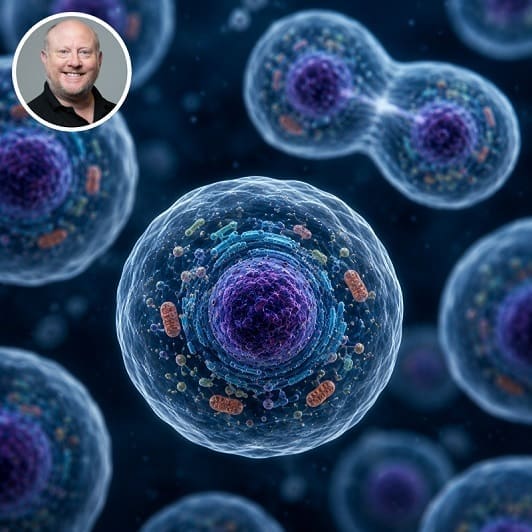
Scientists have created a synthetic cell capable of feeding, growing, copying its genome, dividing and competing across generations, marking an important step towards a future where biology could be engineered from the ground up rather than simply modifying existing life.
What Is SpudCell?
The new system, called SpudCell, was developed by researchers led by Professor Kate Adamala at the University of Minnesota.
Unlike natural cells that have been genetically modified, or minimal cells created by removing genes from existing organisms, SpudCell was essentially made from scratch using individually specified components.
The system basically consists of a fatty membrane containing DNA and the molecular machinery needed to read that DNA and make proteins. Its genome contains around 90,000 base pairs distributed across separate DNA molecules, while its protein-making system uses 36 purified enzymes together with ribosomes.
The really important breakthrough is that all these components have been brought together into a single system capable of completing the main stages of a cell cycle.
As Biotic, the public-benefit organisation launched alongside the research, explains: “SpudCell feeds and grows. SpudCell copies its genome and divides. Each of these steps is written into its own DNA.”
What Makes This Discovery So Special?
Scientists have previously demonstrated individual parts of synthetic cell behaviour. Some experiments have even copied DNA inside artificial membranes, while others have shown ways of growing or dividing synthetic cell-like structures.
SpudCell is significant because it brings feeding, growth, genome replication, division and selection together in one defined chemical system.
This is also fundamentally different from previous attempts to create minimal cells by starting with a natural organism and removing genes until reaching the smallest viable genome.
Even extremely simple natural cells contain biological machinery that scientists don’t fully understand. SpudCell takes the opposite approach because researchers know what has been deliberately placed inside it and can change individual components to study what happens.
Biotic describes the importance of this distinction by saying: “A system we can fully specify is a system we can understand and change.”
How Does A Synthetic Cell Feed?
One of the biggest challenges in building a synthetic cell is providing it with everything it needs to grow.
Natural cells use complex metabolic processes to create and process nutrients. Recreating all of that machinery would require many more genes and considerably greater complexity.
SpudCell, however, uses a simpler approach. Researchers provide tiny feeder packages containing materials including lipids for membrane growth, ribosomes, enzymes and other molecules. A protein produced according to instructions in SpudCell’s own DNA allows the cell to connect and fuse with these feeders.
This means the genome influences whether the cell can feed, how quickly it grows and how large it becomes.
The approach allows SpudCell to perform a complete cycle using a much smaller genome than would be required if researchers attempted to recreate the full metabolism of a natural cell.
Dividing Without A Cellular Skeleton
Another major challenge for the researchers was finding a way for the synthetic cells to divide without recreating the complex internal structures that natural cells often use to organise and control the process.
Natural cells frequently rely on an internal structure called a cytoskeleton to help coordinate division, but rebuilding this from scratch would be extremely difficult because it requires numerous proteins to work together correctly.
SpudCell avoids that complexity by producing proteins that accumulate on its membrane, creating mechanical stress until the membrane divides. Importantly, this process connects the cell’s genetic instructions directly with its reproductive success because cells that produce more of the relevant protein can grow and divide more effectively.
Researchers demonstrated this by introducing a genetic change that increased production of a growth-related protein, causing the altered cells to grow faster, produce more descendants and, after five generations, outcompete the original version. The advantage became even greater when nutrients were scarce, showing how genetic differences could influence which synthetic cells were most successful.
Biotic says this demonstrates “selection, running in a system that was built, not born, assembled from defined parts rather than carved down from something already alive.”
Is SpudCell Actually Alive?
This is where the story requires some caution. The researchers do not claim to have created life, and the work is currently available as a preprint while peer review is under way.
SpudCell performs several behaviours associated with living things, but it can’t actually sustain itself independently. For example, it must be regularly supplied with feeder material, cannot make its own ribosomes and depends on carefully controlled laboratory conditions.
Its genome is also not reliably inherited in full by every daughter cell, meaning the system still faces significant engineering challenges before it could become genuinely self-sustaining.
Biotic puts the distinction clearly, saying: “SpudCell was constructed, not created, and its makers do not claim to have built life.”
The immediate scientific importance really lies less in deciding whether SpudCell is alive and more in what researchers can learn from a biological system whose components are known and can be deliberately modified.
What Could Synthetic Cells Be Used For?
The long-term possibilities are considerable, although many remain some way from practical use.
Living cells already manufacture medicines, foods, fuels and industrial chemicals. However, biotechnology generally works by modifying organisms produced by evolution, meaning scientists must work within biological systems they do not completely understand.
Building cells from defined components could eventually allow scientists to design biological systems specifically for particular tasks.
Biotic believes future synthetic cells could potentially manufacture novel medicines and materials, produce fuels and foods, or help remove carbon and pollutants from the environment.
The organisation argues that the wider goal is to turn synthetic cell research into an engineering discipline built around shared components, standardised methods and reproducible designs.
Why The Research Is Being Shared Openly
The launch of SpudCell is closely connected with the creation of Biotic, a US-based non-profit research organisation founded in Minneapolis, Minnesota, to develop open infrastructure for synthetic cell engineering.
Its founders argue that researchers currently spend too much time independently solving similar problems, while valuable methods and failed experiments are not always shared between laboratories.
Biotic plans to make protocols, genome sequences, reference designs, data and computational tools openly available so that different research teams can build on the same foundations.
As the organisation explains: “The foundations for engineering biology should be built in the open and belong to everyone.”
What Does This Mean For Your Business?
For most businesses, synthetic cells will not have an immediate practical impact. However, the longer-term implications could be significant for pharmaceuticals, manufacturing, materials science, energy, food production and environmental technology.
The important development is really the gradual transformation of biology into something that can be engineered more predictably. If researchers eventually create dependable cellular platforms whose individual components can be understood, replaced and redesigned, biological manufacturing could become far more flexible.
SpudCell remains an early prototype with important limitations, and there is a considerable gap between a laboratory demonstration and a commercially useful synthetic cell.
However, the research provides a glimpse of what could eventually become a new form of industrial technology. Just as software developers build applications using shared platforms and standard components, future biotechnology companies may be able to design cells for particular jobs using biological systems that have been engineered from first principles.
SpudCell is not artificial life in the science-fiction sense, but it is an important demonstration that some of life’s most fundamental processes can be assembled into a defined, controllable system. That could prove to be an important step towards making biology not only something scientists study and modify, but something they can increasingly design and engineer.
