
Musk’s IPO – The World’s First Trillionaire?
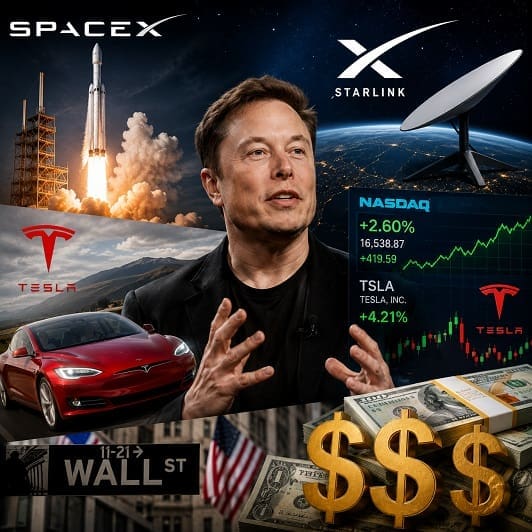
Elon Musk’s planned SpaceX stock market flotation could make him the world’s first trillionaire, highlighting how investors are increasingly placing enormous value on companies that combine AI, communications infrastructure, space technology and long-term strategic ambition.
Why Musk Is Closing In On A Trillion Dollars
Elon Musk is already the richest person on the planet, thanks largely to his holdings in Tesla, SpaceX and other ventures.
Now, SpaceX has filed for what could become the largest initial public offering (IPO) in Wall Street history. Reports suggest the company could seek a valuation of between $1.25 trillion and $1.75 trillion when it begins trading under the ticker SPCX, potentially creating one of the most significant technology listings ever seen.
Musk is expected to retain a controlling stake in the business, meaning that a successful flotation could dramatically increase the value of his existing shareholding. Depending on the final valuation and how investors respond, his SpaceX stake alone could be worth hundreds of billions of dollars, pushing his total net worth beyond the $1 trillion mark for the first time. However, the prospect of creating the world’s first trillionaire is only part of the story.
Why Investors Are Valuing SpaceX So Highly
At first glance, some of the numbers appear difficult to reconcile with the company’s valuation. SpaceX generated approximately $18.6 billion in revenue last year but also reported losses running into billions of dollars as it continued investing heavily in rocket development, satellite deployment, AI infrastructure and long-term research projects.
Traditionally, public markets have rewarded companies that delivered consistent profits and predictable earnings growth. However, it seems that today’s technology markets increasingly reward something different, such as ownership of strategic platforms that could dominate entire industries for decades to come.
That may help explain why many investors view SpaceX differently from a conventional aerospace company. The business launches rockets, operates the world’s largest satellite internet network through Starlink, owns AI assets through xAI, and controls communications infrastructure that reaches large parts of the globe. Taken together, these activities position SpaceX at the intersection of several major technology markets rather than a single industry sector.
In fact, for many investors, the company increasingly resembles a future technology platform rather than a traditional aerospace manufacturer.
Starlink Has Become A Major Business
One of the most important drivers behind SpaceX’s valuation is the growth of Starlink.
What began as an ambitious satellite broadband project has developed into a substantial global communications business serving more than 10 million customers worldwide. Its network of thousands of low Earth orbit satellites provides internet access across vast areas where traditional broadband infrastructure is difficult, expensive or commercially unattractive to build.
Unlike rocket launches, which tend to be project-based and irregular, Starlink generates recurring subscription revenue every month. Investors typically place a premium on businesses with predictable and repeatable income streams because they provide greater visibility over future performance.
Recent price increases across several Starlink consumer packages also suggest that demand remains strong, even as SpaceX continues investing heavily in expanding network capacity and improving services.
AI Is Becoming Part Of The SpaceX Story
The proposed IPO also reflects a significant change in the structure of Musk’s business empire.
SpaceX now owns xAI, Musk’s artificial intelligence company, which develops the Grok chatbot and a growing portfolio of AI technologies. As a result, investors are no longer being asked to back only a space company or communications provider. They are also gaining exposure to one of the fastest-growing and most heavily funded sectors in the global economy.
This matters because AI infrastructure is becoming one of the most valuable assets in technology. Major competitors, including OpenAI, Anthropic, Google and Meta, are investing enormous sums to secure computing power, data centre capacity and AI capabilities.
SpaceX has already announced major agreements linked to AI infrastructure, while the integration of xAI gives the company a direct stake in the rapidly expanding market for generative AI. Taken together, these developments suggest the next major battle for investor capital could centre on AI infrastructure companies rather than traditional software firms.
The AI Giants Are Also Eyeing Wall Street
The timing of the SpaceX flotation is particularly notable because several of the world’s most valuable AI companies are also exploring public market listings. For example, reports suggest OpenAI is preparing a confidential IPO filing with advisers Goldman Sachs and Morgan Stanley, potentially paving the way for a stock market debut as early as September at a valuation that could exceed $1 trillion.
The move has reportedly altered expectations around which AI company will reach public markets first, with prediction markets now favouring OpenAI ahead of Anthropic. If both companies ultimately proceed with listings, investors could soon find themselves choosing between some of the biggest AI and technology flotations in history, with SpaceX, OpenAI and Anthropic collectively representing several trillion dollars of potential market value.
The Risks Have Not Disappeared
All that said, none of this means SpaceX is a risk-free investment. For example, it cannot be ignored that the company remains heavily loss-making, carries substantial debt, and continues to spend vast sums on rocket development, AI infrastructure, satellite deployment and future projects that may take years to generate meaningful returns.
Many of its most ambitious objectives, including plans linked to Mars colonisation, remain years or even decades away from commercial reality. The IPO filing also highlighted a range of legal disputes, including intellectual property claims, regulatory issues and concerns surrounding AI-generated content.
There is also the question of governance. Musk is expected to retain overwhelming control of the company after the flotation, limiting the influence of outside shareholders. Supporters argue this allows SpaceX to pursue long-term innovation without being constrained by short-term market expectations, while critics believe it concentrates too much power in the hands of a single individual.
What Happens Next?
The flotation is expected to attract enormous investor interest. SpaceX has become one of the most closely watched private companies in the world, and many investors have spent years waiting for an opportunity to buy shares in the business.
The outcome could have implications far beyond Musk’s personal wealth. A successful listing would help establish a new benchmark for how public markets value companies that combine AI, communications networks, advanced manufacturing and critical infrastructure within a single organisation.
It could also arrive at a time when several of the world’s most valuable private technology firms are considering public listings. OpenAI is reportedly preparing for an IPO of its own, while Anthropic has also been linked with flotation plans, creating what may become one of the most significant periods of technology fundraising in modern market history.
What Does This Mean For Your Business?
The SpaceX story is not really about rockets, nor is it solely about Elon Musk becoming a trillionaire.
Instead, it offers a glimpse into how investors increasingly define value in the modern economy. Companies that own infrastructure, control data flows, generate recurring revenue and position themselves at the centre of major technological trends such as AI and connectivity are attracting unprecedented levels of attention and investment.
Whether SpaceX ultimately justifies its valuation remains to be seen. What is already clear, however, is that investors are increasingly willing to back businesses that promise to shape the future rather than simply participate in existing markets. As AI, communications and digital infrastructure become more tightly connected, the companies that control those foundations may become some of the most influential businesses of the next decade.
