
Hotels on the Moon by the Early 2030s
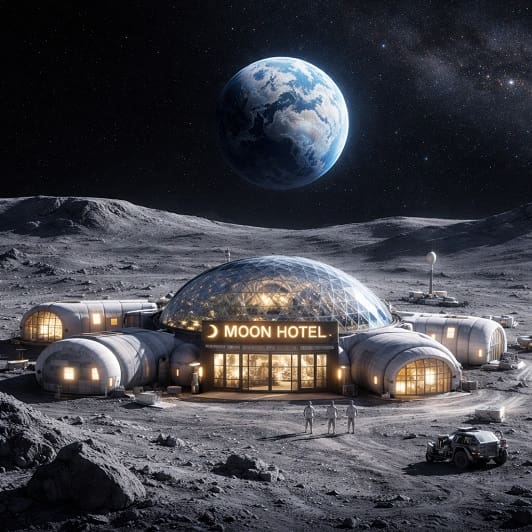
A US startup claims the first hotel on the Moon could be deployed by the early 2030s, as space agencies return to lunar missions and private companies search for commercially viable ways to support long-term human presence beyond Earth.
Who Is GRU?
The proposal comes from Galactic Resource Utilization Space, better known as GRU Space, a US startup founded in 2025 by Skyler Chan, a former University of California, Berkeley graduate with a background in space systems and off-world habitation research. Chan has previously spoken publicly about his interest in lunar and Martian settlement while studying engineering and space technology.
GRU has attracted early backing from investors linked to the US space and defence ecosystem, including individuals who have invested in SpaceX and Anduril, and has been supported by startup programmes such as Y Combinator and Nvidia’s Inception initiative for technology startups. The company positions itself as a space infrastructure business rather than a tourism brand.
GRU argues that human expansion beyond Earth has not stalled because of launch capability, but because of the lack of scalable, safe habitation systems once astronauts arrive on the lunar surface. In its January 2026 white paper, the company states that “humans cannot expand beyond Earth until we solve off-world surface habitation”, describing this as the critical step that enables everything else, from research bases to industrial activity.
A Commercial Prospect
The lunar hotel is presented as a commercial starting point rather than a novelty. For example, GRU says revenue-generating habitation could help fund and validate the technologies required for permanent lunar infrastructure, including life support systems, surface construction methods, and long-duration operations away from Earth.
While the idea may sound pretty futuristic, GRU argues it is actually rooted in current lunar exploration plans, emerging habitat technologies, and a belief that off-world living space, not rockets, is now the main limiting factor.
Why Now?
The timing of GRU’s proposal aligns closely with renewed US government activity around the Moon. For example, NASA’s Artemis programme is preparing to fly its first crewed lunar mission in more than 50 years, with Artemis II expected to carry four astronauts on a ten-day journey around the Moon and back to Earth in early 2026.
Artemis III, which aims to land astronauts near the Moon’s south pole, is currently planned for no earlier than 2027 or 2028. Together, these missions signal a long-term commitment to lunar operations, rather than short symbolic visits.
GRU argues that once regular crewed missions resume, the next question becomes where people stay, work, and shelter on the lunar surface. The company, therefore, believes that a destination built specifically for human habitation, rather than temporary lander modules, is a necessary next step.
How Could a Moon Hotel Be Built?
GRU’s plan relies on a staged approach designed to reduce technical and financial risk. For example, rather than attempting large-scale construction immediately, the company proposes testing smaller systems before deploying a full hotel.
The first mission, planned for 2029, would deliver a small pressurised test payload to the Moon using a commercial lunar payload service provider. This mission would test inflatable habitat deployment and early construction experiments using lunar regolith, the fine dust and rock that covers the Moon’s surface.
A second mission, targeted for 2031, would then deliver a larger payload near a lunar pit or cave. GRU argues that these natural features offer shielding from radiation, micrometeoroids, and extreme temperature swings. An inflatable habitat would be deployed inside or near the pit, alongside more advanced construction trials.
The third mission, planned for 2032, is when GRU says the first hotel would be landed. This version would be built on Earth, transported by a heavy lander, and robotically deployed on the lunar surface before being inflated to create a pressurised living environment.
Why Inflatable Habitats Matter
A central part of GRU’s approach is the use of inflatable structures. This is because traditional rigid modules are heavy and expensive to transport, whereas inflatables can offer far more internal volume per kilogram of launch mass.
GRU has pointed to earlier inflatable habitat demonstrations in orbit as evidence that the technology is viable. The company argues that inflatables are the most practical way to maximise living space during the early stages of lunar settlement, before large-scale construction becomes possible.
Once deployed, these inflatable habitats would be partially enclosed or shielded using locally sourced material. GRU proposes using geopolymer techniques to bind lunar regolith into protective structures around the habitat, reducing radiation exposure and impact risk.
What Happens If a Lunar Hotel Deflates?
Inflatable lunar habitats are built with multiple layers and internal compartments, not as a single pressurised shell. Therefore, it seems that GRU may be banking on the fact that a small puncture would cause a slow pressure leak rather than sudden collapse, giving time for systems to respond.
It is likely that pressure sensors in the structure could detect the leak immediately and onboard life support systems could release stored gas to stabilise conditions, while the affected area could be sealed off internally. The air used to maintain pressure could come from onboard reserves and oxygen generation systems, not from outside the habitat, i.e., the vacuum of space.
Over time, the intention is likely to be to enclose or shield parts of the inflatable structure using lunar material, which could reduce exposure to micrometeoroids and temperature extremes. Even so, any loss of pressure would still be a serious safety issue, with designs assuming faults can occur and focusing on containment, redundancy, and time to respond rather than eliminating risk entirely.
How Could The Hotel Support Healthy Human Life?
The proposed hotel is designed primarily as a life support system rather than a conventional hospitality venue. For example, GRU states that the initial hotel would include a full environmental control and life support system, covering oxygen generation, carbon dioxide removal, water recycling, temperature regulation, and air filtration.
Emergency systems would also be required. These include protection against solar radiation storms, rapid depressurisation response, and contingency plans for evacuation or sheltering in place.
GRU says the hotel would be designed for multi-day stays, with guests able to observe the lunar surface and Earth from within the habitat, and to participate in surface activities under controlled conditions.
Who Would Stay There, and Would You Have to Be Rich?
It seems that, in the near term, access to any lunar hotel would certainly be limited to a very small and extremely wealthy group of travellers. GRU openly acknowledges that early stays on the Moon would be accessible only to the ultra-wealthy, drawing comparisons with the early days of commercial aviation and high-altitude mountaineering, when costs were prohibitive before wider scale and improved technology gradually brought prices down.
The white paper models a first-generation hotel capable of hosting four guests at a time, with five-night stays and an operational life of ten years. GRU estimates an internal cost per person per night of over $400,000 for this version, falling significantly only once larger, more permanent structures are built using lunar materials.
Could Cost Several Million Pounds To Say There!
Public ticket prices would likely exceed internal costs, meaning early visitors would need to commit several million pounds for a single trip. This mirrors the first wave of commercial space tourism, where privately funded rocket flights operated by Blue Origin carried high-profile passengers, including the company’s founder Jeff Bezos, at prices far beyond the reach of most people. GRU argues that lunar travel could follow a similar trajectory, with costs falling over time as launch cadence increases and payload prices drop, although this would depend heavily on wider industry progress rather than the company alone.
Why Launch Costs Are Central to the Plan
A central assumption behind GRU’s lunar hotel timeline seems to be that the cost of delivering people and equipment to the Moon will fall sharply over the next decade. GRU’s plan depends on a significant reduction in the cost of transporting payloads to the lunar surface, with the company citing projected future pricing from heavy lift vehicles that could see costs fall from around $1 million per kilogram to closer to $100,000 per kilogram later in the decade.
However, these figures are not guaranteed and should be treated as projections rather than confirmed market prices. Even so, the broader trend towards reusable launch systems and increased competition is widely expected to put downward pressure on costs over time.
NASA’s use of commercial providers through its lunar payload programmes also supports this assumption, as more companies compete to deliver cargo and infrastructure to the Moon.
What This Would Mean for GRU
GRU frames the hotel as a stepping stone rather than an end goal. In its white paper, the company describes the hotel as “the first economically rational module of a permanent lunar base”, arguing that revenue-generating infrastructure could accelerate wider lunar development.
Successfully deploying and operating a habitat would require GRU to master power generation, communications, surface robotics, life support maintenance, and remote operations. These capabilities would be valuable well beyond tourism, potentially positioning the company as a supplier or partner for future lunar bases.
The approach also appears to shift risk, i.e., instead of relying entirely on government funding, GRU is attempting to combine private capital with commercial demand to justify infrastructure investment.
Are Other Countries or Companies Planning Similar Projects?
Few organisations are publicly marketing lunar hotels with a specific date, but the underlying concepts are being widely explored. For example, space agencies in Europe and Asia have published habitat studies examining inflatable modules, regolith shielding, and long-term surface living.
Also, China and Russia have jointly announced plans for an International Lunar Research Station, aiming to establish a permanent presence on the Moon in the 2030s. These efforts are not tourism-focused, but they rely on many of the same technologies GRU proposes to use.
Private companies working on space stations in low Earth orbit have also explored inflatable habitats, suggesting cross-over between orbital and lunar living systems over time.
Benefits, Challenges, and Criticisms
Supporters argue that a functioning commercial habitat could accelerate innovation in life support systems, construction robotics, power generation, and radiation protection. These technologies would be useful not only on the Moon, but for Mars missions and remote operations on Earth.
However, critics point to safety as the most serious concern. For example, rescue options on the Moon are extremely limited, and even minor system failures could become life-threatening. Regulatory frameworks for commercial human spaceflight remain underdeveloped for surface operations beyond Earth orbit.
Legal questions also remain unresolved. For example, international space law prohibits national sovereignty over the Moon, raising complex issues around property rights, exclusion zones, and commercial activity. While resource utilisation is permitted under current interpretations, long-term habitation will test existing agreements.
That said, GRU’s own roadmap acknowledges significant unknowns, including reliance on regular crewed lunar transport, regulatory approval, and the successful integration of multiple unproven systems. The company describes its plan as ambitious and openly states that many technical and operational challenges remain unsolved.
What Does This Mean For Your Business?
GRU’s proposal seems to sit somewhere between credible engineering ambition and unresolved risk. The company is not claiming the Moon will suddenly become accessible or safe, but it is arguing that habitation has now become the limiting factor in lunar exploration, rather than launch alone. Its hotel concept is, therefore, best understood as an attempt to turn a long-standing research challenge into a commercially funded infrastructure project, using tourism as an early revenue stream rather than the final objective.
Whether that approach succeeds will depend less on marketing and more on execution. Regular crewed access to the lunar surface, falling launch costs, robust life support systems, and clear regulatory frameworks all have to mature in parallel. Any delay or failure in one area would quickly undermine the wider plan. At the same time, the staged nature of GRU’s roadmap reflects a growing realism in the space sector, where incremental demonstrations are increasingly favoured over grand, one-shot visions.
For UK businesses and other stakeholders, the significance is less about lunar tourism itself and more about what such projects demand behind the scenes. Advanced materials, robotics, life support components, power systems, remote monitoring, insurance, legal services, and cyber resilience are all essential to off-world habitation and already sit within areas where UK firms have relevant expertise. Even if hotels on the Moon remain limited to a handful of ultra-wealthy visitors in the 2030s, the technologies, supply chains, and commercial models being tested could shape how space infrastructure develops more broadly, with implications that extend well beyond the lunar surface.
Sponsored
Ready to find out more?
Drop us a line today for a free quote!
