
Under-16s To Be Banned From Social Media From 2027
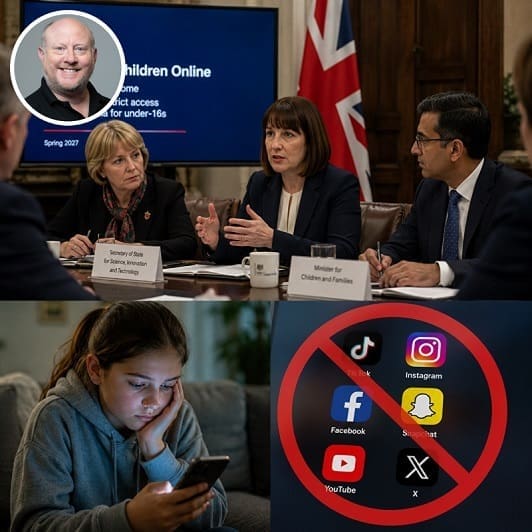
Children under the age of 16 will be banned from using major social media platforms in the UK from Spring 2027 under government plans that represent one of the most significant attempts yet to reshape how young people interact with the online world.
What Has Been Announced?
Before his resignation, Sir Keir Starmer had confirmed that the government intends to introduce legislation before Christmas that will prevent under-16s from accessing a range of major social media services.
The ban is expected to come into force in Spring 2027 and will apply to platforms including TikTok, Instagram, Facebook, Snapchat, YouTube and X. Messaging services such as WhatsApp and Signal will not be included.
Announcing the plans, Starmer said: “That’s why we’re going further than any country in the world by banning social media for under-16s and putting wider protections in place to give kids their childhood back.”
The government has described the move as a “line in the sand” that will create “a new normal for future generations”.
The UK Is Going Further Than A Simple Ban
The proposal extends beyond simply preventing children from creating social media accounts.
The government has also announced restrictions on high-risk online features, including livestreaming and communication with strangers. These restrictions will apply not only to social media platforms but also to a wider range of online services, including gaming sites.
Importantly, some protections will remain switched on by default for 16 and 17-year-olds. Ministers say this is intended to avoid what they describe as a “cliff-edge at 16”, where protections would otherwise disappear overnight.
The government is also examining possible restrictions on infinite scrolling and overnight social media use for under-18s, with further details expected later this year.
Meanwhile, so-called AI “romantic companion” chatbots designed to simulate intimate or sexual relationships will be restricted to adults, while similar intimate AI functions will be limited for under-18s.
Why Is The Government Doing This?
The announcement follows a major public consultation that attracted more than 116,000 responses from parents, children and experts.
According to the government’s findings, nine in ten parents supported a social media ban for under-16s, while two-thirds of young people agreed that children under 16 should not be allowed to use at least some social media platforms.
The government argues that algorithmic feeds, real-time content, cyberbullying, harmful material, addictive platform design and online exploitation are creating risks that existing safeguards have failed to address.
Technology Secretary Liz Kendall said: “Today we take a bold and significant step towards creating a safer, healthier life online for our children and future generations.”
She also argued that technology firms had failed to act voluntarily, stating: “Tech companies have had countless opportunities to keep children safe, yet they have failed to act.”
How Will The Ban Be Enforced?
One of the biggest challenges will be ensuring that under-16s cannot simply bypass the restrictions.
The government says it intends to introduce stronger age assurance requirements and has asked Ofcom to carry out a rapid review into the most effective ways of verifying whether someone is over 16.
Officials have indicated that a range of methods could be used, including facial age estimation technology, identity verification and other forms of age assurance. Many adults may not need additional checks if their accounts are already linked to verified payment methods or age-verified accounts.
The government also says it is learning from Australia’s experience, where social media restrictions have already been introduced but enforcement has proved challenging.
Questions Remain
Not everyone supports the plans. For example, Meta, Snapchat and YouTube have all expressed concerns that blanket bans could push young people towards less regulated services that may be harder to supervise.
YouTube described itself as “a vital resource for young people, educators and parents”, while Meta warned that restrictions could risk isolating teenagers from online communities and information.
Privacy advocates have also raised concerns about age verification technologies, particularly where facial analysis or identity checks may be required to access online services.
Critics also point to evidence from Australia suggesting that many children have continued accessing social media despite restrictions, highlighting the practical difficulties involved in enforcing such bans.
Part Of A Global Trend
The UK’s decision reflects a broader international movement towards tighter controls on children’s access to social media.
Australia became the first country to introduce a nationwide under-16 social media ban, while countries including France, Spain, Greece, Denmark, Canada, Indonesia, Malaysia and others are either introducing similar measures or actively considering them.
Growing concerns about online harms, mental health, addictive platform design, cyberbullying and child exploitation are prompting governments around the world to reconsider the balance between online freedom and child protection.
What Does This Mean For Your Business?
For businesses, the immediate impact may be limited, but the wider significance is substantial.
The proposals signal a growing willingness by governments to intervene directly in how digital platforms operate, particularly where child safety, wellbeing and online harms are concerned. Social media firms, gaming platforms, AI developers and technology providers may all face increasing regulatory scrutiny over the coming years.
The plans also highlight the growing importance of age verification, digital identity, online safety and responsible technology design. Organisations developing online services may find that demonstrating effective safeguards becomes just as important as launching new features.
More broadly, the announcement reflects a wider change in how policymakers view digital platforms. For many years, governments largely relied on technology companies to regulate themselves. The UK’s proposed ban suggests that approach is increasingly being replaced by direct intervention when policymakers believe public safety concerns outweigh the benefits of unrestricted access.
