
Meta And Google Found Liable In Landmark Social Media Addiction Case
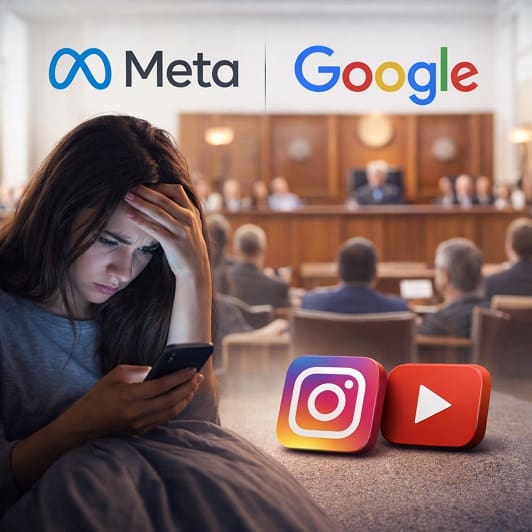
A US jury has just found Meta Platforms and Google liable for harm linked to addictive platform design, marking a pivotal moment in how social media companies may be held accountable.
What Just Happened?
A Los Angeles jury has concluded that Meta and Google were responsible for harm suffered by a young woman who developed compulsive use of Meta-owned Instagram and Google’s YouTube from an early age.
In the case, the US-based plaintiff, now aged 20 and identified in court documents as “Kaley” or “KGM” (her full identity has not been publicly disclosed), said she began using YouTube at six and Instagram at nine, later experiencing anxiety, depression and body image issues. Jurors awarded $6m in damages, split between compensatory and punitive elements, and found that Instagram and YouTube had acted with what was described in court as malice, oppression or fraud.
Crucially, the jury determined that the platforms’ design was a substantial factor in causing harm, rather than focusing on the specific content viewed.
Why This Case Is Being Treated As A Milestone
What makes this case so noteworthy is that it is one of the first cases of its kind to reach a full jury verdict, and it is widely seen as an early indicator of a much larger wave of litigation.
There are already more than a thousand similar claims progressing through US courts, involving families, schools and public authorities. Legal experts expect this ruling to influence how future cases are argued, how damages are assessed, and whether companies choose to settle rather than go to trial.
Some legal commentators have also framed this moment as a broader turning point for the technology sector, comparable to earlier cases in other industries where product design and long-term harm became central to accountability.
As one of the lawyers representing the plaintiff stated after the verdict, “no company is above accountability when it comes to our children,” reflecting a wider sentiment that the legal threshold for responsibility may now be changing.
The Shift From Content To Design
One of the most important aspects of the case is actually what it did not focus on. US law has long protected technology companies from liability for user-generated content, limiting legal exposure in many previous cases. Instead, this case examined how platforms are built.
This distinction could prove significant beyond this single case. Legal protections such as Section 230 in the US have historically shielded platforms from responsibility for content, but a growing focus on design may place aspects of those protections under increased scrutiny.
The plaintiff’s legal team argued that features such as infinite scrolling, autoplay videos and constant notifications were intentionally designed to maximise engagement and keep users returning. These features are now common across most digital platforms, and are often described as engagement tools.
The jury accepted that these design choices could create patterns of compulsive use, particularly among younger users. As one expert witness described during proceedings, the question at the centre of the case was effectively how platforms are designed to ensure “a child never puts the phone down,” framing the issue as one of engineering rather than behaviour.
In Their Defence
Both Meta and Google have said they disagree with the verdict and plan to appeal.
Meta has argued that mental health is complex and cannot be attributed to a single factor, while also pointing to its policies restricting under-13s from using its platforms. During testimony, its leadership maintained that their products are intended to have a positive impact.
Google’s defence focused on positioning YouTube as a video platform rather than a traditional social network, and questioned whether the usage patterns described in the case met the threshold for addiction.
These arguments are likely to form the basis of ongoing appeals and future legal disputes.
A Wider Pattern Of Legal And Political Pressure
It’s worth noting here that this verdict follows closely behind another US ruling that found Meta liable in a separate case involving child safety and harmful content exposure.
Notably, other major platforms involved in similar litigation, including TikTok and Snap, chose to settle before trial, which may indicate the level of legal and financial risk companies now associate with these claims.
At the same time, governments are increasingly exploring regulatory action. In the UK, for example, proposals to restrict social media access for under-16s are under active consideration, while Australia has already introduced measures targeting youth access and platform design.
Political leaders, including Keir Starmer, have signalled that the current approach to social media regulation may not be sufficient. He recently stated that the status quo is “not good enough,” indicating that further intervention is likely.
Campaign groups and families involved in similar cases argue that responsibility is beginning to move away from individuals and towards the companies designing these platforms.
Why This Matters Beyond Social Media
For technology companies more broadly, this case highlights a growing legal focus on how digital products are designed, not just how they are used.
Courts are increasingly treating platform design as a series of deliberate choices rather than neutral features, meaning those decisions may carry legal and ethical consequences in the same way as other product design decisions.
Many business models rely on capturing attention and encouraging repeated engagement. Techniques that support this, such as personalised recommendations and continuous content feeds, are widely used across sectors including media, retail and software.
This also seems to highlight the tension in social media platforms between user wellbeing and commercial performance. Features that maximise engagement are often closely tied to advertising revenue and platform growth, which means any legal pressure to change them could have direct business implications.
The risk here is that these same techniques could now face greater scrutiny if they are seen to contribute to harm, particularly where younger or vulnerable users are involved.
This could lead to a reassessment of how engagement is measured and prioritised within digital services.
What Does This Mean For Your Business?
This ruling signals that digital design choices are becoming a matter of legal and commercial risk, not just user experience.
For Meta Platforms, Google, and other major platforms such as TikTok and Snap Inc., it raises the prospect of sustained legal exposure. This case is widely expected to influence hundreds of similar lawsuits, increasing the likelihood of further damages, settlements, and pressure to redesign core product features that drive engagement.
Businesses that operate platforms, apps or online services should now perhaps begin to review how their products encourage user behaviour, particularly if they rely heavily on notifications, recommendations or continuous scrolling. Features that were once seen as standard may now require clearer justification, stronger safeguards, and potentially formal risk assessments, especially where younger users are involved.
There is also a broader reputational consideration here. Public expectations are changing, and organisations seen to prioritise engagement over user wellbeing may face increased scrutiny from customers, regulators and partners. For large platforms, this could translate into tighter regulation, limits on certain design practices, and closer oversight of how algorithms influence behaviour.
For companies using social media as a marketing channel, this case raises questions about long-term platform stability. Ongoing legal challenges and potential regulation could alter how these platforms operate, how audiences engage, and how data is used, particularly if engagement-driven features are restricted or redesigned.
For the largest platforms, this may ultimately lead to more fundamental changes in how products are designed, especially if courts or regulators begin to place limits on features that are closely linked to prolonged user engagement.
It seems now that accountability is expanding across the sector, and both platform providers and the businesses that rely on them will need to adapt to a landscape where design decisions, not just content, are subject to legal and regulatory scrutiny.
Sponsored
Ready to find out more?
Drop us a line today for a free quote!
