
Ukraine Says Robots Seized Enemy Territory On Their Own
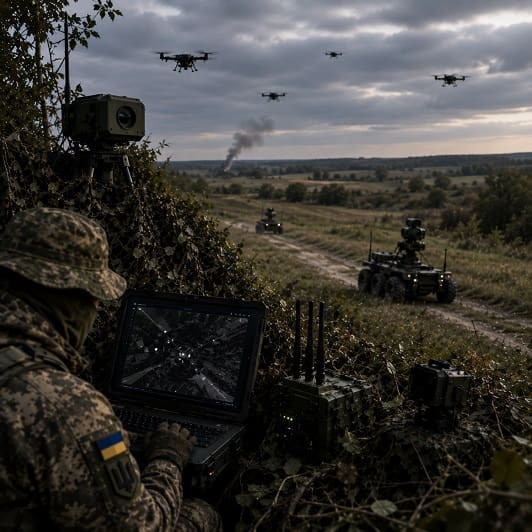
Ukraine says it has carried out the first combat operation in history where enemy territory was captured entirely using robots and drones, signalling a major turning point in how future wars may be fought.
How Ukraine Says Robots Captured Enemy Positions
The claim was made by Ukrainian President Volodymyr Zelensky when he announced that Ukrainian forces had seized an enemy position using only unmanned systems, without infantry entering the battlefield.
According to Zelensky, drones and robotic ground systems identified targets, suppressed enemy fire, and secured the position without Ukrainian casualties. Ukraine’s military has not released detailed operational information, and the full claim has not been independently verified. However, the announcement has attracted global attention because it points towards a battlefield where machines increasingly replace soldiers in frontline combat roles.
The operation reportedly involved a combination of aerial drones and unmanned ground vehicles working together as coordinated systems rather than isolated devices. Analysts say this type of “multi-swarm” warfare allows militaries to overwhelm positions while reducing risk to personnel.
In a statement published alongside footage of the operation, Zelensky said: “For the first time in the history of this war, an enemy position was taken exclusively by unmanned platforms – ground systems and drones.”
Why Ukraine Has Become A Testing Ground For Military Robotics
The war in Ukraine has accelerated military technology development at a pace rarely seen in modern conflicts. Systems that would normally take years to test and deploy are now being modified, upgraded, and returned to combat within weeks.
UFORCE, the Ukrainian-British defence technology company linked to the operation, was formed through the merger of nine Ukrainian defence companies and has now achieved a valuation exceeding $1 billion, making it Ukraine’s first defence technology unicorn. The company develops air, land, and sea drones, alongside battlefield software designed to coordinate unmanned systems during combat.
Its maritime drones have reportedly damaged or destroyed multiple Russian naval assets in the Black Sea, while its ground systems are increasingly being used for reconnaissance, logistics, mine clearance, casualty evacuation, and direct attacks.
The company says it has now conducted more than 150,000 combat missions since Russia’s full-scale invasion in 2022, reflecting how rapidly unmanned systems have become central to modern warfare.
Ukraine’s wider drone production has also expanded dramatically, increasing from a few thousand units in 2022 to several million by the end of 2025, turning the country into one of the world’s largest real-world testing grounds for autonomous military systems.
How The Wider Defence Industry Is Responding
Ukraine is not alone in pushing towards more autonomous warfare systems. Defence technology companies across the United States, Europe, China, and Israel are investing heavily in AI-enabled drones and robotic systems.
US company Anduril Industries recently tested an autonomous fighter jet and is building a major manufacturing facility in Ohio designed to scale production of military drones and autonomous systems. Germany’s Helsing is combining military AI with battlefield analytics software, while Chinese companies are rapidly expanding AI-enabled military technologies with strong state support.
The defence sector itself is also changing. Traditional contractors such as BAE Systems and Lockheed Martin increasingly face competition from technology-focused startups that develop software-defined systems far more quickly than conventional military procurement programmes allow.
UFORCE has openly framed this as part of a broader industrial transformation. The company states that “the age of unmanned warfare is no longer a conference-circuit prediction” and has become an operational and commercial reality.
How Battery Technology Also Fits Into This Story
The growing role of battlefield robots also highlights another practical challenge, which is how these machines are powered in demanding real-world conditions.
This is where developments outside defence can quickly become relevant. For example, Cambridge battery company Nyobolt has developed ultra-fast charging batteries designed for autonomous machines, warehouse robots, physical AI systems, and AI data centres. The company says its technology can charge from zero to 80 per cent in under five minutes and is built for repeated, high-intensity charging cycles.
Nyobolt’s work is not about the battlefield directly, but it shows how the wider robotics ecosystem is developing around the same core problem: autonomous machines need reliable power, rapid charging, and long operating life if they are to work continuously. In warehouses, that means robots spending more time moving goods and less time charging. In military settings, the same principle could shape how future unmanned systems are designed, deployed, and sustained.
This matters because the future of autonomous robotics will not depend on AI alone. Batteries, sensors, communications, materials, and manufacturing capacity will all play a part in determining which systems can operate reliably at scale.
The Ethical Questions Around Autonomous Warfare
The growing use of AI and robotic systems in combat is also intensifying concerns about accountability, ethics, and human oversight.
At present, most battlefield robots still require human operators to approve attacks or direct operations. However, many systems already use software-assisted targeting, autonomous navigation, and machine-learning tools to accelerate combat decisions.
Human rights organisations and international bodies have warned that increasing autonomy risks reducing human accountability in life-and-death situations. Concerns include how responsibility is assigned if autonomous systems malfunction or cause civilian casualties.
At the same time, defence companies argue that automation can reduce human error, improve reaction times, and protect soldiers from increasingly dangerous battlefield conditions.
The United Nations has discussed possible international controls on autonomous weapons, but no binding global framework currently exists despite growing calls for regulation.
What Does This Mean For Your Business?
For most UK businesses, robotic warfare may appear distant from everyday operations, but the technologies emerging from Ukraine are likely to influence far more than defence.
Many of the systems now being refined on the battlefield rely on AI, machine vision, autonomous navigation, secure communications, sensor fusion, and real-time data processing. It is worth noting here that these same technologies are also increasingly used in civilian sectors including logistics, manufacturing, transport, infrastructure monitoring, and cybersecurity.
The conflict is also accelerating investment into robotics and AI across Europe and the United States, creating commercial opportunities for companies involved in software engineering, semiconductors, communications systems, drones, sensors, and advanced manufacturing.
Also, the rapid militarisation of AI is likely to increase regulatory scrutiny around autonomous systems more broadly, particularly where safety, accountability, and decision-making are involved. Businesses developing AI-enabled products may therefore face growing expectations around transparency, oversight, and ethical controls.
Russia’s war against Ukraine is no longer only reshaping modern warfare. It has also become one of the world’s fastest-moving testing grounds for autonomous technology, with the systems emerging from the conflict likely to influence both defence and civilian industries for years to come.
