
Tesla Repositions Its Future Around Robots Rather Than Cars
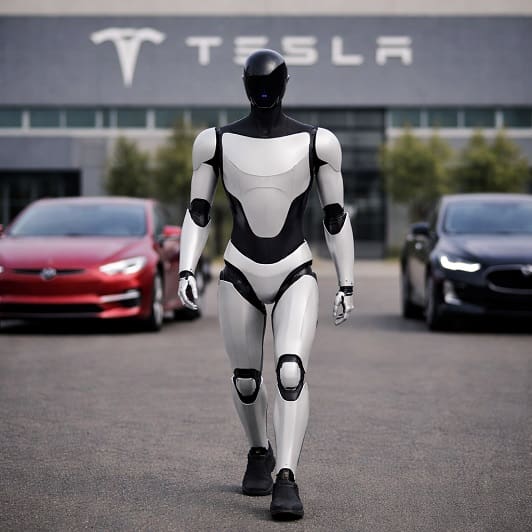
Tesla confirmed it was winding down parts of its car business as Elon Musk publicly repositioned the company around humanoid robots, artificial intelligence and autonomy rather than electric vehicles alone.
Tesla Drops Model S And X As Focus Shifts Beyond Cars
Tesla has said it will end production of the Model S and Model X and repurpose the manufacturing space at its Fremont, California plant to build its Optimus humanoid robots, marking the clearest signal yet that the company’s future strategy is moving away from premium car models.
Speaking on Tesla’s latest earnings call, Elon Musk said the space currently used to build the two vehicles would be converted into an Optimus production facility, with a long-term ambition of producing up to one million robots a year at the site. He described the change as part of Tesla’s broader shift towards what the company now calls “physical AI”.
The Model S and Model X were once central to Tesla’s rise, helping establish the brand in the early and mid-2010s. In recent years, however, both vehicles had become low-volume products compared with the Model 3 and Model Y, which now account for the majority of Tesla’s car sales.
Tesla said it would continue supporting existing Model S and Model X customers despite the end of production.
Why Tesla’s Core EV Business Came Under Pressure
The strategic change of direction came after a difficult year for Tesla’s automotive business, shaped not only by market conditions but also by growing scrutiny of Elon Musk’s leadership and public profile. The company reported total revenue fell 3 per cent in 2025, its first annual decline in revenue, while vehicle deliveries dropped by about 9 per cent to roughly 1.64 million cars worldwide.
The slowdown was particularly visible at the end of the year, with Tesla saying deliveries fell around 16 per cent year on year in the fourth quarter, reflecting weaker demand, intensifying competition and the impact of reduced government incentives in the United States. Analysts also pointed to rising unease among parts of Tesla’s traditional customer base following Musk’s increasingly high-profile political involvement, which included public support for US President Donald Trump and a senior cost-cutting role in his administration.
During the same period, China-based BYD overtook Tesla as the world’s largest seller of battery electric vehicles by volume, reporting more than 2.25 million BEV sales in 2025, up almost 28 per cent year on year. Chinese manufacturers including BYD, Geely and MG continued to pressure Western carmakers by offering a wider range of lower-priced models, while Tesla faced criticism for a relatively ageing vehicle line-up and a slower pace of major new car launches.
Tesla’s earnings update showed that while automotive revenue weakened, other parts of the business performed more strongly, with energy generation and storage revenue rising about 25 per cent year on year in the fourth quarter and services revenue increasing around 18 per cent, highlighting areas of growth beyond car sales as the company recalibrated its strategy.
How Musk Reframed Tesla’s Future Around Robots
Against that backdrop, Musk has been framing Tesla as an AI and robotics company rather than a car manufacturer. For example, in investor materials, Tesla described 2025 as a pivotal year in its transition from a hardware-led business to one centred on artificial intelligence deployed in the physical world.
Optimus
Optimus, Tesla’s humanoid robot programme first unveiled in 2021, has now become central to that narrative. Tesla said the robot is already performing limited tasks inside its factories, such as sorting objects and handling materials, though it remains far from Musk’s long-term vision of a general-purpose household robot.
In fact, Musk has repeatedly claimed Optimus could eventually perform a wide range of jobs, from factory work to domestic tasks, and has described it as more significant to Tesla’s future than vehicles over time. At the World Economic Forum in January, he said Tesla would probably begin selling humanoid robots to customers by the end of 2027, once safety and reliability reached an acceptable level.
Tesla told investors it plans to reveal a third-generation Optimus design in early 2026, describing it as the first version intended for mass production, with manufacturing expected to begin before the end of that year.
The Financial Stakes Behind The Robot Push
The move towards robotics also carries major financial implications for Tesla and Musk personally. For example, Tesla disclosed it had invested $2bn in Musk’s AI start-up xAI, while also signalling a sharp increase in capital spending, with guidance pointing to more than $20bn of investment in 2026.
That spending is expected to support multiple projects, including Optimus production, robotaxi development, battery manufacturing and AI infrastructure.
It’s worth noting here that Musk’s much publicised record-breaking pay package, approved by shareholders in late 2025, is also closely tied to Tesla delivering new growth drivers beyond car sales. Under the terms of the deal, Musk must significantly increase Tesla’s market value over the next decade, with Optimus and autonomous services positioned as central to that ambition.
Tesla has said its long-term targets include selling up to one million humanoid robots over ten years, a goal Musk has described as achievable if production and costs scale as planned.
Why Humanoid Robots Are A Riskier Bet Than EVs
Despite Tesla’s confidence, many experts view humanoid robots as one of the most difficult challenges in modern engineering. For example, unlike industrial robots designed for controlled environments, humanoids must combine balance, dexterity, perception and decision-making while operating safely around people in unpredictable settings.
Estimates of the potential market vary widely. Analysts at McKinsey have suggested a base-case market for general-purpose robotics of around $370bn by 2040, while other banks have forecast multi-trillion-dollar outcomes over longer timeframes if humanoids become widely adopted.
Supporters argue Tesla has relevant advantages, including experience in mass manufacturing, vertical integration across hardware and software, and expertise in motors and battery systems. Tesla has said those strengths allow it to iterate designs quickly and reduce costs as production scales.
However, critics say that the competitive landscape is far more crowded than when Tesla entered the EV market. For example, more than 90 companies are now developing humanoid robots, including established robotics firms, well-funded startups and technology giants supplying chips and AI platforms.
Questions have also been raised about whether consumer-facing humanoid robots will ever prove practical or affordable at scale, and whether Tesla’s ambitious timelines repeat a pattern seen in previous Musk-led projects, where public targets were missed or delayed.
Political Headwinds And Brand Risk
Tesla’s shift has unfolded alongside growing political and reputational challenges. For example, as noted earlier, Musk’s high-profile political involvement, including DOGE and his support for US President Donald Trump, has polarised public opinion and triggered protests and vandalism at Tesla dealerships in several countries.
Some investors and analysts have actually questioned whether that controversy could affect demand not only for Tesla’s cars, but also for any future consumer robot products, particularly if Optimus is positioned for home use.
Musk has acknowledged scepticism around Tesla’s ambitions but has maintained that the company is pursuing what it believes are the most important long-term technological opportunities, even if progress takes longer than expected.
What Does This Mean For Your Business?
Tesla’s decision to scale back parts of its car business in favour of robotics and AI signals a clear attempt to reset its long-term growth strategy. The move places Optimus and autonomous systems at the centre of Tesla’s future valuation, even though both remain technically complex, capital intensive and commercially unproven at scale.
For investors, suppliers and regulators, this has reframed Tesla less as a cyclical carmaker and more as a long-horizon technology bet, with outcomes likely to hinge on execution rather than vision alone. Success will require Tesla to solve problems in robotics that the wider industry has struggled with for decades, while managing near-term pressure on its automotive revenues and brand.
For UK businesses, the implications are more practical than speculative. For example, if humanoid robots move beyond pilot use in factories, logistics and warehousing, they could reshape labour planning, automation strategies and capital investment decisions over the next decade. At the same time, the uncertainty around timelines and costs reinforces the need for caution, with most analysts expecting meaningful deployment to arrive gradually rather than through rapid disruption.
More broadly, Tesla’s pivot shows how closely modern technology companies are now shaped by leadership choices, political context and investor expectations, not just product roadmaps. Whether Optimus becomes a transformative platform or an overextended ambition, Tesla’s repositioning reflects wider changes in how growth, risk and innovation are being recalibrated across the global technology and manufacturing landscape.
Sponsored
Ready to find out more?
Drop us a line today for a free quote!
