
Robot Beats Human Half-Marathon Record
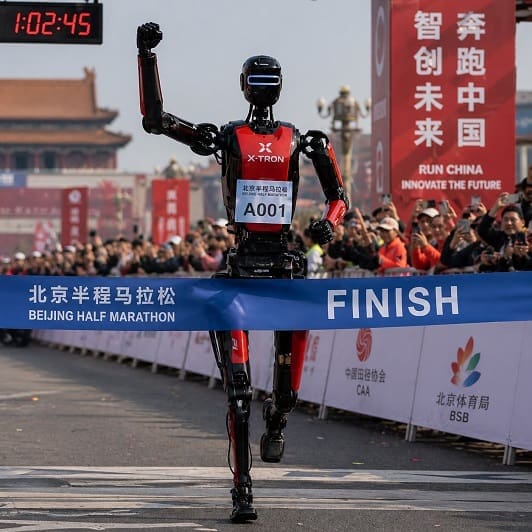
A humanoid robot has completed a half marathon faster than the human world record, marking a striking moment for robotics while raising important questions about what this kind of performance actually proves.
What Happened In Beijing Humanoid Robot Half-Marathon?
At the Beijing E-Town Humanoid Robot Half-Marathon, a robot named Lightning, developed by Chinese technology company Honor, completed the 21-kilometre course in 50 minutes and 26 seconds. That time is nearly seven minutes faster than the current human world record of 57 minutes and 20 seconds, set earlier this year by Jacob Kiplimo.
The event brought together more than 100 teams and over 300 robots, running alongside around 12,000 human participants, although in separate lanes. Unlike last year’s inaugural race, where only a handful of robots finished, this year’s event saw a dramatic improvement in completion rates and overall performance.
While a remotely controlled version of the same robot crossed the finish line even faster, the official winner was the fully autonomous model, reflecting the event’s focus on independent navigation rather than raw speed alone.
How The Robot Achieved It
Lightning’s performance is the result of focused engineering rather than a single breakthrough. The robot was designed to mimic the proportions of elite human runners, with long legs optimised for stride efficiency and lightweight components to reduce energy loss on impact.
One of the most important factors was heat management. For example, sustained running generates significant thermal load in motors and control systems, and Honor addressed this issue by using a liquid cooling system adapted from its smartphone engineering. This allowed the robot to maintain performance over the full distance without overheating, a limitation that has historically held back similar machines.
The robot also relied on multi-sensor fusion and real-time decision-making algorithms to navigate the course. In the autonomous category, machines followed a pre-mapped route and adjusted their movement continuously based on sensor input, maintaining balance and speed over long distances.
Taken together, these elements allowed Lightning to run at speeds of around 25 km per hour while sustaining stability, something that was not achievable in previous generations of humanoid robots.
Why This Is A Significant Step Forward In Robotics
The scale of improvement compared with the previous year is what makes the result notable. In 2025, the winning robot took more than two and a half hours to complete the same course, and most entries failed to finish at all. In 2026, multiple robots not only completed the race but did so at speeds exceeding elite human performance.
That level of progress reflects a combination of increased investment, better hardware design, and more refined control algorithms. It also highlights how quickly capabilities can improve once a field reaches a certain level of maturity and attracts sustained funding and competition.
China’s broader strategy also helps explain the pace of progress, as the country has identified humanoid robotics as a key growth area and is backing it with large-scale state investment aimed at accelerating development and establishing global leadership in the sector.
Why Speed Does Not Equal Capability
Despite the headline result, the achievement does not mean robots have surpassed humans in any general sense. The conditions under which the race took place were tightly controlled, with a pre-defined route, support teams, and no interaction with unpredictable environments or crowds.
Experts in robotics have been quick to point out that performance in a single, highly specialised task does not translate into broader competence. Running a fast, stable half marathon demonstrates advances in locomotion, balance, and endurance, but it says very little about a robot’s ability to perform everyday tasks.
In fact, many researchers argue that seemingly simple activities such as navigating a busy environment, handling objects, or folding laundry remain far more difficult challenges for machines. These tasks require perception, adaptability, and decision-making in unstructured settings, areas where robotics still has significant limitations.
What the race demonstrates, therefore, is not general intelligence but highly optimised performance within a narrow set of conditions.
Where This Technology Could Be Applied
Although the race itself is largely a demonstration, the underlying technologies have some practical relevance. Improvements in structural reliability, energy efficiency, and thermal management are directly applicable to industrial environments where robots need to operate continuously and safely.
The ability to maintain balance and mobility over long periods could support use cases in logistics, construction, and inspection, particularly in environments that are difficult or hazardous for human workers. These are areas where endurance and stability matter more than speed alone.
At the same time, the gap between controlled demonstrations and real-world deployment remains significant. Moving through a factory floor, interacting with people, and adapting to changing conditions requires a level of robustness and awareness that current systems are still working towards.
What Does This Mean For Your Business?
For most organisations, the immediate impact of a robot running a half marathon faster than a human is limited, but the direction of travel is important.
The pace of improvement in robotics is clearly accelerating, driven by a combination of AI, hardware innovation, and substantial investment. Capabilities that seemed out of reach even a year ago are now being demonstrated in public, and that trend is likely to continue.
However, it is important to separate spectacle from practical value. High-profile demonstrations often highlight what machines can do under ideal conditions, rather than what they can deliver reliably in everyday business environments.
For businesses considering automation, the more relevant question is not how fast a robot can run, but how safely and consistently it can perform useful tasks within real operational constraints.
The Beijing race shows that progress is real and accelerating, but it also reinforces that the journey from impressive demonstration to practical deployment is still ongoing.
