
1X California Factory To Produce 10,000 Home Robots
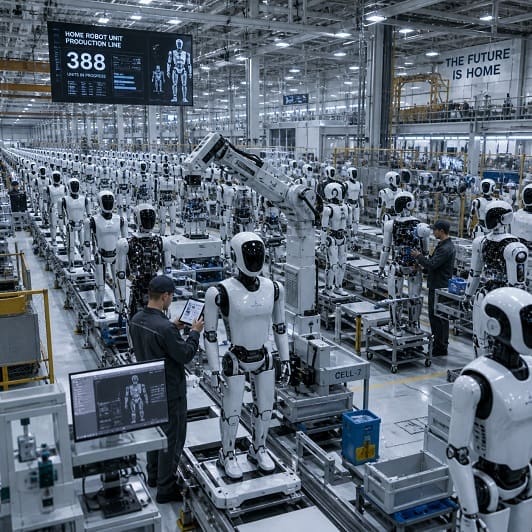
OpenAI-backed 1X Technologies has opened a California factory to build its NEO humanoid robot at scale, marking one of the clearest attempts yet to move home robots from futuristic demos into real consumer use.
Why 1X Is Scaling Home Robots Now
1X Technologies, a Norway-founded robotics company now based in California, has opened a 58,000 sq ft factory in Hayward with capacity to build up to 10,000 NEO robots a year, with plans to scale towards more than 100,000 units annually by the end of 2027. The company says demand has already been strong, stating that it “booked out our entire production capacity for the next year in just 5 days (10,000 NEOs).”
NEO is designed as a general-purpose home robot rather than a factory machine, with 1X positioning it as a household assistant that can learn tasks, move safely around people, and provide conversational support. Early access pricing has been reported at $20,000, with a subscription option around $499 per month, placing it firmly in early-adopter territory rather than the mainstream consumer market.
What Makes This Factory So Important
The significance of the Hayward factory lies in 1X’s attempt to control more of the robot’s production process in-house, rather than relying mainly on external suppliers. The company describes the site as “America’s first vertically integrated high-volume humanoid robot factory,” producing key components including motors, batteries, structures, transmission systems, sensors, and soft materials.
That matters because humanoid robots are still changing quickly. Manufacturing components internally should allow 1X to test, redesign, and improve parts faster as real-world feedback comes in from internal testing and early customers. As 1X puts it, “Most people think humanoids are a robotics problem. They’re wrong. It’s a manufacturing problem. Production makes prototypes look easy.”
Why Home Robots Are So Difficult To Build
Building a robot that can work in a private home is much harder than building one for a controlled factory floor. Homes are unpredictable, with different layouts, furniture, lighting, pets, children, clutter, and daily routines that do not follow a fixed industrial pattern.
1X appears to recognise that challenge, stating that “there is a lot that goes into creating the first ever humanoid consumer product experience” and that the product must be tested, improved, and packaged for customers who have “paid good money for a life-changing experience.” The company has also said, “We promised the first NEOs would ship in 2026, and we’re keeping that promise.”
The Competitive Landscape
The market around 1X is becoming crowded, with Tesla, Figure AI, Agility Robotics, Apptronik, Unitree, Agibot, UBTech, and others all developing humanoid robots for different use cases. Tesla’s Optimus is probably the most high-profile rival, but it is still primarily being tested inside Tesla’s own operations rather than sold broadly to consumers.
Agility Robotics’ Digit is already focused more clearly on logistics and warehouse work, while Figure AI has been targeting industrial and commercial deployments with partners such as BMW. Chinese companies including Unitree and UBTech are also moving quickly, often with lower-cost robots and strong manufacturing capacity, though many are aimed more at research, demonstration, or industrial use than general household assistance.
What makes 1X different is its consumer-first positioning. While many competitors are starting with factories, warehouses, or enterprise environments where tasks are more predictable, 1X is trying to put humanoid robots directly into homes, which could be more transformative but also much harder to make reliable.
What This Means For The Future Of Robotics
The move from prototypes to production is an important test for the whole humanoid robotics sector. Impressive videos can generate attention, but real adoption depends on whether robots can work safely, consistently, and usefully in ordinary environments.
The question is not whether NEO can perform selected tasks in controlled demonstrations. The real test is whether it can help enough in real homes to justify the cost, deal with unpredictable situations, and improve over time without frustrating users.
If 1X succeeds, home robots could begin to follow a path similar to early electric cars, starting as expensive, limited early-adopter products before becoming more capable and affordable as production improves. If it struggles, the market may move more slowly through enterprise settings before reaching the home.
What Does This Mean For Your Business?
For UK businesses, the immediate impact is not that humanoid robots will suddenly appear in every home or workplace, but that robotics is moving closer to practical deployment at scale. Organisations in care, facilities management, logistics, hospitality, retail, and property services should be watching this closely because many of the same capabilities being developed for homes could eventually apply to workplaces.
The wider business relevance sits in automation, workforce planning, and service delivery. Robots that can move safely around people, understand instructions, and handle varied physical tasks could eventually support cleaning, stock movement, basic maintenance, customer assistance, or care-related activities.
There are also important questions around safety, liability, privacy, cybersecurity, and staff acceptance. Any organisation considering robotics in future will need to understand not only what the machines can do, but how they collect data, how they are updated, who is responsible when something goes wrong, and how they fit into existing teams.
For now, 1X’s factory is less a guarantee that home robots are about to become mainstream and more a sign that the industry is entering a more serious phase. Businesses that start understanding the technology now will be better prepared if humanoid robots move from novelty to practical tool over the next few years.
