
Microsoft’s Glass Storage and the Future of Long Term Data
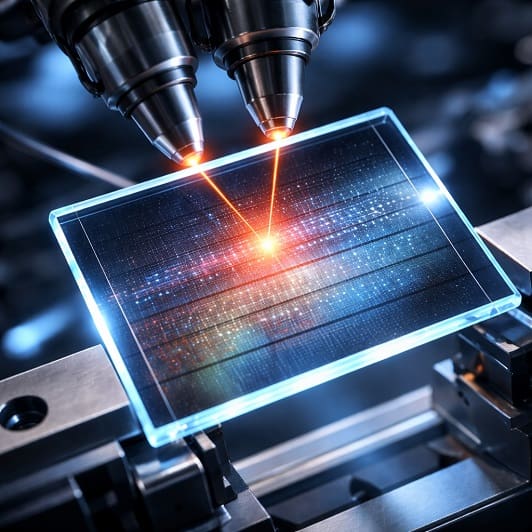
Microsoft has published peer-reviewed research demonstrating that data can be written into ordinary borosilicate glass and preserved for more than 10,000 years, positioning its ‘Project Silica’ work as a potential long-term archival storage platform for the cloud era.
The Challenge
This development addresses a persistent challenge for hyperscale cloud providers and large enterprises, i.e., how to store growing volumes of data reliably, economically and sustainably for decades.
Why Long-Term Storage Is Becoming a Strategic Issue
Global data volumes are growing at an exponential rate. Much of that data does not need high-performance storage. It needs durable, low-cost archival storage that can be retrieved if required, often for regulatory, legal or historical reasons.
Traditional archival media have limits. Magnetic tape, still widely used for cold storage, degrades over time. Hard disk drives and solid-state systems are not designed for century-scale retention. All require periodic migration to new media generations. That migration cycle consumes energy, equipment, labour and budget.
Microsoft’s Project Silica is designed to remove that recurring migration requirement. The central proposition is simple: store data once, in a chemically and thermally stable medium, and leave it in situ for its entire retention life.
How The Technology Works
Project Silica uses femtosecond lasers to write data inside glass. The laser modifies the optical properties of microscopic regions within the material, creating three-dimensional data structures known as voxels. These voxels encode information in multiple layers within a 2 mm thick glass platter.
In its latest Nature publication, the Microsoft Research team reports:
– A data density of 1.59 Gbit per cubic millimetre
– 301 data layers within a 120 mm square glass piece
– A usable capacity of approximately 4.8 TB per platter
– Write throughput of 25.6 Mbit per second per beam
– Energy efficiency of around 10 nJ per bit
Crucially, the team has extended the technology beyond high-purity fused silica to borosilicate glass, the same class of material used in cookware and industrial glazing. This change addresses one of the barriers of cost and material availability to commercialisation.
The research also demonstrates accelerated ageing tests suggesting data lifetimes could exceed 10,000 years at room temperature.
Why Borosilicate Changes the Equation
Earlier glass storage demonstrations relied on specialised fused silica, which is expensive and available from limited suppliers. Borosilicate is far more common and significantly cheaper.
Moving to borosilicate reduces media cost and simplifies manufacturing. It also allows Microsoft to streamline the read hardware. The latest phase-voxel method requires only a single camera in the reader, rather than multiple polarisation-sensitive cameras.
From a systems perspective, that reduction in mechanical and optical complexity matters. Archival infrastructure must be robust, scalable and economically viable at datacentre scale. The shift to borosilicate makes that discussion more realistic.
Security and Air Gap by Design
One notable feature of the Silica architecture is its inherent immutability (it can’t be altered, overwritten or deleted without leaving evidence). Reading the glass requires regular light microscopy, which does not have sufficient power to modify the material. Writing requires high-energy femtosecond laser pulses.
As a result, the medium cannot be overwritten accidentally during read operations. Microsoft describes this as “true air gap by design”. In practical terms, it offers strong protection against ransomware and unauthorised modification of archived data.
For organisations with strict evidential retention requirements, that immutability is significant.
Performance Is Not the Primary Objective
Silica is not competing with SSDs, HDDs or even active tape libraries for performance workloads. It is designed for deep archival storage.
The write throughput, while technically impressive, remains modest compared to high-performance systems. Read operations rely on wide-field microscopy and machine-learning-based decoding to reconstruct data from voxel patterns. Error correction is handled using forward error correction and low-density parity-check codes.
The system has been engineered end-to-end, from writing and reading hardware to machine-learning decoding models. That full-stack approach distinguishes it from earlier academic demonstrations that focused only on materials science.
This is really a storage system design project, not simply a physics experiment.
Sustainability and Cloud Economics
Microsoft is also keen to frame Project Silica within a sustainability context. Magnetic media requires periodic data refresh cycles. Each refresh involves powering up systems, copying data, validating integrity and decommissioning ageing media.
A medium that can remain stable for millennia reduces the need for repeated migrations. That lowers energy use, operational complexity and embodied carbon associated with replacement hardware.
For hyperscale cloud providers operating at massive archival volumes, even incremental reductions in refresh cycles translate into meaningful cost and energy savings.
The broader strategic implication is that long-term archival storage may become more media-centric and less migration-dependent over time.
Where This Sits in Microsoft’s Strategy
Project Silica sits within Microsoft Research and has been developed alongside Azure storage architecture research. It has already been used in proofs of concept, including archival storage of Warner Bros.’ Superman film and collaborations with preservation initiatives.
Microsoft describes the research phase as complete, and the company is now evaluating how the learnings translate into production systems.
That distinction matters. This is not yet a commercial Azure tier. It is a demonstrated platform technology that has met key storage system metrics in peer-reviewed publication.
Commercial deployment will require further engineering around robotics, media handling, library design and operational integration within datacentres.
Is This a Near-Term Disruption?
Glass storage will not replace existing archival systems overnight. Tape remains cost-effective and deeply embedded in enterprise infrastructure.
However, the technical barriers that once made glass storage largely theoretical have been reduced. The extension to borosilicate glass, simplified reading systems and validated longevity testing move the concept closer to practical viability.
If Microsoft can industrialise the robotics and system-level integration, Silica could become a credible long-term archival tier within hyperscale cloud platforms.
What Does This Mean For Your Business?
For most organisations, Microsoft’s glass storage technology is certainly not something you will deploy next year.
The more important development here is not the material itself, but what it reflects. Long-term data retention is no longer just an IT housekeeping task. It is becoming a strategic infrastructure issue. Regulatory obligations are extending retention periods. Litigation exposure is expanding. Sustainability commitments are tightening. Meanwhile, data volumes continue to grow.
If your archival strategy relies entirely on periodic media refresh cycles, manual integrity checks and legacy tape rotations, it is worth asking whether that model will remain economically and operationally sustainable over the next ten to twenty years.
Microsoft’s research indicates that the industry is now actively exploring media that reduce migration cycles, lower long-term energy use and improve immutability by design. Whether Silica becomes commercially mainstream is almost secondary. The strategic lesson is that archival architecture is evolving.
For your business, the practical implications are essentially threefold:
1. Treat long-term data retention as part of your infrastructure strategy, not just a compliance checkbox.
2. Understand the full lifecycle cost of your archival estate, including refresh, migration and energy overheads.
3. Recognise that immutability and physical air gap characteristics are becoming increasingly relevant in a world shaped by ransomware and supply chain attacks.
Glass storage may or may not become the dominant archival medium. What is clear is that long-term data stewardship is now a strategic capability. Organisations that plan for that reality early will have greater flexibility, lower long-term risk and a clearer sustainability narrative than those that continue to treat archive storage as static background plumbing.
Sponsored
Ready to find out more?
Drop us a line today for a free quote!
