
Microsoft Unveils 1,000 Times More Reliable Quantum Chip
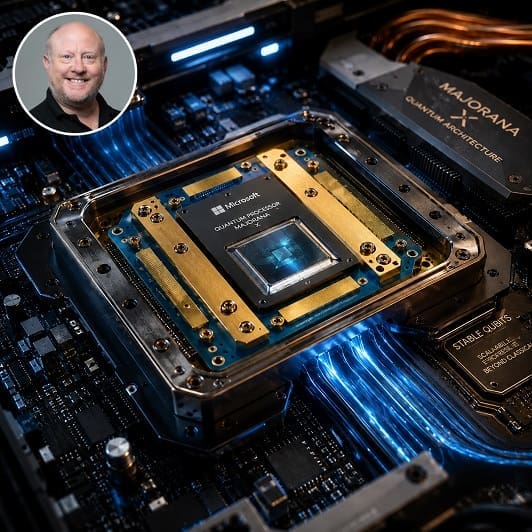
Microsoft has unveiled Majorana 2, a next-generation quantum chip that it says is 1,000 times more reliable than its predecessor, helping bring forward its target for a scalable quantum computer from 2033 to 2029.
What Is It?
Majorana 2 is Microsoft’s latest topological quantum chip, a processor designed to overcome one of the biggest obstacles in quantum computing, which is keeping quantum bits, or qubits, stable long enough to perform useful calculations.
According to Microsoft, the new chip is 1,000 times more reliable than its previous generation. The company says its qubits have a mean lifetime of 20 seconds, with some lasting as long as one minute. By comparison, many competing quantum systems measure qubit lifetimes in microseconds.
Microsoft attributes much of the improvement to a new materials design that replaces aluminium with lead in its topological superconductor architecture. The company says this provides greater protection against the environmental disturbances that can cause qubits to lose their quantum state and fail.
As Microsoft Technical Fellow Chetan Nayak explains, “Majorana 2 contains qubits that are 1,000x more reliable than those in our previous quantum processing unit”, and that “The new material stack, which swaps aluminium for lead, creates highly reliable topological qubits with operations on the microsecond scale and lifetimes with a mean of 20 seconds, occasionally exceeding one minute.”
Why This Matters
Reliability is one of the most important challenges facing quantum computing because even extremely powerful quantum systems are of limited value if their qubits cannot remain stable long enough to complete calculations.
Microsoft believes the improvement delivered by Majorana 2 is significant enough to accelerate its roadmap towards a scalable quantum computer. The company has now brought forward its target date from 2033 to 2029.
Microsoft’s announcement about the new quantum chip is also notable because the company says AI played an important role in achieving the breakthrough. For example, using its Microsoft Discovery platform, the company says it deployed AI agents to analyse research data, automate measurements, optimise manufacturing processes, identify hidden problems, and help researchers evaluate new materials more quickly.
Although practical large-scale quantum computing remains a major engineering challenge, Microsoft’s announcement suggests that advances in AI may now be helping accelerate progress towards systems capable of solving problems that remain beyond the reach of today’s conventional computers.
Why AI Is Part Of The Story
Although the quantum hardware itself is attracting most of the attention, Microsoft is also keen to place equal emphasis on the role of its Microsoft Discovery platform.
Microsoft Discovery uses teams of AI agents to help researchers analyse data, generate hypotheses, automate experiments, optimise manufacturing processes, and identify problems that may otherwise be missed.
According to Microsoft, AI agents were used to analyse almost two decades of quantum research data, automate complex measurement processes, optimise fabrication techniques, and even identify an uncalibrated temperature sensor that was introducing unwanted noise into the manufacturing process.
Describing the impact, Nayak said: “Agentic AI has permeated almost everything we do – it’s just become kind of a very natural part of our workflow.”
The company’s quantum team also used AI to help identify promising material combinations before conducting physical experiments, reducing the amount of costly trial-and-error testing required.
Zulfi Alam, Corporate Vice President for Quantum at Microsoft, described this as a move from the “old world order” of repeated experimentation towards simulations that identify “where the highly probable target is.”
A Different Approach To Quantum Computing
Microsoft’s strategy here seems to differ from many of its competitors. For example, companies such as IBM and Google largely focus on superconducting qubits, while Microsoft’s topological approach attempts to create a more stable form of quantum computing by exploiting exotic quantum states known as Majorana Zero Modes.
That said, the approach has not been without controversy. Microsoft’s earlier claims regarding Majorana particles attracted significant scientific scrutiny, and some previous findings were challenged by other researchers.
However, the company believes Majorana 2 demonstrates that the underlying approach is now delivering measurable engineering progress.
Support
It seems Microsoft has also attracted support from DARPA, the US Defence Advanced Research Projects Agency. DARPA has advanced Microsoft into the final phase of its Quantum Benchmarking Initiative, one of only two companies to reach that stage.
According to Microsoft, DARPA concluded that the company could “plausibly build a utility-scale quantum computer in a reasonable timeframe.”
What Could Quantum Computers Actually Do?
If Microsoft can achieve its 2029 target, the implications could be substantial. Quantum computers are not expected to replace conventional computers. Instead, they are designed to tackle highly specialised problems that are currently impractical or impossible for classical systems.
Potential applications include drug discovery, advanced materials research, energy optimisation, logistics, manufacturing, climate modelling, and cryptography.
Microsoft says a scalable quantum computer could help solve problems affecting “global health, food supply, sustainability, energy production and more.”
However, significant technical challenges remain before these systems become commercially useful at scale.
The wider quantum computing industry has a long history of optimistic forecasts, many of which have taken far longer to materialise than originally predicted.
What Does This Mean For Your Business?
For businesses, the announcement is less about purchasing quantum computers any time soon and more about understanding where things seem to be going in the world of advanced computing.
The most significant aspect of Microsoft’s announcement may actually be the growing convergence between AI and scientific research. Rather than simply helping users write documents or answer questions, AI is increasingly being used to accelerate materials science, engineering, pharmaceutical research, manufacturing, and frontier technology development.
Microsoft’s claim that AI helped reduce its quantum computing timeline by four years highlights how AI is becoming a tool for discovery as well as productivity.
Whether Microsoft’s 2029 target ultimately proves achievable remains to be seen. However, the combination of increasingly capable AI systems and advancing quantum hardware suggests that some of the world’s most difficult scientific and engineering challenges may begin moving faster than many experts previously expected.
For organisations watching emerging technologies, the bigger story may not be quantum computing alone, but how AI is increasingly being used to accelerate the creation of the next generation of technology itself.
