
Microsoft Makes Copilot Optional In Windows 11
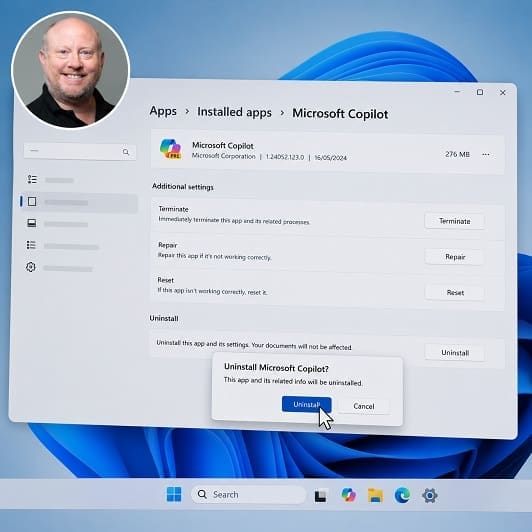
Microsoft has introduced a new Windows 11 policy that allows organisations to remove the Microsoft Copilot app from managed devices, giving IT teams greater control over how AI is deployed.
A New Copilot Removal Policy
The change arrived as part of Microsoft’s April 2026 Windows 11 update and introduces a policy called “Remove Microsoft Copilot app”.
According to Microsoft’s own documentation, “This policy setting allows you to uninstall Microsoft Copilot from devices in a targeted way.” The company explains that the policy applies only under specific circumstances, including where Microsoft Copilot was not installed directly by the user and has not been used recently.
Microsoft also states: “The Microsoft Copilot app will be uninstalled. Users can still re-install if they choose to.”
Although that may sound like a relatively minor technical change, it represents quite a notable change in Microsoft’s approach to AI deployment.
Why Microsoft Is Making The Change
For the past two years, Microsoft has invested heavily in positioning Copilot as a central part of the Windows and Microsoft 365 experience.
The company has integrated AI into Windows, Office applications, security products, development tools, search functions, and business workflows. Microsoft’s long-term strategy clearly assumes that AI assistants will become a standard part of everyday computing.
However, adoption has not always matched the enthusiasm coming from technology vendors.
Many organisations remain cautious about introducing AI assistants into business environments due to concerns around governance, licensing costs, staff training, compliance obligations, data protection, and uncertainty about where AI genuinely improves productivity.
The introduction of an official removal policy seems to suggest Microsoft now recognises that many organisations still want the ability to decide for themselves when, where, and how AI tools should be deployed.
Importantly, Microsoft has not positioned the policy as a rejection of AI. Instead, it is being presented as a management and governance tool that gives administrators greater control over managed devices.
What The Policy Actually Does
The policy is aimed primarily at Enterprise, Education, and other managed environments where IT teams oversee large numbers of devices.
Rather than preventing Copilot from ever being installed, the policy allows administrators to remove inactive installations that meet Microsoft’s criteria.
This distinction matters because Microsoft is not abandoning its AI strategy. The company is simply providing organisations with more flexibility around deployment.
The documentation makes clear that users retain the ability to reinstall Copilot if they choose to do so later.
It is also important to understand that removing the Copilot app does not remove artificial intelligence from Windows entirely.
AI-powered capabilities remain embedded across numerous Microsoft products and services, including Microsoft 365, security tools, developer platforms, cloud services, and various operating system features.
In practical terms, the policy removes one specific application rather than reversing Microsoft’s broader AI integration strategy.
A Wider Industry Trend
The change actually reflects a broader trend emerging across the technology industry.
Many software providers initially approached AI as a feature that should be added everywhere as quickly as possible. Increasingly, vendors are discovering that customers want flexibility, transparency, and control alongside innovation.
Businesses are often willing to adopt AI where there is a clear business case, measurable productivity gains, or operational benefits. Resistance tends to emerge when tools appear to be imposed without clear governance frameworks or obvious value.
This is particularly true in regulated sectors where organisations must consider compliance, security, auditability, and data handling requirements before introducing new technologies.
Microsoft’s decision to introduce a removal policy can therefore be viewed as a recognition that successful AI adoption depends as much on customer trust and organisational readiness as it does on technical capability.
What Does This Mean For Your Business?
For businesses, the announcement is less about uninstalling one application and more about the growing importance of AI governance.
Many organisations are still working out which AI tools genuinely improve productivity, which require additional oversight, and which may create unnecessary complexity or cost. The ability to manage deployment more precisely gives IT teams greater flexibility while those decisions are being made.
The wider significance is that the AI market appears to be entering a more mature phase. Rather than simply asking how quickly AI can be rolled out, businesses are increasingly asking where it delivers value, how it should be governed, and whether users actually want it.
Microsoft’s new policy suggests the company understands that customer choice will remain an important part of AI adoption, even as artificial intelligence becomes more deeply embedded throughout Windows and the wider software ecosystem.
