
Microsoft Introduces Copilot Cowork For Agentic AI-Driven Work
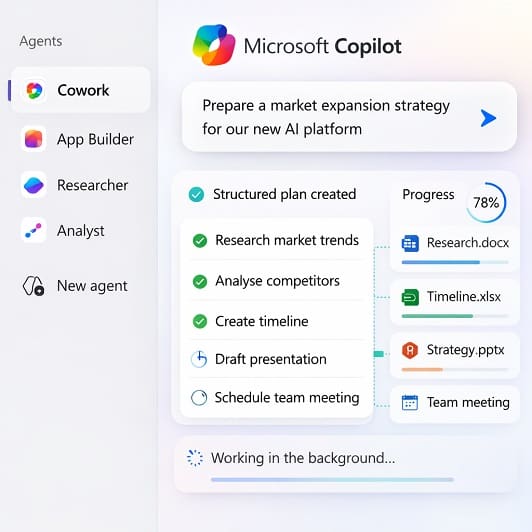
Microsoft has introduced Copilot Cowork, a new artificial intelligence capability designed to move Copilot beyond answering questions and towards completing real tasks across Microsoft 365.
Why Microsoft Wants AI To Do More Than Just Chat
Since launching Copilot in late 2023, Microsoft has steadily expanded the role of AI inside its productivity tools, embedding AI capabilities directly into applications such as Word, Excel, Outlook and Teams.
The company now believes the next stage of workplace AI is turning responses into action. For example, rather than simply suggesting what to do next, Copilot Cowork is designed to carry out tasks across multiple Microsoft 365 applications on behalf of the user.
Microsoft said the goal is to move from answering questions to completing work. The company explained that Copilot is evolving from a tool that drafts responses into one that can help execute tasks across the digital workplace.
How Copilot Cowork Turns Requests Into Workflows
Copilot Cowork allows users to describe the outcome they want and then delegate the task to the AI system.
According to Microsoft, Cowork converts a request into a structured plan and then begins carrying out that work in the background. Users can monitor progress, pause the task or approve suggested actions before they are applied.
The company says the system “turns your request into a plan” and continues executing that plan in the background while allowing users to review each stage of progress.
This approach reflects a broader industry trend toward so called agentic AI systems, which are designed to execute tasks rather than simply generate answers.
The Role Of Work IQ In Understanding Workplace Data
A key element behind Copilot Cowork is a technology Microsoft calls Work IQ.
Work IQ acts as a context layer that connects enterprise data stored across Microsoft 365 applications. This includes emails in Outlook, files in SharePoint and OneDrive, conversations in Teams and documents created in Word, Excel and PowerPoint.
The same technology is also underpinning Microsoft’s new Microsoft 365 E7 bundle, sometimes referred to as “The Frontier Suite”, which combines Microsoft 365 E5 with Copilot and a new automation capability known as Agent 365.
Work IQ links organisational knowledge with AI tools so that Copilot can understand how projects, documents and communications relate to one another before taking action.
Why Microsoft Is Partnering With Anthropic
Another notable aspect of Copilot Cowork is Microsoft’s decision to incorporate technology from multiple AI developers.
The system includes Anthropic’s agentic AI technology and supports several AI models, including those developed by OpenAI and Anthropic. This multi model approach allows Microsoft to select different AI models depending on the task being performed.
Industry analysts say this reflects a broader direction in enterprise AI platforms, where companies combine several AI models rather than relying on a single provider.
Microsoft has already begun rolling out these capabilities as part of the latest wave of Microsoft 365 Copilot updates.
Growing Investment In Copilot
The launch of Copilot Cowork forms part of Microsoft’s wider effort to increase adoption of its AI tools across enterprise customers.
Microsoft said in its 2025 Annual Report that Copilot has reached more than 100 million monthly active users across both consumer and enterprise environments. Chief executive Satya Nadella has also said usage has grown nearly three times year on year.
However, adoption among paid enterprise users remains relatively modest. Industry reports suggest only a small proportion of Microsoft 365 users currently pay for Copilot Chat licences.
The company is therefore expanding the feature set and integrating Copilot more deeply into Microsoft 365 to encourage wider adoption across businesses.
What This Means For Your Business?
For organisations already using Microsoft 365, tools such as Copilot Cowork could change how routine tasks are managed across teams.
AI systems capable of coordinating tasks across email, documents, meetings and research may reduce the time employees spend gathering information or preparing materials for projects.
However, the effectiveness of these tools will depend heavily on how well an organisation manages its internal data and permissions.
As AI systems become capable of carrying out work tasks rather than simply generating responses, businesses may need stronger governance over data access, workflow controls and AI usage policies to ensure these systems operate securely and responsibly.
Sponsored
Ready to find out more?
Drop us a line today for a free quote!
