
HP Fined Over Government Tender Rigging
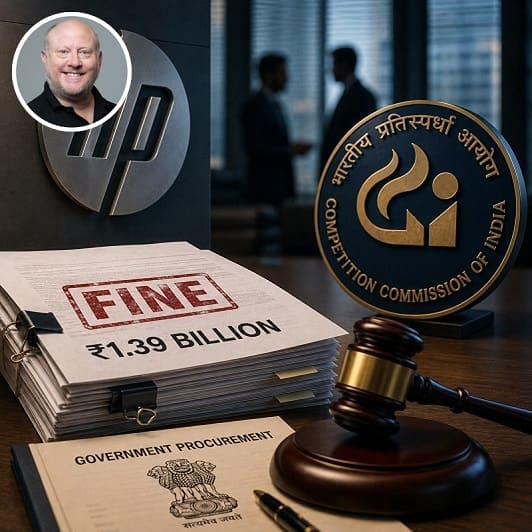
HP India has been fined almost 1.39 billion Indian rupees (around £12 million) by India’s Competition Commission after a lengthy investigation concluded that it coordinated with resellers to manipulate bidding in government technology procurement, in one of the most significant competition law cases involving the IT sector in recent years.
What Happened?
The penalties arise from two separate investigations covering personal computing equipment and printer consumables sold through India’s Government e-Marketplace (GeM), the country’s central online procurement platform for public sector purchasing. India’s regulator concluded that HP and a number of authorised resellers worked together in ways that undermined genuine competition during public tenders, resulting in combined penalties of approximately 1.3885 billion rupees.
What Did The Investigation Find?
The larger of the two cases focused on laptops, desktops, workstations, notebooks, point-of-sale systems and related accessories supplied through GeM. The Competition Commission began investigating after HP itself applied for leniency under India’s competition laws, admitting that anti-competitive arrangements had taken place and providing evidence to investigators.
Investigators examined dozens of government tenders before identifying seven major procurements where they found evidence that HP and selected resellers had coordinated their activities. According to the Commission, this coordination included deciding which reseller should have the strongest chance of winning particular contracts, arranging “cover bids” from other partners to create the appearance of competition, influencing bid prices and controlling which resellers received the Manufacturer’s Authorisation Forms (MAFs) needed to participate in tenders.
The Commission concluded that HP was not simply responding to requests from resellers but had become actively involved in facilitating these arrangements.
As the order states: “The coordination amongst HP India’s reseller was accordingly designed to ensure that at least one HP reseller remained present in the final round.”
Evidence relied upon by investigators included internal emails, witness statements, WhatsApp conversations and other communications exchanged between HP employees and reseller organisations.
Why Did It Happen?
The Commission’s findings essentially reveal that the behaviour developed during the transition from India’s older government procurement arrangements to the newer GeM platform.
For example, before GeM was introduced, many resellers had built long-standing relationships with particular government departments. Under the new system, suppliers across India could compete much more easily for the same contracts, increasing price competition and making it harder for established partners to protect their existing business.
According to HP’s own submissions, resellers asked the company to help preserve these legacy customer relationships by limiting competition between HP partners. The requests included restricting which resellers received Manufacturer’s Authorisation Forms (MAFs), allocating particular accounts to preferred partners and facilitating support bids where other resellers would deliberately submit non-competitive quotations.
HP argued that it was attempting to manage commercial pressures created by the new procurement system and that competition from other manufacturers such as Dell, Acer and Lenovo remained strong. It also maintained that any coordination only affected competition between HP resellers rather than competition across the wider market. However, clearly, the Competition Commission wasn’t persuaded by HP’s arguments.
The Second Investigation
Going from bad to worse for HP, alongside the personal systems case, the Commission also investigated HP’s sale of printer consumables, including ink cartridges and toner supplies.
Investigators concluded that similar anti-competitive practices had taken place in government tenders for printing supplies, leading to a further penalty of approximately 119.8 million rupees (about £923,000). Together, the two decisions resulted in total penalties approaching 1.39 billion rupees (about £10.7 million), with additional fines imposed on participating reseller companies and several individuals involved in the conduct.
Although HP received substantial reductions under India’s leniency programme because it voluntarily disclosed the conduct and cooperated throughout the investigation, the regulator still considered the company’s role sufficiently serious to justify one of the largest competition penalties imposed on an IT manufacturer in India.
Why This Matters Beyond India
While the case concerns India’s procurement system, the underlying issues are very relevant to manufacturers and channel partners worldwide.
For example, most technology vendors rely on networks of distributors and authorised resellers. Those relationships naturally involve discussions about pricing, product availability, technical specifications and manufacturer approvals. None of those activities are inherently problematic.
However, the risk arises when those conversations begin influencing who should bid, what prices should be quoted or which partners should deliberately avoid competing. At that point, legitimate channel management can cross into anti-competitive behaviour.
One particularly interesting aspect of the case involves Manufacturer’s Authorisation Forms. These documents exist for good reasons, helping purchasers verify that products are genuine and supported by the manufacturer. However, the Commission found that selectively issuing or withholding those authorisations became one mechanism for controlling competition between resellers rather than simply protecting customers from counterfeit products.
What Does This Mean For Your Business?
For organisations buying technology, the decision serves as a reminder that procurement platforms alone can’t guarantee competitive markets if suppliers coordinate behind the scenes.
For technology manufacturers, distributors and resellers, the message is even clearer. Competition authorities are increasingly willing to examine communications between channel partners in detail, looking beyond formal contracts to understand how bidding decisions are actually made.
Internal emails, messaging platforms and routine commercial discussions can all become evidence if they reveal attempts to coordinate pricing, allocate customers or influence tender outcomes.
Businesses operating partner programmes should therefore ensure that their competition law compliance extends beyond formal policies. Sales teams, account managers and channel partners all need clear guidance on where legitimate commercial co-operation ends and unlawful co-ordination begins, because, as this case demonstrates, the financial and reputational consequences of crossing that line can be substantial.
