
Google Smart Glasses Ready For A Comeback
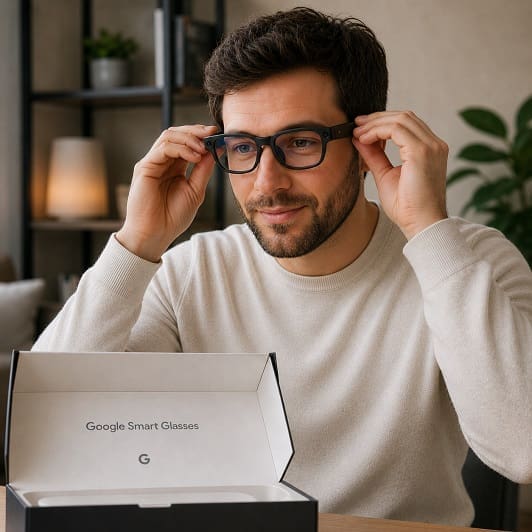
More than a decade after the failure of Google Glass, Google is returning to smart eyewear with a new generation of AI-powered glasses that could signal the beginning of a broader move away from smartphones and towards always-available digital assistants.
Why Google Is Trying Again
When Google Glass launched in 2013, it was widely seen as a glimpse into the future. However, concerns over privacy, a high price tag and limited practical usefulness meant the product struggled to gain mainstream acceptance before being withdrawn. Now it seems Google believes the technology landscape has changed.
At its I/O developer conference, the company unveiled new intelligent eyewear built around its Gemini AI platform. The first products, arriving later this year through partnerships with Samsung, Warby Parker and Gentle Monster, will provide spoken AI assistance through discreet speakers built into the frames.
Google says the glasses are designed to provide “help in the moment without taking you out of it” while allowing users to “stay hands-free and heads up”.
Those phrases may sound like marketing language, but they reveal something much more significant about Google’s ambitions.
The Smartphone Is The Real Target
The new glasses are not simply another wearable gadget. In fact, Google appears to be positioning them as a new way of interacting with technology that reduces reliance on phones and screens. Instead of taking a device out of your pocket, opening an app and navigating menus, the idea is that users can simply ask Gemini for help.
Google says the glasses can provide navigation, send messages, summarise missed communications, translate speech and text, take photographs and even complete multi-step tasks such as ordering coffee through connected services.
This reflects a much broader trend across the technology industry. Increasingly, major companies are trying to make AI more accessible by embedding it into everyday activities rather than requiring users to open dedicated apps.
In effect, Google seems to be attempting to make Gemini a constant companion rather than a destination.
Why It Could Be Different This Time
One of the biggest challenges facing Google Glass was that the technology simply was not ready. For example, voice assistants were relatively basic, artificial intelligence was far less capable, and many of the features people expected from smart glasses were either unreliable or unavailable. However, today’s environment looks very different.
Modern AI systems can understand natural conversation, translate languages in real time, recognise objects and locations, summarise information, and perform increasingly complex tasks. The arrival of Gemini gives Google a much more capable platform to build around than was available a decade ago.
As Google explains on its blog, users will be able to “ask questions about the world around you” and request help executing tasks on their behalf.
In many ways, the AI revolution may have solved the biggest problem Google Glass faced: giving people a compelling reason to wear it.
Meta Has Already Proven There Is Demand
Google is also benefiting from something it lacked the first time around, which was evidence that consumers are willing to wear smart glasses.
Meta’s Ray-Ban smart glasses have reportedly sold around seven million units, demonstrating that there is a growing market for eyewear that combines cameras, microphones, speakers and AI capabilities.
That success has encouraged a growing number of competitors to enter the market. Snap is expected to release new smart glasses, Apple is reportedly developing its own products, and several other technology firms are exploring similar concepts.
What was once a niche category is increasingly becoming one of the industry’s most closely watched battlegrounds.
Gemini Is The Real Product
Although much of the attention will focus on the glasses themselves, the real story is arguably Gemini. It could be said that the glasses themselves simply provide Gemini with direct awareness of a user’s surroundings.
By combining cameras, microphones, location information and AI reasoning, Google is creating a system that can understand what a user is seeing, where they are, and what they may need help with at that moment. That creates possibilities that extend well beyond voice assistants.
Whether helping someone navigate a city, understand a foreign-language menu, identify a landmark or complete a task without touching their phone, the glasses effectively become a delivery mechanism for Gemini’s intelligence.
There Are Still Privacy Questions
Despite the technological advances, some familiar concerns remain. For example, the original Google Glass generated significant criticism because people were uncomfortable with the idea of being recorded without their knowledge. Similar concerns have emerged around Meta’s smart glasses, which can capture photos and video in public spaces.
Google has so far focused its announcements on features and functionality rather than detailed privacy safeguards. As adoption grows, questions around consent, data collection and the use of AI-enabled cameras are likely to become increasingly important.
What Does This Mean For Your Business?
Google’s latest announcement is about far more than just smart glasses. The company is actually signalling its belief that AI assistants are gradually moving beyond phones, laptops and web browsers into the physical world. Instead of opening applications and searching for information, users may increasingly rely on AI systems that understand their surroundings and provide assistance in real time.
Hands-free access to navigation, translation, customer information, scheduling, messaging and AI assistance could make these devices particularly useful for mobile workers, engineers, delivery drivers, field service teams and healthcare staff. Rather than stopping to check a phone or laptop, employees could receive information, complete tasks and interact with business systems while continuing with their work. As AI capabilities improve, smart glasses could also support workplace training, remote assistance and customer service, potentially helping organisations improve productivity and reduce friction in everyday processes.
Whether smart glasses ultimately replace smartphones remains uncertain, and questions around privacy, security and workplace policies will need careful consideration. What is becoming increasingly clear, however, is that Google, Meta, Apple and others all believe the next major computing platform will place AI much closer to the user. If they are right, businesses may soon need to think not only about how employees use AI on screens, but also how they use it while moving through the real world.
