
Google Replaces Chromebook With AI-Powered “Googlebook” Strategy
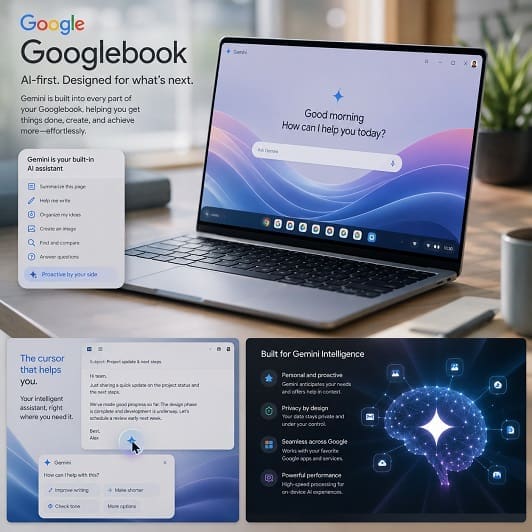
Google has unveiled a radical new laptop strategy that replaces the Chromebook concept with AI-first “Googlebooks”, devices where Gemini AI is embedded directly into the operating system and even the cursor itself becomes an intelligent assistant.
AI As The Core Layer
The move represents one of the clearest signs yet that major technology companies no longer see AI as simply another app or feature, but increasingly as the core layer through which users interact with computers altogether.
A Big Change For Google’s Laptop Strategy
For more than 15 years, Google’s Chromebook strategy focused on lightweight, low-cost laptops built around the Chrome browser and cloud services.
Now Google says the industry is moving “from an operating system to an intelligence system”, and believes laptops need to be redesigned around AI itself.
The result is Googlebook, a new category of premium laptops built on Android rather than ChromeOS, with Gemini deeply integrated into the entire experience.
According to Google, the devices are “the first laptops designed from the ground up for Gemini Intelligence, to deliver personal and proactive help when and where you need it.”
That wording matters because Google is no longer positioning AI as a separate assistant sitting beside applications. Instead, AI is becoming the interface itself.
The Cursor Becomes The AI
Perhaps the most striking feature is something called “Magic Pointer”, developed with Google DeepMind.
Google says the feature “brings Gemini’s helpfulness right to your fingertips” by turning the cursor into a context-aware AI agent capable of understanding what is on screen and proactively suggesting actions.
For example, hovering over a date inside an email could trigger an option to create a meeting automatically. Pointing at two images could allow Gemini to combine them instantly, and highlighting text could trigger summarisation, rewriting, or translation suggestions.
Importantly, the system is designed to work proactively rather than waiting for typed prompts.
Google says users can “wiggle your cursor and watch it come alive with Gemini, offering quick, contextual suggestions every time you point at something on your screen.”
That may sound like a relatively small interface change, but strategically it is extremely significant.
For decades, the cursor has simply been a pointing mechanism, but now it seems Google is effectively turning it into an AI interaction layer that constantly interprets context and anticipates actions.
Strategically Different To Competitors
This also represents a noticeably different strategy from rivals like Microsoft and Apple. For example, Microsoft largely places Copilot alongside applications, while Apple has focused heavily on embedding intelligence into individual apps and workflows. Google, by contrast, appears to be positioning Gemini as the layer sitting between the user and the entire operating system.
Unifying Android And AI
The launch also attempts to solve a long-running Google problem. Traditional Chromebooks could run Android apps, but often through compatibility layers and container systems that created limitations around multitasking, file access, and desktop integration.
Googlebook removes that separation entirely because the laptops themselves now run Android-based software natively.
Google says this allows users to move more seamlessly between phones and laptops while sharing apps, files, AI services, and workflows across devices.
Features such as “Quick Access” will reportedly allow users to browse and use phone files directly from their laptop without transfers, while “Cast my Apps” will let Android phone apps appear directly on the laptop screen.
Google describes the overall goal as “keeping you in the flow”, especially as people increasingly move between multiple connected devices throughout the day.
The company is also introducing “Create your Widget”, where users describe a dashboard or widget in natural language and Gemini builds it automatically using information pulled from services like Gmail, Calendar, and web search.
In practical terms, users are increasingly being asked not to choose software from menus, but instead describe what they want AI to create for them dynamically.
A Premium AI Device
One of the most surprising aspects of the announcement is Google’s decision to move away from the Chromebook market’s traditional low-cost positioning.
Googlebook devices are being described as premium products with “premium craftsmanship and materials”, launching through partners including Acer, ASUS, Dell, HP, and Lenovo. This could create important questions for education markets where Chromebooks became dominant largely because they were cheap, simple, and easy to manage.
Chromebooks currently hold a huge share of the global education laptop market, particularly in the US, and Google says existing devices will continue receiving support for now.
However, the long-term direction does seem to be becoming clearer, with Google now appearing to see Gemini itself as the core product, with the laptop becoming just the delivery mechanism for AI-powered experiences across Google’s wider ecosystem.
What Does This Mean For Your Business?
For businesses, Googlebook is another strong signal that the next phase of computing may revolve less around applications and more around AI-mediated workflows and interfaces.
The bigger story here is not simply a new laptop category. It is that major technology firms are redesigning operating systems, interfaces, and entire ecosystems around context-aware AI systems that attempt to anticipate user intent in real time.
That could eventually change how employees interact with software altogether, particularly in areas like administration, scheduling, document handling, collaboration, and workflow automation.
This also raises important questions around privacy, regulation, AI dependency, cloud processing costs, and how much contextual access businesses are comfortable giving AI systems embedded deeply inside everyday devices.
Google’s original Chromebook strategy argued that the browser was becoming the operating system. Googlebook now suggests the company believes AI itself may become the operating system instead.
