
Google Maps Introduces ‘Ask Maps’
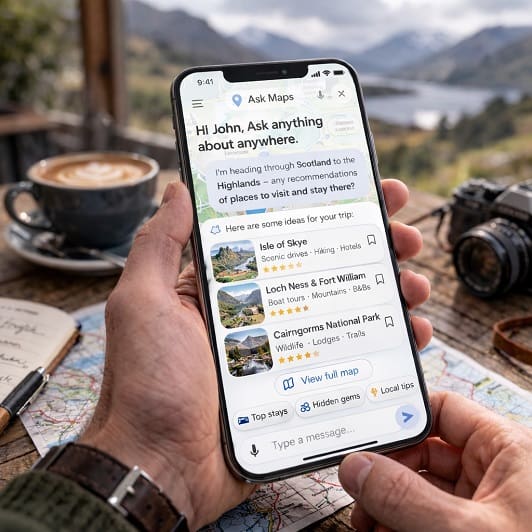
Google has launched a major update to Maps, introducing a new AI feature called Ask Maps alongside a redesigned 3D navigation experience powered by its Gemini models.
From Search To Conversation
For years, Google Maps has been built around search, users typed in a place or category and selected from a list of results. Ask Maps changes that model by allowing users to ask complex, real-world questions in natural language.
For example, instead of searching for a specific location, users can now ask contextual queries such as where to charge a phone without waiting, or where to find a suitable venue based on time, preferences, and availability. Google describes this as “a new conversational experience that answers complex, real-world questions a map could never answer before.”
This is part of a broader shift in how digital tools are evolving. Maps is no longer just a navigation platform, it is becoming a decision-making layer that interprets intent and delivers tailored outcomes.
How Ask Maps Works In Practice
The system combines Gemini’s AI capabilities with Google Maps’ extensive dataset, which includes information on hundreds of millions of locations and contributions from a global user community.
Ask Maps draws on this data to generate responses that are both relevant and personalised. According to Google, it is “uniquely helpful — tapping into Maps’ fresh information about the world to show you everything you need to know before you go.”
Personalisation plays a central role. The feature uses signals such as previous searches and saved places to refine results automatically. This means users may receive tailored recommendations without needing to specify preferences each time.
Once a decision is made, the system is designed to move seamlessly into action. Users can navigate, save locations, or share plans directly from the same interface, reducing the need to switch between apps or repeat searches.
Immersive Navigation Rebuilds The Driving Experience
Alongside Ask Maps, Google has introduced Immersive Navigation, a significant redesign of its core navigation experience. This replaces traditional flat maps with a dynamic 3D view that reflects real-world surroundings, including buildings, terrain, and road features.
The update also changes how directions are delivered. Instead of relying primarily on distances, Maps now uses more natural, landmark-based guidance. As Google explains, the goal is to make driving feel more intuitive, with directions that resemble how a person would guide someone in real life.
The company describes this as “our biggest transformation of the navigation experience in over a decade.” The system is supported by real-time data processing, drawing on imagery and live updates to reflect current road conditions and provide more accurate guidance.
Why Now?
This update arrives at a time of increasing competition in both mapping and AI-driven search. Apple has been expanding its own Maps capabilities, while AI-native platforms are beginning to integrate location-aware responses into their services.
For Google, Maps is not just a utility, it is a key part of its broader search and advertising ecosystem. Many local business discoveries begin within Maps, making it a critical interface for capturing user intent.
By integrating Gemini directly into Maps, Google is positioning the platform as a central point for real-world queries, rather than allowing that interaction to shift towards standalone AI tools.
At the same time, this reflects a wider trend whereby AI is increasingly being embedded into everyday products, transforming them from passive tools into active assistants that anticipate needs and guide decisions.
The Open Question Around User Behaviour
While the technology is significant, adoption is less certain. Google has introduced conversational features in other products before, and user behaviour has not always changed as quickly as expected.
There is still a question around whether people will naturally begin asking their maps complex questions, or whether they will continue to rely on familiar search habits.
However, the infrastructure is now in place. If users do adopt this behaviour, it could fundamentally change how people interact with location-based services.
What Does This Mean For Your Business?
This update signals a meaningful change in how customers may discover and choose businesses. Instead of appearing in a list of search results, businesses may increasingly be selected by AI systems interpreting user intent and context.
That has implications for visibility. Traditional local SEO, which focuses on keywords, categories, and rankings, may become less influential as AI-driven systems prioritise relevance, reputation, and contextual fit. Factors such as reviews, completeness of business profiles, and alignment with user preferences are likely to carry more weight.
There is also a change in how decisions are made. Ask Maps is designed to reduce friction by moving users from question to action in a single flow. This means fewer steps between discovery and conversion, which could benefit businesses that are well positioned within the ecosystem, but reduce opportunities for others to compete once a recommendation is made.
For organisations, this highlights the importance of maintaining accurate, detailed, and up-to-date information across platforms like Google Maps. It also reinforces the value of customer feedback and engagement, as these signals increasingly influence how AI systems rank and recommend options.
More broadly, this development reflects the growing role of AI as an intermediary between businesses and customers. Companies that understand how these systems interpret data, and adapt their digital presence accordingly, are likely to be better positioned as this model evolves.
Google Maps is no longer just helping people get from one place to another. It is beginning to shape how decisions are made along the way, and that has clear implications for how businesses are discovered, compared, and chosen.
Sponsored
Ready to find out more?
Drop us a line today for a free quote!
