
Google Is Turning AI Into A Digital Workforce
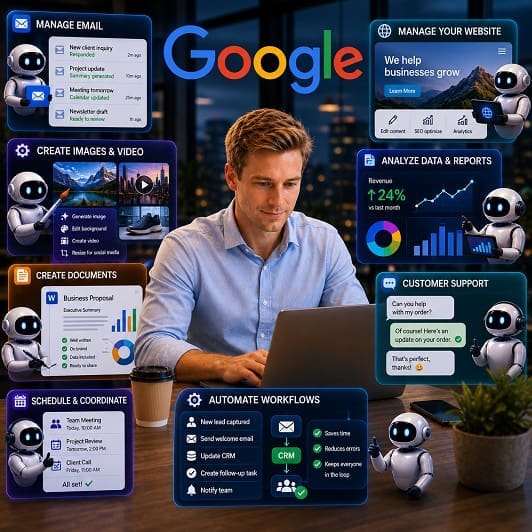
Google’s latest wave of AI announcements reveals a company that is moving beyond chatbots and search results, towards a future where AI agents actively perform tasks, manage information and work alongside users throughout the day.
Why Google’s Latest AI Updates Matter
At first glance, Google’s latest announcements appear to be a collection of unrelated AI features. For example, there is:
– Gmail Live, which allows users to search their inbox using natural conversation.
– Google Pics, an AI-powered image generation and editing tool.
– Gemini Omni, a new multimodal model capable of generating and editing video.
There are updates to AI Inbox, along with a new AI agent called Gemini Spark. However, when viewed together, a much clearer picture emerges.
Google is increasingly focused on moving AI beyond answering questions and towards taking action on behalf of users. In other words, the company is attempting to transform AI from a tool that provides information into a digital workforce that helps people get things done.
The Rise Of The AI Agent
Perhaps the clearest example of this strategy is Gemini Spark. Google describes Spark as a “24/7 personal AI agent” that can help users manage their digital lives, take action on their behalf and integrate with Workspace applications such as Gmail and Docs. The system runs on dedicated cloud infrastructure, meaning it can continue working even when a user’s laptop or phone is switched off.
According to Google’s announcement, Spark “helps you navigate your digital life, takes action on your behalf and is under your direction.”
This is significant because it moves beyond the traditional chatbot model. Instead of waiting for a user to ask a question, Spark is designed to complete longer-running tasks and manage activities across multiple applications.
The launch also places Google directly into competition with similar agentic AI offerings from OpenAI and Anthropic, both of which are pursuing the same vision of autonomous digital assistants.
Search Is Becoming Something New
The wider shift towards AI agents is also reshaping Google’s core business. For more than two decades, Google Search has largely revolved around helping users find information through lists of links. Increasingly, that model is changing.
Google’s AI Overviews and AI Mode already provide direct answers to many queries, while upcoming features will introduce information-gathering agents capable of monitoring topics, tracking changes and presenting synthesised updates automatically.
This represents a major change in how information is discovered online. Instead of manually searching for information, users may increasingly rely on AI systems to find, monitor and summarise it for them.
For businesses that depend on website traffic, search visibility or content marketing, this trend is likely to become increasingly important.
Gmail Is Becoming An AI Knowledge Assistant
Another notable development is Gmail Live, which allows users to ask questions about their email using natural language.
Rather than searching for keywords, users can ask questions about flight details, appointment times or information contained within previous conversations. Gmail Live then searches the inbox and presents an answer conversationally.
Google says these new voice capabilities are designed to help users “brainstorm, organise your thoughts and get things done”.
Although this may appear to be a relatively small feature, it reflects a broader shift in how software is being designed. Instead of users learning how applications work, AI increasingly learns how users work.
Google Wants AI To Create As Well As Assist
It seems the company’s ambitions also extend beyond productivity and information management.
For example, Google Pics introduces AI-powered image generation and editing directly into Workspace, allowing users to modify individual objects, translate text within images and collaborate on visual projects without leaving Google’s ecosystem.
Google says the goal is to make image creation feel like “creative direction, not a roll of the dice”.
Alongside this, Gemini Omni expands Google’s generative capabilities into video. The model can combine images, video, audio and text as inputs while allowing users to edit videos through natural conversation. Google describes Omni as a system “where Gemini’s ability to reason meets the ability to create”.
Taken together, all these developments suggest Google increasingly views content creation as a conversational process rather than a collection of separate software tools.
What Does This Mean For Your Business?
The most important takeaway here is that Google’s announcements are not really about email, images or video. Instead, they reveal a company that is systematically embedding AI into every stage of digital work. Search is becoming more agentic, email is becoming more conversational, content creation is becoming more automated, and AI assistants are becoming more capable of taking action independently.
For businesses, this could create significant productivity opportunities. For example, it may mean employees spend less time searching for information, organising documents, drafting communications and creating content. At the same time, organisations that rely heavily on search traffic may need to prepare for a future where AI increasingly intermediates the relationship between users and websites.
Whether Google’s vision ultimately succeeds remains to be seen. What is already clear, however, is that the company believes the next phase of AI will involve systems that do far more than answer questions. Increasingly, they will be expected to carry out work on behalf of the people using them.
