
Tim Cook Replaced As Apple CEO
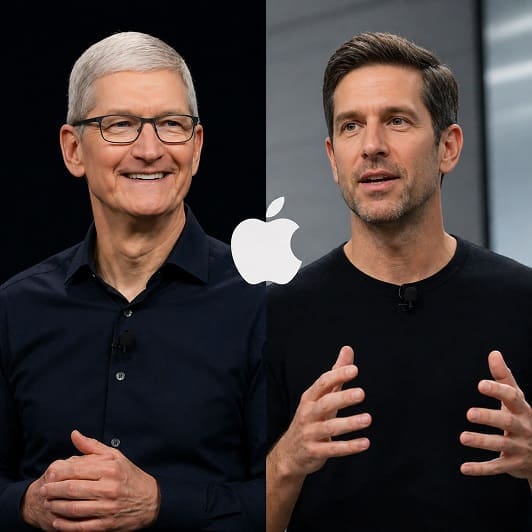
Apple has confirmed that Tim Cook will step down as CEO in September 2026, handing leadership to long-time hardware chief John Ternus in a planned transition that marks a major shift for one of the world’s most valuable companies.
A Planned Transition
Apple has been keen to highlight that this is not an abrupt departure but the result of long-term succession planning. The company said the move was approved unanimously by its board and follows a “thoughtful, long-term succession planning process.”
Cook will remain closely involved as executive chairman, a role that will see him continue working on key strategic areas such as global policy and relationships. He is expected to work alongside Ternus over the summer to ensure a smooth handover before the change takes effect on 1 September.
In a statement, Cook described his time in the role as deeply personal, saying, “It has been the greatest privilege of my life to be the CEO of Apple.” He added that he remains confident in the company’s direction and leadership, stating that Ternus is “without question the right person to lead Apple into the future.”
This framing matters because Apple is signalling continuity, stability, and control at a moment when leadership changes at major technology firms often trigger uncertainty.
What Tim Cook Leaves Behind
Cook’s tenure as CEO, which began in 2011 following Steve Jobs’ death, has been one of the most commercially successful in corporate history.
When he took over, Apple was already a major player, but its long-term trajectory was far from certain. Under Cook, the company’s market capitalisation grew from around $350 billion to approximately $4 trillion, while annual revenue increased from $108 billion to more than $416 billion.
Apple itself credits Cook with reshaping the business in several key ways. The company said he “introduced groundbreaking products and services time and again” and expanded Apple’s reach to more than 200 countries and territories.
One of his most significant contributions has been the growth of Apple’s services division, which now generates more than $100 billion annually. The company also highlights his role in creating entirely new categories, including wearables such as Apple Watch and AirPods.
Cook’s leadership has also been defined by operational discipline and strategic consistency rather than product showmanship. He strengthened Apple’s supply chain, expanded its global footprint, and positioned privacy and sustainability as central pillars of the business.
Apple has noted that under his leadership, the company reduced its carbon footprint by more than 60 percent while continuing to grow revenue, and reinforced its stance that privacy is a “fundamental human right.”
Why Tim Cook Is Stepping Aside Now
Cook has made it clear that the timing is deliberate, indicating internally that leadership transitions should happen when the business is strong, the product pipeline is stable, and a successor is ready, all of which appear to be in place given that Apple remains highly profitable, its product ecosystem continues to dominate consumer markets, and Ternus has spent more than two decades inside the company preparing for this role.
Cook’s move to executive chairman also allows him to focus on areas where his experience remains particularly valuable, especially global political relationships that have become increasingly important for a company operating at Apple’s scale. This is less a step back and more a change in focus.
Who Is John Ternus?
John Ternus, 51, has spent almost his entire career at Apple and is widely seen as a steady, internally trusted leader.
He joined the company’s product design team in 2001 and rose through the ranks to become senior vice president of Hardware Engineering in 2021. Over that time, he has played a key role in developing many of Apple’s core products, including iPad, AirPods, iPhone, Mac, and Apple Watch.
Apple credits him with overseeing major advances in hardware performance, durability, and sustainability. This includes the introduction of Apple-designed silicon, new materials such as recycled aluminium compounds, and improvements in repairability that extend product lifespans.
In his own statement, Ternus emphasised continuity, saying he was “humbled to step into this role” and would “lead with the values and vision that have come to define this special place for half a century.”
Cook reinforced that message, describing him as having “the mind of an engineer, the soul of an innovator, and the heart to lead with integrity and with honour.”
What This Could Mean For Apple’s Direction
The choice of Ternus signals a clear strategic direction, with Apple doubling down on its strengths in hardware, product integration, and long-term engineering discipline.
This comes at a time when the company faces growing pressure in AI, where rivals such as Google, Microsoft, and OpenAI have moved faster in delivering advanced consumer-facing AI tools. Apple’s approach has been more cautious, often integrating third-party capabilities rather than leading with its own models.
Ternus’s background suggests Apple may prioritise embedding AI more deeply into its existing devices rather than competing directly on standalone AI platforms. This aligns with the company’s long-standing strategy of controlling both hardware and software to deliver tightly integrated user experiences.
At the same time, Apple must address questions about its next major growth category. Products such as Vision Pro have yet to achieve widespread adoption, and the company faces ongoing scrutiny over whether it can deliver another breakthrough device on the scale of the iPhone.
What Does This Mean For Your Business?
This leadership change is less about disruption and more about understanding where one of the world’s most influential technology companies is heading next.
Apple’s decision to promote from within and maintain continuity at the top suggests that its core strategy is not changing dramatically. Its focus on integrated hardware, services, and ecosystem control will remain central.
However, the shift also highlights where attention is likely to move, with AI integration, device capability, and long-term product evolution becoming more important than headline-grabbing launches or entirely new platforms.
For organisations that rely on Apple devices, services, or app ecosystems, this points to steady progression rather than sudden change. New capabilities are likely to arrive incrementally, built into familiar products rather than introduced as standalone systems.
More broadly, the transition reinforces a wider trend across the technology industry. Leadership is increasingly moving towards operators and engineers who can scale complex systems sustainably, rather than visionary founders alone.
Cook’s move to executive chairman ensures continuity at a strategic level, while Ternus’s appointment signals a focus on execution, engineering, and product delivery.
For businesses, the message is that stability at Apple does not mean stagnation, but it does mean that change will be controlled, deliberate, and closely aligned with the company’s existing strengths.
