
Amazon Launches UK Drone Deliveries
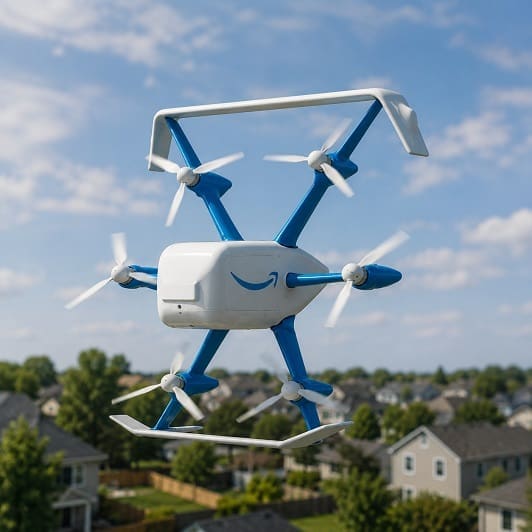
Amazon has begun making drone deliveries in the UK for the first time, marking a major step towards autonomous AI-driven logistics becoming part of normal daily commerce.
Why Amazon Has Started UK Drone Deliveries Now
Amazon Prime Air has officially launched limited drone deliveries in Darlington, County Durham, making the UK the first country outside the United States where the company has rolled out the service commercially.
The launch follows years of testing, regulatory delays, safety reviews, and technical development. Amazon first trialled drone deliveries near Cambridge back in 2016, when one early test delivery reportedly took just 13 minutes.
The company is now using its newer MK30 drone platform, which has been designed to operate more quietly, fly further, and cope with a wider range of weather conditions than previous models.
For now, deliveries are restricted to a 7.5-mile radius around Amazon’s Darlington fulfilment centre. Packages must weigh less than 2.2kg and fit inside a relatively small parcel size.
Eligible customers can receive items such as batteries, cables, office supplies, beauty products and household essentials in under two hours.
Amazon says the long-term goal is to make deliveries significantly faster. In some parts of the US, where the system is already operational in five states, the average delivery time is reportedly around 36 minutes.
How The Drone System Actually Works
The MK30 drones operate largely autonomously using onboard cameras, sensors, GPS, and machine learning systems designed to identify obstacles and avoid collisions.
Amazon says the drones can detect objects including washing lines, trampolines, trees, animals, people and other aircraft while descending for deliveries.
Packages are lowered into a customer’s garden or driveway from a height of around 10 to 12 feet, rather than requiring the drone to land fully.
The flights are taking place under Beyond Visual Line of Sight, or BVLOS, rules approved by the UK Civil Aviation Authority. That matters because it allows drones to operate autonomously beyond what a human pilot can physically see.
Even so, the drones are still monitored remotely from a control centre, with operators able to coordinate with air traffic control if needed.
Amazon has also secured temporary protected airspace around the Darlington test area while the trial continues.
Why Darlington Was Chosen
Darlington was selected partly because it is believed to offer a useful mix of residential areas, rural land, roads and nearby airspace within a relatively compact area.
That allows Amazon to test how the drones cope with real-world conditions without immediately dealing with the extreme complexity of major cities.
This is important because dense urban environments remain one of the biggest technical challenges for drone delivery systems.
Practical Limitations
It should be noted here that drone deliveries also face practical limitations in dense urban environments, where high-rise buildings, congested airspace, and limited landing areas make autonomous delivery far more difficult than in lower-density suburban or rural locations.
Issues such as access to flats and apartments, rooftop delivery infrastructure, airspace congestion, safety management and public acceptance remain unresolved in many city environments.
The current Darlington operation is also still relatively small in scale, with Amazon carrying out only a maximum of around 10 flights per hour.
Still Safety Questions Around Drone Parcel Deliveries
Despite Amazon’s confidence in the technology, safety concerns remain one of the biggest barriers to wider public acceptance and regulatory expansion.
Amazon’s rollout comes after several incidents involving its MK30 drones in the United States.
One drone reportedly clipped a building in Texas earlier this year after temporarily losing GPS positioning. Other incidents involving collisions during testing in Arizona and Oregon also triggered investigations and delays.
Amazon says no injuries occurred and describes the incidents as part of the normal process of refining a new aviation system.
The company also argues that the drones operate to aerospace-level safety standards and include multiple backup systems.
Public Reaction
Public reaction in Darlington seems to have been mixed. Some residents have reportedly embraced the convenience and novelty of near-instant deliveries, while others have raised concerns around noise, safety and whether drones are really necessary for ordinary household deliveries.
Many AI-powered autonomous systems still face a basic problem, namely that people do not automatically trust them simply because the technology works.
A similar challenge is now emerging elsewhere in the tech industry. Meta, for example, is increasingly using AI systems to estimate users’ ages and help enforce safety rules on platforms like Instagram. In both cases, companies are asking the public to trust autonomous systems to make decisions that were previously handled directly by humans.
Why This Matters Beyond Parcel Deliveries
The full significance of Amazon’s rollout is not really about faster deliveries of batteries or office supplies.
The bigger story is really that autonomous AI systems are steadily moving out of controlled test environments and into ordinary public infrastructure.
Drone delivery combines several technologies that businesses are likely to encounter more frequently over the next decade, including machine learning, autonomous navigation, remote monitoring, automated compliance systems and AI-assisted decision-making.
The UK is already experimenting with similar technology elsewhere. For example, the NHS has been trialling drones for transporting blood supplies in London, while Royal Mail has used drones to deliver parcels to remote communities in Orkney. Many of these early deployments focus on environments where conventional transport is slow, expensive or difficult.
The commercial logic for drone parcel deliveries is also now becoming a bit clearer. For example, labour shortages, rising delivery costs, pressure for faster fulfilment and growing demand for same-day delivery are all pushing logistics companies towards greater automation.
What Does This Mean For Your Business?
For most UK businesses, drone deliveries are unlikely to become an immediate operational reality. The technology still faces significant regulatory, technical, and public acceptance barriers, especially in towns and cities.
However, AI-driven autonomous systems are increasingly becoming part of everyday business operations, with AI now making more decisions in areas such as logistics, security, customer verification, fraud detection and operational management.
That creates opportunities for faster services and lower operating costs, but it also increases the importance of governance, oversight, cybersecurity and trust.
Amazon’s drone rollout is, therefore, less about flying parcels and more about what happens when AI systems begin interacting directly with the physical world at scale.
For UK businesses, the key lesson here may simply be that autonomous systems are no longer experimental concepts sitting in research labs. They are beginning to appear in everyday operations, regulation, infrastructure and customer services, often much sooner than many organisations expected.
